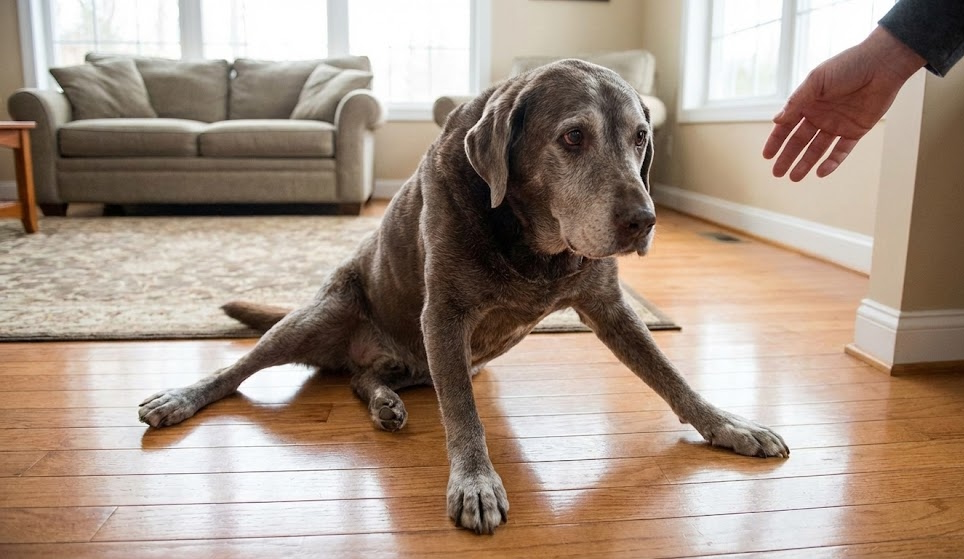
It’s usually late when you notice it. The house is quiet. Your dog gets up to follow you into the kitchen and—just for a second—his back feet skitter on the hardwood.
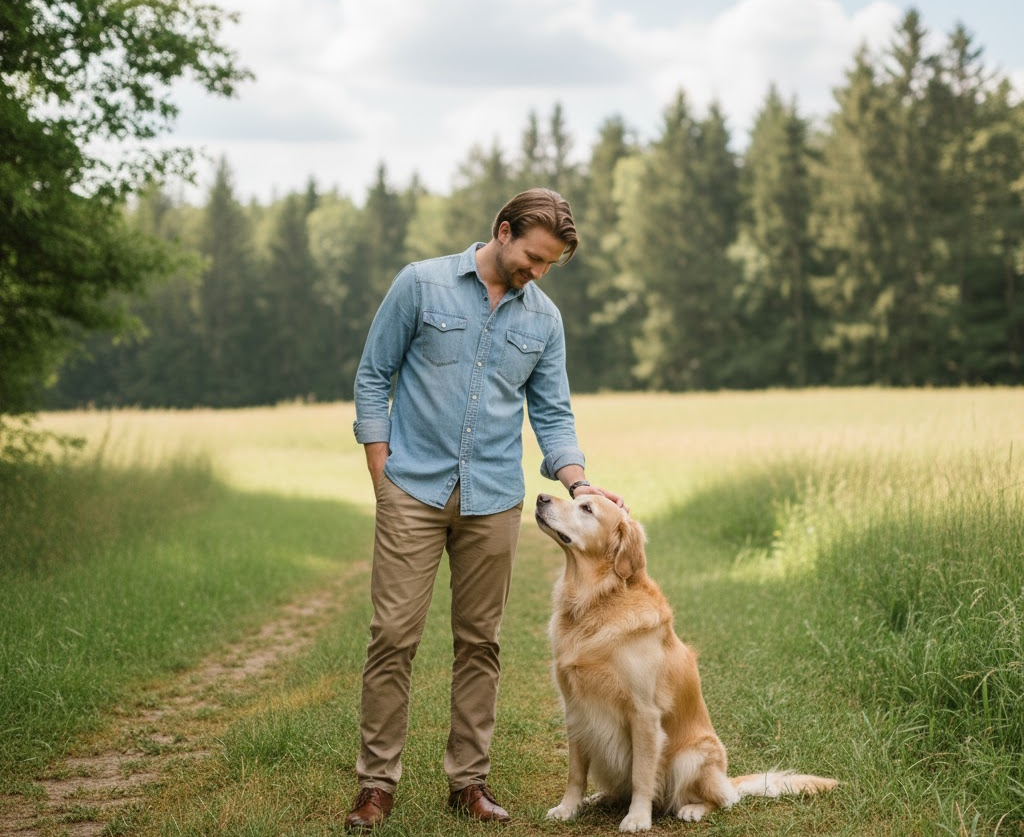
Outside earlier, he walked the block like he always does. No limping. No drama. But inside, on that smooth floor, something looked off.
If your dog walks fine outside but slips indoors, what does that usually mean?
Most of the time, it means the floor is no longer forgiving tiny changes in footing. Outdoors provides texture and straight-line momentum. Indoors asks for tight turns, sudden stops, and standing up on low-grip surfaces.
If your dog walks fine outside but slips indoors, you’re not looking for a label. You’re trying to understand a contradiction you can see with your own eyes—especially when it happens at night, when everything feels louder.
Here’s the plain version: this pattern usually has more to do with traction and stability on smooth surfaces than sudden decline. Not always. But usually.
This article exists for that moment—so the behavior makes sense in real-home terms, without turning your dog into a diagnosis.
If Your Dog Slips Indoors, Start Here
Before blaming the floor, check your dog’s paws
In many senior dogs, indoor slipping isn’t just about the surface—it’s about how the paws meet it. A few common, fixable changes quietly reduce grip over time.
- Dry or calloused pads
As dogs age, pads often become harder and smoother. That reduces friction, especially on polished floors. - Fur covering the pads
Even dogs that never had slipping issues before can lose traction when toe fur grows long enough to sit between the pad and the floor. - Nails that are just a bit too long
When nails make first contact, the pad lifts slightly—like wearing shoes a half-size too big. Indoors, that small lift matters.
These changes don’t mean something is “wrong.” They mean the paws need a little more help doing what they used to do automatically.
Why dogs slip indoors — and what usually helps
Match what you’re seeing to the most common “why,” then start with the simplest fix first. This is built for real homes (hardwood, tile, laminate).
Back feet slide on hardwood or tile
Often shows up when starting from rest or crossing a smooth hallway.
Pads can become drier or smoother with age, reducing friction on glossy floors.
Smooth surfaces don’t give the paw texture to “bite,” so small grip changes show up fast.
Slipping mostly when turning or stopping
The “wipeout” happens during pivots, not straight walking.
Weight shifts demand balance; low-grip flooring removes the margin for error.
Indoors has tight turns and sudden stops; outside is mostly straight-line momentum.
Feet slide even though legs look strong
Strength can be fine while grip and contact are the issue.
Long nails or toe fur can prevent the pads from fully touching the floor.
Nails/fur act like tiny spacers on slick surfaces, lifting the pad slightly.
Hesitation before entering slick rooms
Your dog slows down before the hallway, kitchen, or doorway threshold.
Dogs remember where slipping happened and start moving cautiously in those zones.
Same spots, same surfaces, same outcome—so the behavior becomes predictable.
Walks fine outside but slips only inside
The contradiction that sends most people searching at night.
The house has less traction margin than outdoor ground, so small changes show up indoors first.
Outdoors provides texture and forward motion; indoors requires starts/stops/turns on smooth flooring.
Caregiver note: If the slipping is predictable (same spot + same movement), it’s usually fixable with small changes—starting with paw contact and a few traction “bridges” in the problem zones.
Why indoor slipping shows up at home first
Professionals see dogs on short walks, exam tables, and rubberized floors. Owners see dogs crossing thresholds at midnight.
Indoor slipping shows up first because home flooring removes the margin for error. Smooth surfaces don’t forgive small changes in balance, grip, or confidence. Outside, texture does the work for them. Inside, your dog has to do it alone.
This is why the pattern looks so confusing:
- The dog still walks fine outside
- The dog still moves normally most of the time
- The slipping is brief, inconsistent, and location-specific
That combination doesn’t point to collapse or injury. It points to a loss of traction tolerance—the moment when tiny adjustments your dog used to make without thinking start to matter.
Owners catch this because it happens:
- At night
- In familiar rooms
- During routine movements (turning, stopping, standing up)
Those moments never show up in a clinic.
What matters more than a single slip
Same spot in the house • Mostly during turns • After naps • On smooth floors only • Increasing frequency over weeks
Excitement skids • Wet paw moments • Fast chasing indoors • A single slip with no repeat pattern
Quietly useful note: predictable slipping is often a surface-and-movement combo. When you can describe the “where + when,” you’re no longer guessing—you’re observing.
If your dog walks fine outside but slips indoors, what does that usually point to?
In most homes, this pattern means the environment is now harder than the dog, not that the dog suddenly became incapable.
Three things tend to happen at once:
1. Smooth floors remove feedback
Hardwood, tile, laminate, and polished concrete don’t “talk back” to paws. There’s no bite, no give. Dogs rely on that feedback more than we realize. When it fades, they hesitate or slide.
2. Micro-instability shows up during transitions
The slipping often shows up in the in-between moments: turning in place, stopping short, stepping off a rug, or standing up after rest. That’s not random. Those moments demand balance and foot placement more than forward walking does. Outside, your dog gets to move in a straight line on textured ground. Inside, the floor demands precision—especially when the body is shifting its weight.
That’s because transitions demand balance, not strength. Outside walking is linear. Inside movement is full of starts, stops, and pivots.
3. Your dog is compensating successfully—until the floor asks too much
Your dog may already be distributing weight differently, shortening steps slightly, or bracing more carefully. On grass or pavement, that works. On slick flooring, it doesn’t.
That’s why you see slipping without limping.
What indoor slipping does not automatically mean
This pattern is easy to misread, especially late at night when worry fills the gaps.
It does not automatically mean:
- Your dog is in sudden pain
- Your dog has lost mobility
- Your dog is unsafe to walk
- Your dog needs medication
- Your dog is “going downhill fast”
Indoor slipping alone is not a crisis signal. It’s a context signal.
It’s the dog saying, “This surface doesn’t give me enough margin anymore.”
That’s very different from saying, “I can’t move.”
Why timing and repetition matter more than a single slip
A single slip is information. Repetition is a pattern.
Owners who get the clearest picture pay attention to where and when, not how dramatic the slip looked.
The “when” matters as much as the “where.” Many owners notice slips late at night because fatigue makes fine balance harder. Others notice it first thing in the morning or right after a long nap, when the body needs a moment to feel steady again.
The location pattern is usually even clearer. Some dogs slip only in one hallway, only near the food bowl, where they pivot fast, or right at a doorway threshold where the surface changes. When the same spots keep showing up, it’s rarely a mystery problem—it’s a predictable surface-and-movement combo that’s finally exceeding your dog’s traction margin.
These patterns matter because they tell you the issue is predictable, not random.
Predictable problems are manageable ones.
Why your dog looks normal outside but slips inside
Outside walking gives dogs:
- Texture
- Forward momentum
- Visual focus
- Purpose
Inside, they’re:
- Turning frequently
- Starting and stopping
- Navigating tight spaces
- Relaxed enough to expose weakness
This is why owners often say, “He looks great on walks, but…”
That “but” is where the truth lives.
Common owner misinterpretations that cause unnecessary stress
“He slipped, so he must be in pain.”
Slipping reflects traction mismatch, not pain levels. Pain shows up as avoidance, guarding, or altered behavior—not momentary loss of grip.
“If I ignore this, something bad will happen suddenly.”
This pattern tends to progress gradually. Noticing early gives you time, not urgency.
“I should wait until he limps.”
Limping is a late signal. Indoor slipping is an early one. Waiting for worse signs doesn’t add clarity.
What often changes next if nothing is adjusted
When floors stay the same, and nothing else changes, owners often notice:
- Hesitation before entering slick rooms
- Shorter strides indoors
- Choosing carpeted routes
- Pausing before standing
- Occasional “splay” of back feet
None of this means failure. It means your dog is self-modifying to stay upright.
That’s competence, not decline.
What to quietly monitor (without hovering)
You don’t need to watch every step. You’re looking for patterns, not perfection.
Pay attention to:
- Whether slips are increasing in frequency
- Whether they involve the same feet
- Whether your dog starts avoiding certain areas
- Whether confidence changes before movement (hesitation)
Ignore:
- One-off slips
- Playful skids
- Excitement-related scrambling
Dogs slip sometimes. You’re tracking change, not accidents.
Which patterns matter more than one-off events
More informative than a single slip:
- Slipping only indoors
- Slipping only on smooth floors
- Slipping during turns
- Slipping after resting
Less informative:
- Slipping while running
- Slipping while excited
- Slipping on wet surfaces
Context turns observation into understanding.
Indoor slipping is usually a traction-margin issue: the floor is asking more of your dog than it used to, and your dog is adapting.
When it’s reasonable to bring observations to a vet (without urgency)
Not because something is “wrong,” but because you have useful information.
It’s reasonable to mention this pattern if:
- Slipping increases over weeks
- Confidence indoors decreases
- Your dog avoids standing on smooth floors
- You’re already there for another reason
What helps most is describing the environment, not the behavior alone:
“He walks fine outside, but slips on hardwood when turning or standing up.”
That sentence carries more meaning than any label.
Frequently asked questions about dogs slipping indoors
Why does my dog slip indoors but walk normally outside?
Outdoors provides texture and forward momentum, which helps dogs stay stable without thinking about it. Indoors, smooth floors demand tight turns, sudden stops, and standing up on low-grip surfaces. When a dog’s traction margin shrinks, it usually shows up inside first.
Does slipping on hardwood floors mean my dog is in pain?
Not automatically. Slipping reflects a traction mismatch, not a pain level. Pain usually shows up as avoidance, guarding, or behavior changes. Indoor slipping alone is more often a surface issue than a signal that something suddenly hurts.
Is it normal for senior dogs to slip on tile or hardwood?
It’s common, especially as dogs age and smooth surfaces become less forgiving. Many dogs still have strength and mobility, but need more grip to move confidently indoors.
Why does my dog only slip when turning or standing up?
Those movements require balance and weight shifts rather than straight-line walking. Smooth floors offer little feedback during transitions, which is why slips often happen during turns, stops, or rising from rest.
Should I worry if my dog slips only occasionally?
One-off slips happen to most dogs. What matters more is repetition. Slipping in the same spots, during the same movements, or more often over time is more informative than a single incident.
When should I mention indoor slipping to my vet?
It’s reasonable to bring it up if the pattern increases, your dog avoids smooth floors, or confidence indoors decreases. Describing where and when the slipping happens is often more helpful than focusing on the slip itself.
Can indoor slipping get worse if nothing changes?
Often, dogs adjust by hesitating, shortening steps, or choosing carpeted routes. That’s adaptation, not failure. Noticing the pattern early gives you time to adjust the environment before confidence drops further.
Why noticing this early is responsible, not anxious
When a dog walks fine outside but slips indoors, it’s rarely a sudden problem. It’s usually a small loss of traction meeting a surface that no longer forgives it.
The important part isn’t spotting the slip—it’s noticing the pattern early, while your dog is still confident, mobile, and adapting well.
In most homes, a few quiet adjustments—starting with the paws, then the floor—restore stability long before slipping becomes fear or avoidance.
If you’re noticing this now, you’re not late.
You’re early enough to make it easier.