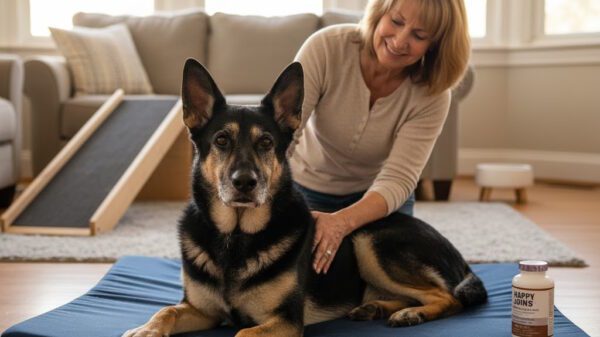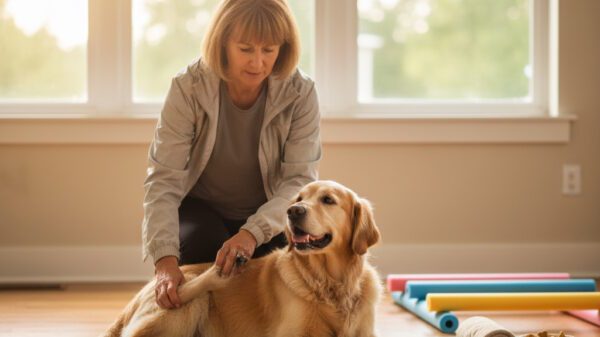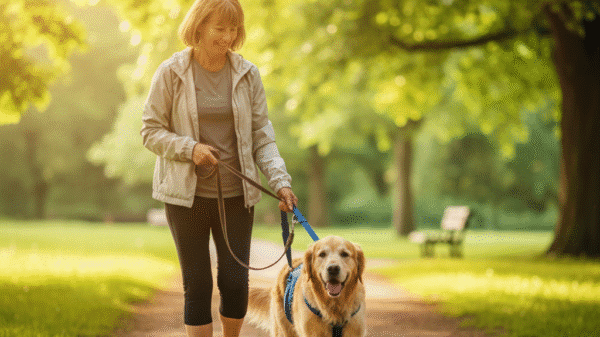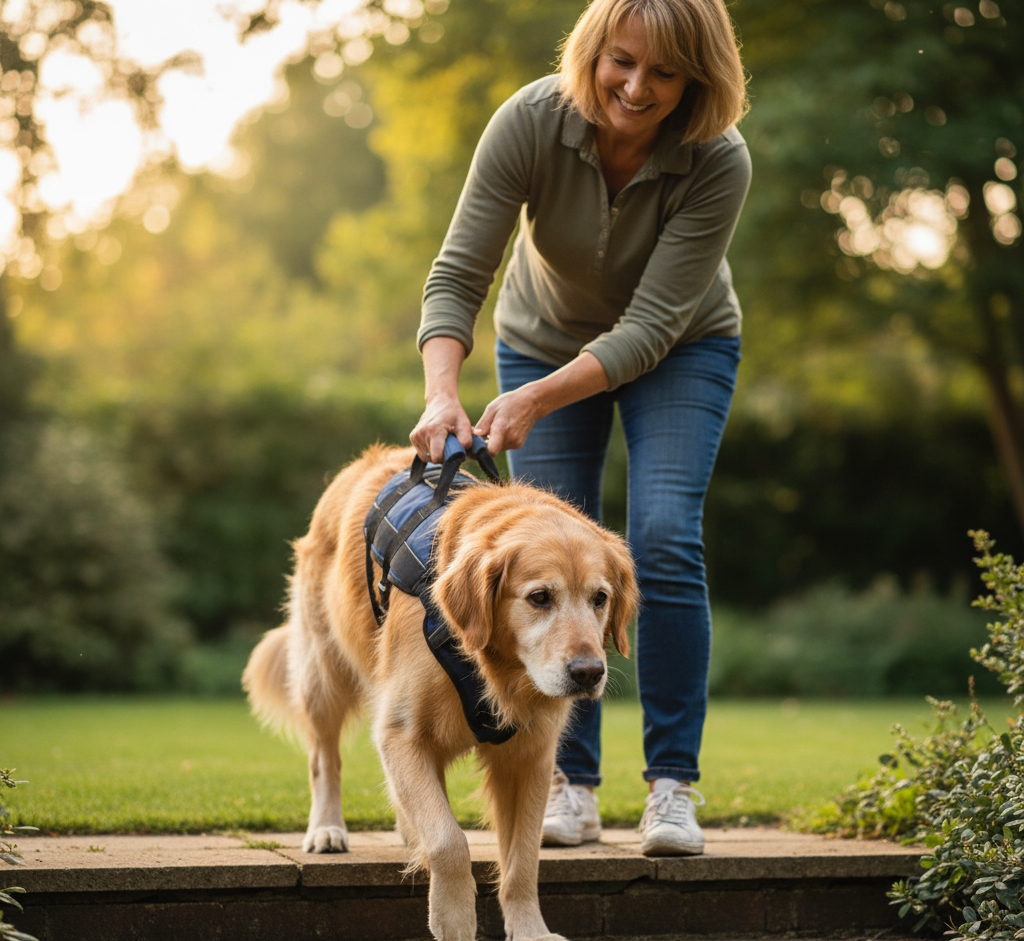
The sparkle in their eyes might be a little dimmer, their once-energetic wag a bit more gentle, and their steps perhaps a little less steady. As our beloved canine companions enter their golden years, the joy of a daily walk or even just moving around the house can become a challenge. The ground that once seemed boundless might now feel treacherous, and stairs, once conquered with gusto, become formidable mountains. This is where the profound difference of a well-chosen mobility harness or sling comes into play.
🐾 Why Older Dogs Need Mobility Support
As dogs age, muscle tone and joint cushioning gradually decline — especially in large or arthritic breeds. Simple tasks like climbing stairs, getting into a car, or standing up after sleep can become painful or even dangerous. A properly fitted lift harness or sling restores stability and confidence, allowing you to assist without adding pressure to the spine or hips.
Mobility aids aren’t just about movement — they’re about dignity, safety, and connection in a senior dog’s final years of active companionship.
Did You Know?
Studies show that over 40 % of dogs aged 9–13 experience some degree of mobility impairment,
and the risk nearly doubles in large-breed seniors (University of Georgia, Veterinary Aging Studies, 2021).
Early use of support harnesses can reduce secondary joint strain and prevent fall injuries.
It’s a heartbreaking sight to watch an older dog struggle – perhaps their back legs buckle, or they have difficulty standing after a nap. But this doesn’t mean their quality of life has to diminish, far from it. With the right support, we can offer them comfort, restore a measure of their independence, and help them remain active members of the family. This isn’t just about functionality; it’s about preserving dignity, extending precious moments, and reminding them that they are still loved, valued, and safe.
As someone who has navigated these waters with my own senior dogs, I can tell you that finding the right tool can feel overwhelming. There are so many options, and each dog’s needs are unique. That’s why I’ve put together this guide, combining practical experience with expert insight to help you choose from the best mobility harnesses and slings for older dogs.
In This Article
Understanding the Need: Why Mobility Aids Become Essential
Before diving into specific products, let’s understand why these aids become so crucial for our senior friends. The reasons often stem from age-related changes:
- Arthritis and Joint Pain: This is perhaps the most common culprit. Degenerative joint disease causes pain with every movement, leading to weakness and instability, particularly in the hips, knees, and spine.
- Muscle Atrophy: With reduced activity due to pain or neurological issues, muscles, particularly those in the hindquarters, can atrophy, further reducing strength and support.
- Neurological Conditions: Degenerative Myelopathy (DM), Wobbler Syndrome, or disc disease can impair nerve signals, leading to weakness, poor coordination, and dragging paws.
- Post-Surgical Recovery: After undergoing orthopedic surgery, a dog requires significant support during rehabilitation to prevent reinjury and aid in healing.
- General Weakness and Frailty: In simple terms, some older dogs experience a decline in their overall strength and balance, making them more prone to falls.
📚 Veterinary Insight: Assistive Devices for Arthritic Dogs
A review by the Canine Arthritis Management (CAM) initiative highlights that properly fitted harnesses, slings, and ramps can significantly reduce compensatory strain on weakened joints. They also note that using assistive devices helps dogs maintain confidence and independence while lowering fall risk on slick floors.
Source: CanineArthritis.org – “Assistive Devices for Dogs with Arthritis”
🩺 Veterinary Rehabilitation Perspective
According to Millis & Levine’s Canine Rehabilitation and Physical Therapy (Elsevier, 2nd ed., 2014), the use of lift harnesses during assisted walking improves proprioception and reduces muscular fatigue in geriatric dogs. They recommend lift aids as part of a long-term management plan for osteoarthritis and post-surgical recovery.
Source: Millis DL, Levine D. Canine Rehabilitation and Physical Therapy. Elsevier, 2014.
These conditions make everyday tasks, such as standing up, navigating stairs, getting into a car, or even going outside to use the restroom, incredibly difficult and sometimes dangerous. Mobility harnesses and slings offer the support needed to mitigate these challenges.
🦮 Recommended Support Harnesses & Slings for Senior Dogs
Gentle lift, better balance, fewer slips. Choose a style that matches your dog’s needs, then check size with our fit guide.
Rear Support (Hips/Back Legs)
Best for arthritis, hip dysplasia, post-surgery hind-end weakness.
🛒 GingerLead – Check PriceFull-Body Assist (Overall Support)
For daily help on stairs, ramps, and walks; distributes lift evenly.
🛒 Ruffwear Web Master – Check PriceBudget Sling (Everyday Lift)
Simple, padded belly support for short assists and potty breaks.
🛒 Labra Sling – Check PriceDisclosure: As an Amazon Associate, GoldenPawsCare may earn from qualifying purchases—at no extra cost to you.
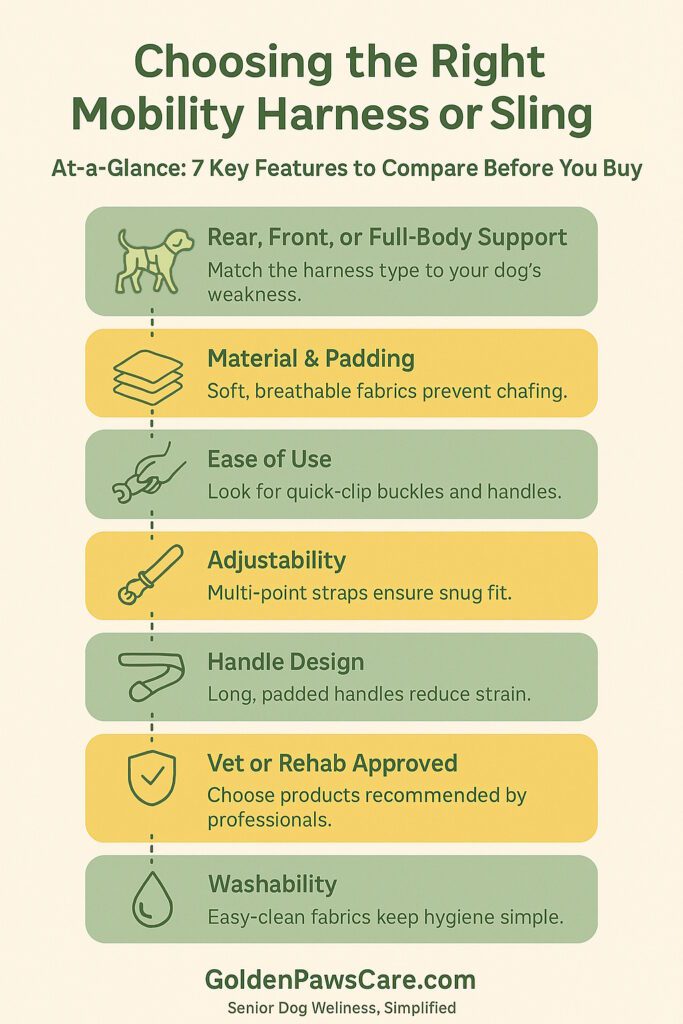
What to Look For: Key Features of a Great Mobility Aid
Choosing the right harness or sling isn’t a one-size-fits-all decision. Consider these critical factors:
- Support Location (Front, Rear, or Full Body):
- Rear-only Slings: Ideal for dogs with primarily hindquarter weakness (e.g., hip dysplasia, hind leg paralysis). They support the abdomen and pelvis.
- Front-only Harnesses: Less common as a standalone mobility aid, but useful for shoulder or front leg issues, or paired with a rear sling for full body support.
- Full-Body Harnesses: Ideal for dogs with generalized weakness, balance issues, or those requiring assistance with stairs and loading into vehicles. They distribute weight evenly.
- Material and Comfort:
- Soft, Breathable Fabrics: Look for materials like neoprene, fleece-lined, or mesh that won’t chafe or dig into sensitive skin. Seniors often have thinner skin.
- Padding: Crucial around pressure points, especially under the belly and around the legs, to prevent sores and discomfort during prolonged use.
- Adjustability:
- Straps and Buckles: Highly adjustable straps are essential for a snug, secure fit that doesn’t pinch or slip. Wide straps are generally more comfortable.
- Sizing: Always measure your dog carefully and follow the manufacturer’s guidelines. A poor fit can do more harm than good.
- Durability and Washability:
- Sturdy Construction: The aid must withstand your dog’s weight and movement over time.
- Machine Washable: Accidents happen. Easy cleaning is essential for maintaining hygiene.
- Handles and Ergonomics:
- Comfortable Handles: Padded handles are essential for your comfort, especially when lifting a heavy dog.
- Adjustable Handle Height: This feature allows you to maintain good posture and avoid back strain.
🦮 Recommended Mobility Harnesses for Senior Dogs
These vet-approved mobility harnesses balance comfort, control, and support for aging dogs. Each is tested for ergonomic fit, ease of lifting, and long-term durability.
| Harness | Support Type | Best For | |
|---|---|---|---|
| GingerLead Support Harness | Rear lift + leash integration | Post-surgery or hip support recovery | Check Price |
| Ruffwear Web Master Harness | Full-body lift & assist design | Everyday mobility for arthritis or ataxia | Check Price |
| Labra Canine Support Sling | Rear-only lift with padded belly support | Budget-friendly daily support | Check Price |
| Kurgo Up & About Lifter | Front + mid-body lift | Dogs with chest or shoulder weakness | Check Price |
| Walkabout Rear Harness | Heavy-duty neoprene rear sling | Large-breed dogs with chronic arthritis | Check Price |
Disclosure: Links above are affiliate-based and help support GoldenPawsCare’s senior-dog resources — at no additional cost to you.
Our Top 7 Mobility Harnesses and Slings for Older Dogs
Based on extensive research, veterinary recommendations, and countless owner reviews, these options stand out for their effectiveness, comfort, and user-friendliness.
1. The “Simple Lift” Rear Support Sling: Labra Dog Veterinarian Approved Plush Soft Canine Sling Lift with Adjustable Straps
- Why it’s a top choice: For dogs experiencing initial hind leg weakness or recovering from minor injury, a basic rear sling offers crucial support without a full harness. These slings are typically made from soft, durable fabric, often lined with fleece or neoprene, to prevent chafing under the belly. The design is straightforward: a wide band that scoops under the dog’s abdomen, usually with reinforced handles.
- Ideal for: Dogs with hip dysplasia, mild arthritis, or post-operative recovery where only rear support is needed. It’s excellent for short-term assistance for getting into cars, up a few steps, or quick bathroom breaks.
- Considerations: Not suitable for dogs needing front or full-body support, or for extended walks if significant instability is present.
2. The Full-Body “Vest-Style” Harness: Help ‘Em Up Harness
- Why it’s a top choice: This is often considered the gold standard for comprehensive mobility support. A full-body harness provides secure lifting points at both the front and rear, allowing for balanced assistance. They typically feature separate front and rear sections that connect over the back, ensuring even weight distribution and preventing pressure points. The materials are usually robust but padded, and the adjustability is often extensive.
- Ideal for Dogs with generalized weakness, severe arthritis in multiple joints, neurological conditions affecting all four limbs, or those requiring significant assistance with standing and walking. It’s particularly useful for lifting a large older dog as it allows two people to assist.
- Considerations: It can be more complex to put on initially due to multiple straps, but once fitted, it offers unparalleled support.
3. The Lightweight & Breathable Full-Body Harness: Ruffwear Web Master Harness
- Why it’s a top choice: While primarily a hiking harness, the Ruffwear Web Master’s secure, multi-point design and robust handle make it an excellent front-half mobility aid, especially when paired with a rear sling. Its padded chest and belly panel are very comfortable, and its lightweight, breathable construction is great for longer wear. The integrated padded handle on the back provides a solid grip point for added stability or light assistance.
- Ideal for: Dogs requiring front-end support or as part of a two-piece system for comprehensive body assistance. Suitable for dogs who are still fairly mobile but require a little assistance over obstacles or for added stability.
- Considerations: Not designed for full hindquarter lifting on its own; requires a separate rear sling for complete support.
4. The “Walkabout” Rear-End Support Harness: Walkabout Harness
- Why it’s a top choice: Specifically designed for dogs with hind leg weakness, this harness often offers more structure and comfort than a simple sling. It typically features leg loops that comfortably cradle the dog’s rear legs, distributing weight more evenly and preventing pressure points that can occur with simple belly slings. The handles are usually adjustable and ergonomic, making them comfortable for the owner.
- Ideal for: Dogs with severe hind leg weakness, partial paralysis, or those who drag their paws. It allows for more natural hind-leg movement while providing continuous support.
- Considerations: It may take some practice to get the leg loops on comfortably, primarily for hindquarter support.
5. The “Integrated Leash” Mobility Harness: GingerLead Support Harness
- Why it’s a top choice: This clever design integrates a rear support sling with an attached leash system, often allowing you to walk your dog with one hand. The sling portion goes under the belly, and the attached leash handle extends over the dog’s back, providing a convenient and balanced way to offer support and guidance simultaneously.
- Ideal for: Owners who need a hands-free option or prefer the simplicity of an integrated walking solution. Great for walks where consistent, moderate rear support is needed.
- Considerations: Primarily rear support, though some models offer front-attachment options. Ensure the handle height is comfortable for your posture.
6. The “Wheelchair-Friendly” Harness: HandicappedPets.com Walkin’ Lift Combo Harness
- Why it’s a top choice: For dogs who have progressed to needing a wheelchair, finding a harness that works with the cart is essential. These harnesses are designed to attach seamlessly to a dog wheelchair and function as a standalone lifting aid. They are often robust, padded, and allow for easy transitions between assisted walking and using a cart.
- Ideal for Dogs with complete hind leg paralysis, severe neurological conditions, or those who benefit from using a wheelchair for extended mobility but still require assistance with getting in and out of the cart or for short manual lifts.
- Considerations: This is a more specialized harness, intended for integration with other mobility devices.
7. The “Emergency or Short-Term” Towel Sling
- Why it’s a top choice: While not a commercial product, a sturdy towel or a reusable shopping bag can be an invaluable emergency sling. Fold a large bath towel lengthwise into a thick strip, or use a strong fabric shopping bag with the bottom cut out. Slide it under your dog’s belly, just in front of their hind legs, and use the ends as handles.
- Ideal for: Sudden injuries, temporary weakness, or as a makeshift solution until a proper harness can be acquired. It’s also a good way to test if your dog tolerates a sling before investing in a specialized product.
- Considerations: Offers very basic support and can slip; not suitable for long-term or consistent use.
🐕 Handling Senior Dogs: Safety First
The American Animal Hospital Association (AAHA, 2020) guidelines on senior pet care recommend the use of slings and supportive harnesses for dogs with advanced age-related weakness. They emphasize avoiding lifting by the abdomen or under the ribs to prevent internal strain or discomfort.
Source: AAHA Senior Care Guidelines, American Animal Hospital Association (2020).
🦴 Choosing the Right Harness or Sling for Your Senior Dog
Every mobility challenge is different. Use this guide to match your dog’s condition with the harness or sling style that offers the most comfort and control.
| Condition | Harness Type | Key Benefits | Best For |
|---|---|---|---|
| Arthritis or Hip Dysplasia | Rear Support Harness | Lifts hindquarters gently; reduces pressure on hips | Large breeds, aging labs, shepherds |
| Weakness in Front Legs | Front Support Harness | Improves stability and posture; prevents shoulder strain | Small/medium breeds with arthritis |
| Full-Body Mobility Issues | Full Support Harness | Evenly distributes weight; assists both front and rear | Advanced arthritis, degenerative myelopathy |
| Post-Surgery or Injury | Rehab Sling / Lift Strap | Temporary lift for recovery; easy-on/off design | Dogs in rehab, short-term support |
| Mild Stiffness or Balance Issues | Everyday Mobility Harness | Gives light lift; adds confidence during walks | Dogs with early mobility decline |
Tip: Look for wide, padded handles and adjustable straps for your own comfort when assisting larger dogs.
📏 How to Measure for Lift Harnesses & Slings
Use a soft measuring tape. If between sizes, size up and use adjusters. Re-measure when weight or coat length changes.
| Measurement | How to Measure | Used For |
|---|---|---|
| Chest Girth | Around the widest part of the ribcage (behind front legs). Keep tape level; allow two-finger ease. | Front-support, full-support, everyday mobility harnesses |
| Belly/Abdominal Girth | Around the abdomen just in front of the rear legs. Measure when standing; avoid pulling tight. | Rear-support harnesses, full-support harnesses, slings |
| Rear Thigh/Upper Leg | Circumference at the top of the thigh (for cupped rear slings). Take on each leg if sizes differ. | Rear-leg lift slings with leg cuffs/loops |
| Neck Circumference | Where a collar sits; ensure two-finger ease. For Y-front or overhead harnesses only. | Front-support and full-support harnesses with neck panels |
| Back Length (optional) | From withers (base of neck) to base of tail; useful if the harness has a long spine panel. | Full-support harnesses, rehab harnesses with back plates |
| Weight (owner lift comfort) | Know your dog’s current weight to choose handle/strap ratings you can safely control. | All lift types (choose padded, wide handles for large breeds) |
✅ Quick Try-On Checklist
- Two-finger ease under all straps; no pinching at armpits, abdomen, or groin.
- Even lift: dog’s spine stays neutral; no flexing or twisting when you raise the handle.
- Free shoulder/hip motion during three steps forward; no strap “sawing.”
- Handle height matches you: you can walk upright without hunching or jerking the dog.
- Short sessions first: 3–5 minutes; check for skin rub, heat, or stress signs.
Safety: Avoid lifting by the abdomen alone. For fragile seniors, support both front and rear when navigating stairs.
Using Mobility Aids Safely and Effectively
Once you’ve chosen a harness or sling, proper use is critical:
- Proper Fit: Ensure it’s snug but not too tight. You should be able to slide two fingers under any strap comfortably.
- Gradual Introduction: Let your dog sniff the harness, praise them, and offer treats. Start with short wear times and gradually increase them as they get used to it.
- Maintain Good Posture: When lifting, bend your knees, not your back. Let the harness do the work.
- Watch for Pressure Sores: Regularly check your dog’s skin, especially in areas where the harness makes contact.
- Combine with Other Therapies: Mobility aids work best as part of a holistic approach, which might include physical therapy, acupuncture, medication, or supplements. Consult with your veterinarian.

GingerLead Support Harness
- Vet-recommended by mobility specialists and rehab clinics
- Padded sling design ensures comfort for both handler and dog
- Ideal for arthritic, post-surgery, or large-breed seniors needing rear support
❓ Senior Dog Mobility FAQs
Answered by Dr. Sarah Kent, DVM — Veterinary Mobility & Rehabilitation Specialist
🦴 Do lift harnesses actually help with arthritis pain?
Yes — a proper harness redistributes your dog’s weight, easing joint strain and making movement less painful. While it doesn’t treat arthritis itself, it reduces flare-ups by keeping the spine and hips stable. Combine it with supplements and controlled exercise for best results.
🚶 How long can my senior dog safely wear a harness each day?
Most dogs can comfortably wear their harness during waking hours as long as it’s not rubbing or restricting. Always remove it during rest, sleep, or when unsupervised, and check for any skin irritation around straps.
🧼 How do I keep the harness clean and odor-free?
Wash removable padding weekly and wipe straps with a mild pet-safe detergent. Avoid high-heat drying — air dry instead to preserve fabric stretch and stitching integrity. For heavy-duty harnesses, a quick rinse after muddy walks helps prevent bacterial odor buildup.
🩺 When should I move from a harness to a full-body lift system?
Transition when your dog starts struggling with both front and rear movement, or shows spinal instability. A full-body system distributes weight more evenly, supporting your lift while maintaining posture control. Your vet can help assess muscle tone and determine when additional assistance is needed.
*Always consult your veterinarian for individualized recommendations, especially if your dog has neurological or orthopedic conditions.*
“A good lift harness doesn’t just move a senior dog from point A to B—it protects joints, prevents slips, and restores confidence. The right fit lets you assist with your dog, not drag or strain them.”
— Dr. Sarah Kent, DVM • Veterinary Mobility & Rehabilitation
A Final, Heartfelt Word
The journey with a senior dog is one filled with immense love, but also unique challenges. Seeing them struggle with basic movements can be agonizing, a stark reminder of the passage of time. But providing them with a well-chosen mobility harness or sling isn’t just a practical solution; it’s an act of profound compassion. It says, “I’m here for you. I’ll help you up. We’ll face this together.”
These tools don’t just lift their bodies; they can lift their spirits, allowing them to enjoy more walks, more moments with family, and more dignity in their golden years. Investing in their comfort and mobility is one of the most loving things we can do for our cherished older companions.