
Senior Dog Food Label
You are not alone. Standing in the pet food aisle, trying to choose the “best” food for your senior dog, is one of the most overwhelming experiences a loving owner can have.
The marketing is brilliant. The bags are beautiful. The buzzwords are confusing. “Holistic,” “Natural,” “Grain-Free,” “Optimal Aging,” “Vibrant Maturity.” They all sound wonderful, but what do they mean?
Mostly, they mean nothing.
I’m here to tell you that 90% of what’s on the front of the bag is designed to appeal to you, the human. The information you actually need is hidden on the back, in two small, boring-looking boxes: The AAFCO Nutritional Adequacy Statement and the Guaranteed Analysis.
If you can learn to read these two boxes, you will never feel confused in that aisle again. You will be able to compare any two foods in the store—kibble, canned, or fresh—and know, with confidence, which one is better for your dog.
Let’s become an expert, together.
In This Guide
Step 1: Ignore the Hype, Find the AAFCO Statement
Before you look at anything else, flip the bag over and find the smallest, most boring-looking text. You are looking for a sentence that starts with: “(Product Name) is formulated to meet the nutritional levels established by the AAFCO Dog Food Nutrient Profiles…”
Veterinary Note: Label reading is a great first step, but seniors often have unique needs (joint disease, weight changes, kidney or thyroid issues). Use the label to shortlist options, then confirm the choice with your veterinarian—especially if your dog has a medical diagnosis.
This is the AAFCO Statement. It’s the only thing that tells you if the food is legally complete and balanced. But there’s a secret here. You’re looking for what it’s balanced for.
- “For All Life Stages”: This is the most common one. It sounds good, right? It means it’s for puppies, adults, and seniors. But to do that, it must meet the requirements for a growing puppy. This means it often has higher levels of protein, fat, calcium, and phosphorus than your senior dog needs. It’s a “one-size-fits-all” that doesn’t fit your senior very well.
- “For Maintenance”: This is the one you want. This means the food is formulated for adult dogs at maintenance. This is a much better starting point for a senior, as the nutritional minimums are more appropriate for a non-growing dog.
- “For senior dogs”: There is no official AAFCO definition for “senior.” This is a marketing term. A bag labeled “Senior” on the front will usually have only an AAFCO “Maintenance” statement on the back.
The Takeaway: A food with a “Maintenance” statement is your target. An “All Life Stages” food is a potential red flag for being too “rich” for your senior.
Step 2: The “Guaranteed Analysis” — Your New Best Friend
This is it. This is the decoder ring. The Guaranteed Analysis is a small box that gives you four key numbers:
- Crude Protein (min)
- Crude Fat (min)
- Crude Fiber (max)
- Moisture (max)
“Simple!” you think. “I’ll just compare the protein on two bags!”
Not so fast. This is Trap #1. You cannot compare two foods, especially kibble vs. canned, using these numbers. Why? Moisture.
A can of wet food might say “8% protein,” and a bag of kibble might say “27% protein.” The kibble looks way better, right?
But canned food is 78% water, while kibble is only 10% water. We have to remove the water to compare them. We have to look at them on a “Dry Matter Basis” (DMB).
Source: Reading Pet Food Labels — Guaranteed Analysis & ingredients. AAFCO.
The “Secret Decoder” Math (I Promise It’s Easy)
- Find the Moisture % on the bag. Let’s say it’s 10%.
- Subtract that from 100. (100 – 10 = 90). This means the food is 90% Dry Matter.
- Find the Protein %. Let’s say it’s 27%.
- Divide the Protein by the Dry Matter. (27 / 90 = 0.3).
- Convert to a percentage. That’s 30% Protein on a Dry Matter Basis.
Now let’s do the canned food:
- Moisture: 78%
- Dry Matter: 100 – 78 = 22% Dry Matter
- Protein: 8%
- Protein / Dry Matter: 8 / 22 = 0.36
- That’s 36% Protein on a Dry Matter Basis!
The canned food that looked like it had no protein actually had more than the kibble.
This one simple calculation is your superpower. Now you can truly compare any two foods. So, what numbers should you be looking for?
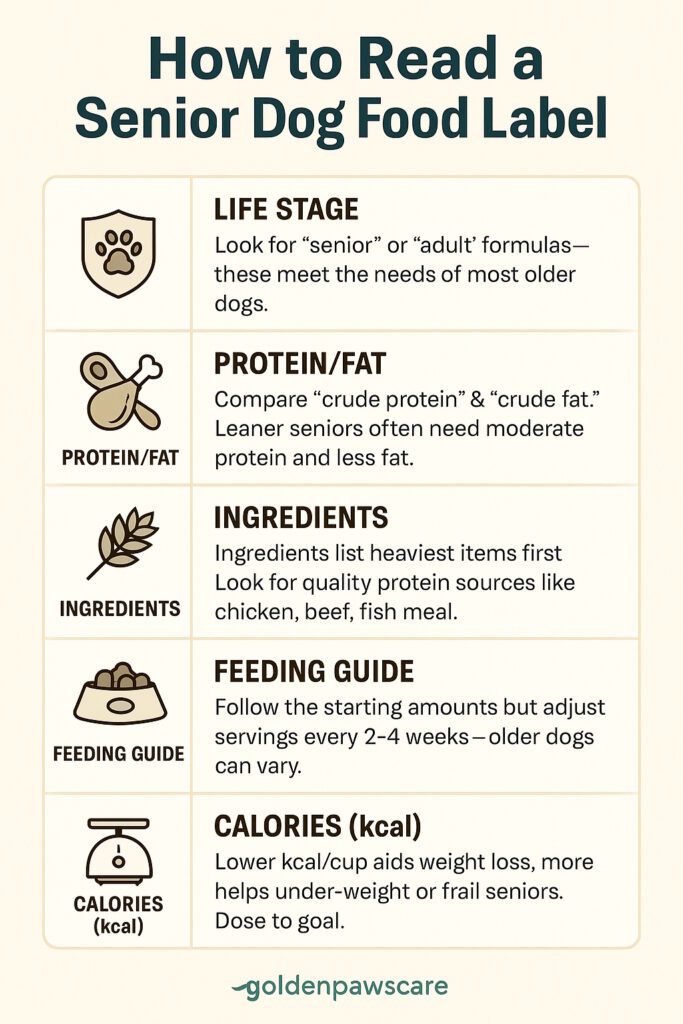
Dog Food Label — What It Means for Seniors
| Label Element | Where to Find It | What It Means | Senior-Specific Tip |
|---|---|---|---|
| Life Stage | Front panel or near GA | “Adult maintenance” vs “All life stages” (ALS) | ALS can be richer; many seniors do better on adult maintenance calories unless advised otherwise. |
| Guaranteed Analysis | Panel with protein/fat/fiber/moisture | Minimums (protein/fat) and maximums (fiber/moisture) | Compare on a dry-matter basis when moisture differs; seniors often need adequate protein for muscle. |
| Ingredients | List by weight (as-fed) | Fresh meats weigh more due to water | Look for consistent protein sources; note whole grains/fiber for stool quality and weight. |
| Feeding Guide | Back/side panel | Starting amounts by weight | For seniors, recalibrate based on body condition score every 2–4 weeks. |
| Calories (kcal/cup) | Near GA or feeding guide | Energy density | Lower kcal/cup helps weight loss; higher can help under-weight seniors—dose to goal. |
The Big Four: What to Look for in a Senior Dog
This is where the “art” of loving a senior dog comes in. The “right” numbers depend on your dog. Are they overweight? Are they skinny? Do they have heart or kidney issues?
Here are the general, time-tested guidelines.
1. Protein: The Myth-Buster
- The Myth: “Seniors need a low-protein diet.”
- The Truth: This dangerous, outdated myth must be retired. Seniors need more protein, not less. As they age, their bodies become less efficient at processing protein, leading to sarcopenia—the medical term for age-related muscle loss. It’s the reason their back legs become weak and their spines become more prominent.
- What you need: High-quality, easily-digestible protein to fight muscle loss.
- The Numbers (DMB): For a healthy senior, I look for a DMB protein level of 28%-32% or higher. The quality matters, too. In the ingredient list, you want to see a named, whole meat (like “Chicken,” “Salmon,” “Beef”) as the first ingredient, not “Meat and Bone Meal.”
2. Fat: The Calorie-Control
- The Truth: Fat is not the enemy; it’s the primary source of calories. And for most seniors, their metabolism is slowing down, and they’re moving less. This is why they get overweight, which is devastating for arthritic joints.
- What you need: To control their weight. For most seniors, this means a lower-fat food.
- The Numbers (DMB): For a senior who needs to maintain or lose weight, I look for a DMB fat level of 10%-13%.
- The Exception: Is your senior a “hard keeper”? Are they skinny and struggling to keep weight on? If so, a “lower-fat” senior food is the wrong choice. You’d want a food with a higher fat content (14% – 18% DMB) to get more calories per bite.
Source: Veterinary guidance on pet food labels & nutrients. PetMD.
3. Sodium: The Heart-Health Monitor
- The Truth: Sodium is a hidden problem. It’s used as a preservative and to enhance the taste of food. For a senior dog, especially one with a heart murmur or early signs of congestive heart failure (CHF), excess sodium is a huge strain.
- What you need: To be aware of the salt content before it becomes a problem.
- The Numbers (DMB): The AAFCO minimum for adults is 0.3% DMB. Many “grocery store” brands can be 1.0% DMB or even higher. For a healthy senior, I recommend choosing a food with a DMB Sodium level below 0.50%. If your dog has a known heart condition, your vet will prescribe a food with a much lower fat content (around 0.1% – 0.3%).
4. Phosphorus: The Kidney-Guardian
- The Truth: This is the most important, least-known number. Aging kidneys struggle to filter excess phosphorus from the blood. A high-phosphorus diet can accelerate the progression of kidney disease. Restricting phosphorus is the only proven nutritional intervention to slow the progression of kidney disease.
- What you need: A “kidney-friendly” food, even if their bloodwork is currently normal. This is about prevention.
- The Problem: Phosphorus is almost NEVER on the Guaranteed Analysis. This is the “insider” tip. You have to go to the brand’s website or, even better, call or email their customer service and ask: “What is the phosphorus level of this food on a dry matter basis?”
- The Numbers (DMB): For a healthy senior, I look for a food with a DMB Phosphorus level under 1.0%. (Many high-protein, meat-heavy foods can be 1.5% or higher.) If a dog has any sign of kidney decline, they need to be on a prescription diet with levels closer to 0.3% – 0.6%.
Compare Two Senior Formulas — Label Numbers (Example)
| Metric | Food A (As-Fed) | Food B (As-Fed) | Better for Seniors?* |
|---|---|---|---|
| Protein (min) | 24% | 28% | Often B (muscle support) |
| Fat (min) | 10% | 12% | Depends (weight goal) |
| Fiber (max) | 4.0% | 6.0% | Higher fiber helps weight control |
| Moisture (max) | 10% | 12% | Compare on dry-matter if different |
| Calories (kcal/cup) | 345 | 390 | Lower kcal for weight loss; higher if under-weight |
*General guidance—match to your dog’s body condition and vet advice.
Step 3: The Ingredient List — Telling the Story
You’ve used the Guaranteed Analysis to find a food with the right numbers. Now, you’ll use the ingredient list to judge the quality.
Ingredients are listed by weight, so the first 5-7 ingredients are what the food is mostly made of.
- Look For:
- A whole, named meat as the #1 ingredient (“Deboned Chicken,” “Salmon”).
- Whole grains or vegetables (“Brown Rice,” “Oatmeal,” “Sweet Potatoes”).
- Named fat sources (“Chicken Fat,” “Salmon Oil”).
- Watch Out For:
- Vague, low-quality ingredients (“Meat Meal,” “Animal By-Product Meal,” “Animal Fat”).
- “Split” ingredients. This is a trick. A bag that says “Chicken, Corn Gluten Meal, Ground Corn, Corn Flour…” is a corn-based food, not a chicken-based one. They just “split” the corn into three types to push it down the list.
- Artificial colors and flavors. (Red 40, Blue 2, etc.). Your dog does not care what color the kibble is. This is for you.
A special note: You will often see “Glucosamine” and “Chondroitin” at the very bottom of the list. This is a marketing gimmick. The amount included is almost never enough to be therapeutic. Do not choose a food based on this; buy a separate, high-quality joint supplement.
Vet-Trusted Senior Dog Food Picks
| Product | Protein / Fat | Key Benefit | Avg. Rating | Buy |
|---|---|---|---|---|
| Hill’s Science Diet Senior 7+ | 19% / 13% | Balanced nutrition with antioxidants for aging immune systems. | ★ 4.7 / 5 | Check Price |
| Blue Buffalo Life Protection Senior | 20% / 10% | Natural formula with glucosamine and chondroitin for joint health. | ★ 4.6 / 5 | Check Price |
| Purina Pro Plan Bright Mind 7+ | 29% / 14% | High-protein kibble with botanical oils to support brain function. | ★ 4.7 / 5 | Check Price |
| Nutro Ultra Senior Dry Dog Food | 26% / 12% | Trio of proteins (chicken, lamb, salmon) with superfoods and antioxidants. | ★ 4.7 / 5 | Check Price |
*All protein and fat values shown “as-fed.” Always consult your veterinarian before switching diets.
Senior Nutrition — Related Guides
🍖 Senior Dog Food Label — FAQ
1. What does “crude protein” mean on a dog food label?
“Crude” refers to the analytical method, not ingredient quality. It measures nitrogen to estimate protein content. Senior dogs still benefit from 25–30% protein on a dry-matter basis to preserve muscle mass and mobility.
2. Should I choose food labeled “senior” or “adult maintenance”?
“Senior” isn’t a regulated term, so formulations vary. Compare the guaranteed analysis instead of relying on the label name. Many “adult maintenance” formulas meet older dogs’ needs when paired with vet guidance.
3. How can I tell if a food meets AAFCO standards?
Check the AAFCO Nutritional Adequacy Statement printed near the ingredients list. It confirms the food meets minimum nutrient profiles for a specific life stage like “adult maintenance” or “all life stages.”
4. What’s the most important number on the label for older dogs?
Calories per cup (kcal/cup) and protein percentage are key. Adjust calories for weight control and ensure adequate protein to support lean muscle. Use dry-matter comparison when moisture levels differ between foods.
5. Should fiber or fat be higher for seniors?
Moderate increases in fiber (4–7%) help digestion and satiety. Fat should stay balanced—8–12% for most seniors—to maintain energy and coat quality without unwanted weight gain.
— Reviewed by Dr. Sarah Kent, DVM
Senior Dog Nutrition Specialist
“For many older dogs, muscle maintenance—not just weight control—is the goal. Read the label for adequate protein and match calories to your dog’s body condition.”
— Dr. Sarah Kent, DVM • Senior Canine Nutrition
The Conclusion: You Are Now in Control
This is it. This is the whole “secret.”
The aisle isn’t scary anymore. You can walk in, pick up any two bags, and, in 60 seconds, have a real, data-driven conversation:
“This one has 30% protein and 12% fat, which is great for my dog’s weight. The other one is ‘All Life Stages,’ and I can see its fat is 18%, which is too high. I’ll go with the first one.”
You’re no longer guessing. You’re not being fooled by a picture of a wolf anymore. You are making an informed, medical-grade decision for your best friend.
Choosing a food isn’t just a chore. It’s one of the most powerful, frontline ways you have to manage their health, build their muscles, protect their joints, and give them more good, comfortable years. You are a great dog owner for caring this much. Now you have the tools to act on it.