When to Start Glucosamine for Dogs
It’s a subtle shift. So subtle, most of us miss it for months.
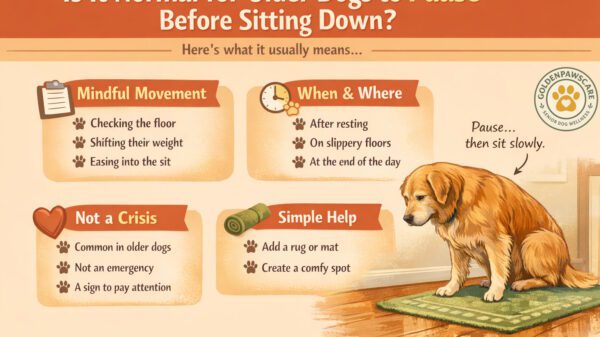
Your dog, who once levitated onto the couch, now seems to pause and think about it for a second. The “zoomies” in the backyard end a little sooner. Or maybe you notice a new sound—a quiet “grunt” as they settle into their bed for the night.
Source: Osteoarthritis in Dogs. American College of Veterinary Surgeons.
🦴 Did you know? Studies show that 1 in 5 dogs over age six already display early signs of cartilage wear — even before limping appears.
Source: Veterinary Orthopedic Society, 2023
And then the question hits you, often in the middle of the night: “Is this it? Is this the start of arthritis? Am I too late?”
This anxiety is the unofficial membership card for the “Loving a Dog” club. And it inevitably leads to the most common, frantic question I’ve heard from dog owners over the years—often typed into a search bar exactly like this: “When to Start Glucosamine Dog?”
We’re all terrified of two things: starting too early and wasting money on something a young dog doesn’t need, or starting too late and feeling racked with guilt for missing our window to help.
I want to replace that anxiety with a clear, confident plan.
The answer isn’t a single number. It’s not “at eight years old.” The real answer is a strategy, and it depends entirely on which of two categories your dog falls into:
In This Guide
- The Proactive Group: High-risk dogs who should start before any signs appear.
- The Observant Group: All other dogs, who should start at the very first subtle sign.
Let’s break down exactly what that looks like in the real world.
First, What Are We Even Doing? (Hint: It’s Not a Painkiller)
Before we talk about when, we have to understand why, this is the single biggest misunderstanding about joint supplements.
Glucosamine, Chondroitin, and other ingredients (like MSM or Green-Lipped Mussel) are not painkillers. They are not aspirin for a sore joint.
📚 Clinical Insight: A controlled study found that dogs receiving glucosamine and chondroitin showed significant improvement in weight-bearing and comfort after 70 days compared to placebo.
Source: McCarthy G. et al., “Evaluation of oral glucosamine for osteoarthritis,” J. Vet. Pharmacol. Ther., 2007
They are chondroprotectives—a fancy word for “cartilage-protecting.” Think of them as “joint food.” Their job is to:
- Supply the building blocks for healthy cartilage.
- Help retain water in the joint, keeping that vital “synovial fluid” thick and slippery.
- Provide a mild anti-inflammatory effect to calm the low-grade inflammation that slowly chews away at joint surfaces.
I like to use a retirement fund analogy.
You don’t start saving for retirement on the day you retire. That would be absurd. You build the fund over decades so that when you need it, it’s there.
Joint supplements are a retirement fund for your dog’s mobility. You are “investing” in their cartilage health before it’s gone. You can’t regrow cartilage, but you can do a magnificent job of protecting and preserving what’s there.
This is why “proactive” is always better than “reactive.”
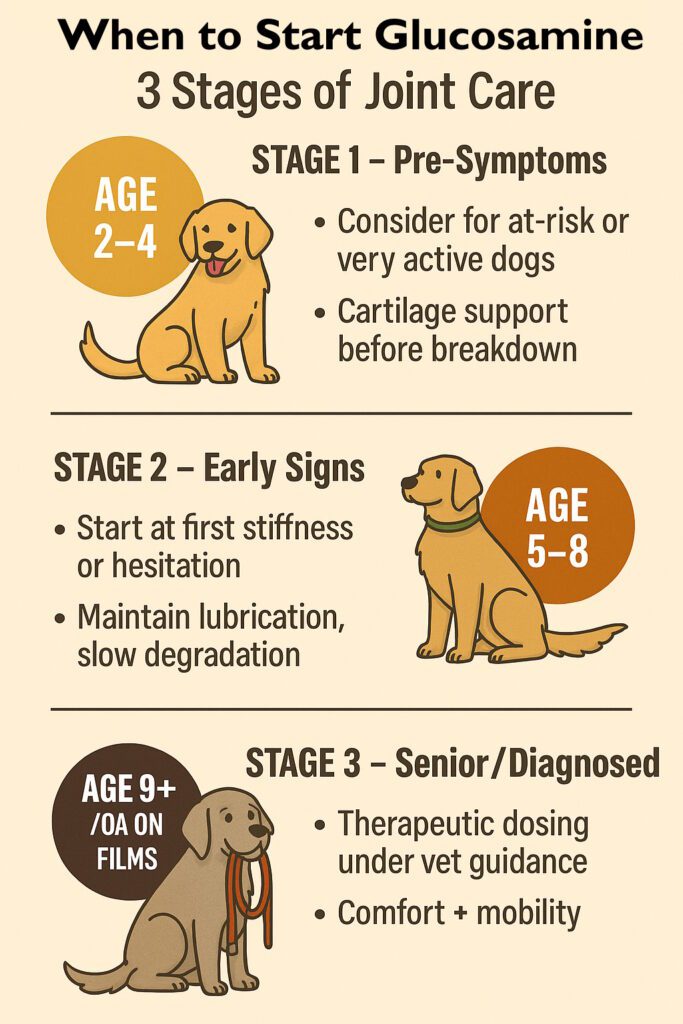
🕒 When to Start Glucosamine: Age & Condition Guide
| Dog Stage | When to Begin | Why It Helps |
|---|---|---|
| Young Adults (2–4 yrs) | After intense activity or early stiffness | Supports cartilage before breakdown starts |
| Middle Age (5–8 yrs) | Preventive dosing recommended | Maintains joint lubrication & flexibility |
| Seniors (9+ yrs) | Daily therapeutic dose with vet guidance | Slows progression of arthritis pain |
Group 1: The Proactive Plan (For High-Risk Dogs)
If your dog is on this list, your decision is easy. The time to start is long before you see a problem. You are in the “prevention” business.
Who is in this group?
- Large & Giant Breeds: German Shepherds, Labrador Retrievers, Golden Retrievers, Rottweilers, Bernese Mountain Dogs, Great Danes, Newfoundlands, etc. Their sheer body weight puts immense daily stress on their joints. Their frames are like the suspension on a heavy-duty truck—they just wear out faster.
Source: Osteoarthritis in Dogs (risk & management). ACVS.
- Structurally-Challenged Breeds: Dachshunds (backs), Corgis (long bodies, short legs), Pugs and French Bulldogs (hemivertebrae, luxating patella).
- High-Impact Athletes: Any dog that competes in agility, flyball, dock diving, or Frisbee. Also, working dogs (ranch, police K9s, search and rescue). The repetitive, high-impact stress of jumping, weaving, and landing accelerates wear and tear.
- Dogs with a Known Injury: Any dog that has torn a cruciate ligament (CCL/ACL), had joint surgery (like FHO or TPLO), or been diagnosed with hip or elbow dysplasia.
The “When” for This Group: The ideal time to start is when they finish their primary growth phase, around 1-2 years old.
Glucosamine Options at a Glance
| Form | Why choose it | Notes | Link |
|---|---|---|---|
| Chews | Easy acceptance; good for daily routines | Check label for amount per chew; vet-approved brand | Check Price |
| Liquid | Mix with food; easier for picky eaters | Measure carefully; shake well | Check Price |
| Capsule/Powder | Flexible dosing | Open capsule if needed; mix thoroughly | Check Price |
Some links are affiliate links. We may earn a small commission at no extra cost to you.
This often shocks owners. “But he’s just a baby!” Yes, but he’s a 90-pound baby whose joints are already managing incredible forces. You are not “medicating” them. You are “investing” in their 10-year-old self. By starting early, you are building that retirement fund, keeping the cartilage thick and the fluid healthy from the get-go.
⚕️ Clinical Reminder
Nutraceuticals are slow-acting; expect several weeks before judging benefit. Don’t adjust prescription pain meds without veterinary direction. JSAP Review (2024).
GoldenPawsCare Source Bar: Dr. Sarah Kent, DVM • JSAP
Group 2: The Observant Plan (For Everyone Else)
What if you have a “regular” dog? A 25-pound terrier mix, a beagle, a poodle, or a dog of unknown-but-adorable origin?
Your job is different. You don’t need to rush out and buy glucosamine for your 1-year-old. Your job is to become a world-class observer. You will start at the very first subtle sign of change.
The problem is that most owners are looking for a limp. A limp isn’t the first sign. A limp is the last sign. It is a big, red, flashing light that says, “I have been in pain for a long time, and I simply cannot hide it anymore.”
We must learn to see the signs before the limp.
The Real, Subtle Signs of Joint Discomfort (What to Watch For):
- The Hesitation: This is the most common first clue. They stand at the bottom of the stairs for a beat. They size up the jump onto the couch. They pause before leaping into the car. This isn’t them being “stubborn”; it’s them calculating, “Is this going to hurt?”
- The “Stiff Morning”: They don’t spring out of their bed anymore. They take a few, slow, stilted steps to “unfurl.” They look like a little old man for the first 30 seconds, and then they walk it off.
- The “Fake-Out Sniff”: On walks, they start lagging behind. They stop to sniff a patch of grass, and you wait. Then they walk five more feet and stop to sniff another patch. This is often a stalling tactic. They’re not that interested in the grass; they’re taking a micro-break to let their joints rest.
- The “Grunt” or “Groan”: You know the sound. It’s the audible “huff” or “oof” when they lie down or change positions. This is the sound of discomfort.
- Shifting Weight: They stand with their back legs slightly “tucked” under them, or they consistently shift their weight off one leg when standing still.
- Excessive Licking: You notice them constantly licking at their “wrist” (carpus) or “ankle” (tarsus). There’s no cut or bug bite. This is often a sign of a deep, localized ache.
The “When” for This Group: The moment you notice any of these signs, and they are repeatable (you see it three days in a row), it’s time to start.
This is your signal. This is the body’s polite but firm request for help. At this stage, you are shifting from “prevention” to “active support and preservation.”
If your dog is a “medium” risk and you’re a “belt-and-suspenders” type of person, starting them on a high-quality joint supplement when they hit “middle age” (around 5 to 7 years old) is a perfectly reasonable, wise, and proactive choice.

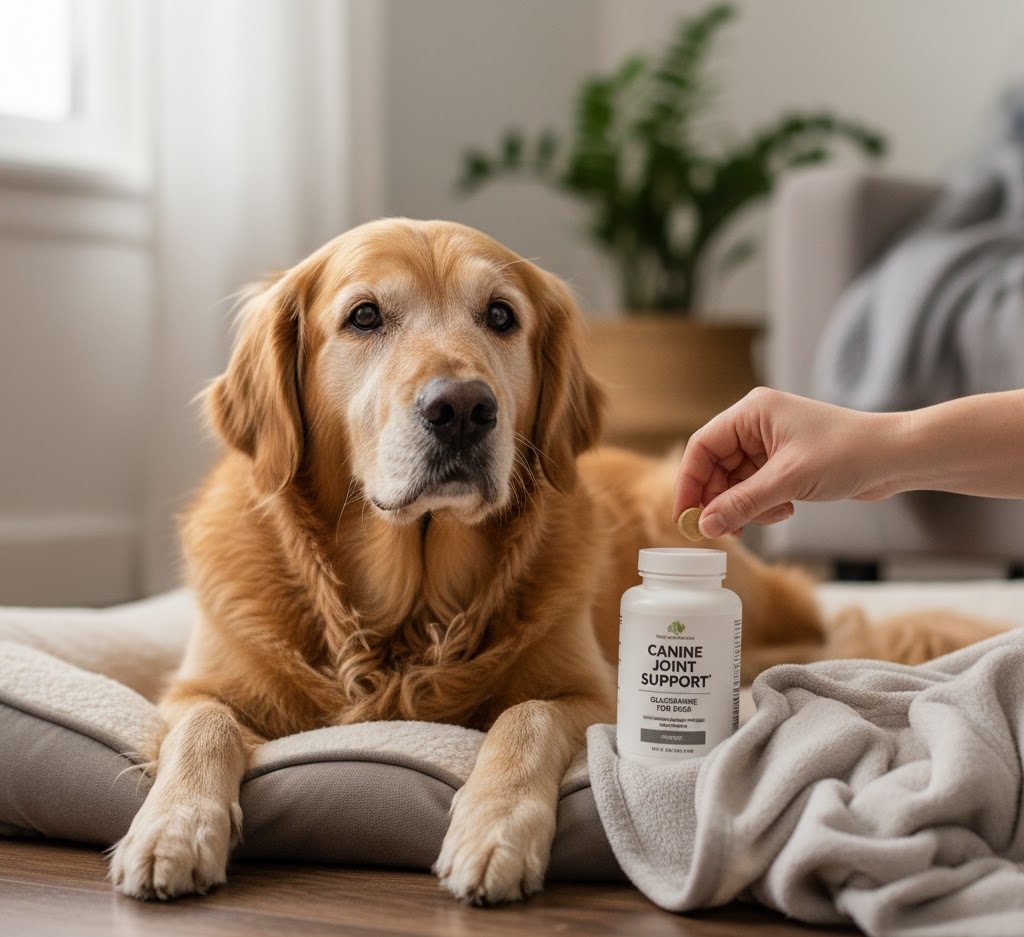
Editor’s Pick: Cosequin Maximum Strength
- Vet-recommended glucosamine & chondroitin blend
- Chewable tablets easy for senior dogs
- Supports cartilage repair & comfort
“But What If…?” (Common Fears Addressed)
“My dog is a puppy. Should I start now?” No. A healthy, normal-risk puppy does not need a joint supplement. Their nutritional needs are complex and best met with a high-quality, large-breed puppy food (if applicable). Their joints are forming, not degenerating. Do not add supplements to their diet unless you are explicitly directed to do so by your veterinarian for a specific diagnosed condition, like severe hip dysplasia.
“My dog is already 12. Am I too late?” Absolutely not. It is never, ever too late.
Please read that again. Have you missed the “prevention” window? Yes. But that’s okay. The supplement’s job just changes.
For a 12-year-old dog, the supplement’s role is now 100% about comfort and quality of life. You are working to slow any further degradation, provide as much lubrication as possible, and use the anti-inflammatory properties to reduce their daily pain level.
I have seen countless senior dogs get a new spring in their step 4-6 weeks after starting a good supplement. It’s not a miracle. We didn’t reverse the arthritis. We simply gave their joints the “food” they were screaming for, which reduced the pain.
“Start joint support at the first consistent signs of stiffness—don’t wait for a crisis. Track comfort weekly and review with your veterinarian.”
— Dr. Sarah Kent, DVM • Senior Canine Health | context
❓ FAQs: Glucosamine Timing for Senior Dogs
When should I start giving my dog glucosamine?
Most vets recommend starting around age 5–6 for medium to large breeds, or sooner if early stiffness appears.
Can glucosamine be given with other joint supplements?
Yes. It’s often paired with chondroitin, MSM, or omega-3s. Always confirm with your vet before combining products.
Does my dog need glucosamine forever?
Long-term use is safe and most beneficial. Many vets recommend lifelong supplementation once arthritis begins.
Expert reviewed by Dr. Sarah Kent, DVM — Pet Nutrition Specialist
The Real Takeaway: It’s an Act of Love, Not a Pill
The decision of when to start glucosamine for your dog isn’t a medical test you can fail. It’s an act of observation.
It’s noticing the “grunt.” It’s respecting the “hesitation” at the stairs. It’s understanding that your Bernese Mountain Dog’s joints have a tougher job than a chihuahua’s.
You are not “medicating” your dog. You are giving their bodies the resources they need to fight back against time. You are not just buying a bottle of pills; you are investing in more comfortable mornings, more willing walks, and more good days.
And there is no better investment in the world than that.