The Love-Weight Paradox
There is a specific look every senior dog owner knows. It’s that soulful, cloudy-eyed gaze they give you when you’re holding a piece of cheese or opening the biscuit jar. It’s a look that says, “I’ve been your good boy for twelve years. Surely, I deserve this?”
And your heart breaks a little. You think about their gray muzzle, their slower gait, and the limited time you have left together. You think, “Yes. You do deserve it. You deserve everything.”
So, you toss the treat. And then another.
This is the Love-Weight Paradox. In our golden years with our dogs, food becomes our primary way of saying “I love you” when long hikes and ball chasing are no longer options. But there is a hard biological reality that we, as guardians of their twilight years, must face: The metabolism of a 12-year-old dog is not the engine it was at 2.
It’s the conflict senior dog owners face when showing love through food while accidentally contributing to weight gain, inflammation, and joint pain.
Managing a senior dog’s weight is arguably the single most effective thing you can do to extend their lifespan and reduce arthritis pain. But how do we do that without feeling like the “fun police”? How do we balance the joy of treating with the necessity of a strict senior diet?
Let’s walk through the science of the senior metabolism, the hidden math of “just one bite,” and a new tool I’ve developed to take the guesswork out of their dinner bowl.
In This Guide
The “Engine” Slows Down: Understanding Senior Metabolism
When your dog was three, they burned calories like a furnace. They ran, they played, and their resting metabolic rate was high. You could be loose with measurements, and they’d burn it off by Tuesday.
As dogs age, two invisible shifts happen simultaneously:
- Muscle Mass Reductions (Sarcopenia): Even healthy seniors lose muscle mass over time. Muscle burns more calories than fat, so as muscle fades, their daily energy requirement drops.
- Activity Decline: They sleep more and zoom less.
Veterinary nutritionists estimate that a senior dog often needs 20% to 30% fewer calories than a young adult to maintain the same weight. If you are feeding the same scoop of kibble today that you fed five years ago, your dog is likely slowly gaining weight.
And for a senior, weight is not just cosmetic. It is physical stress.
The Arthritis Multiplier
If your dog has osteoarthritis (and 80% of dogs over age 8 do), every extra pound of body weight exerts roughly four pounds of extra pressure on their knees and hips.
Think about that. If we overfeed them to gain just two pounds, we are adding eight pounds of grinding pressure to their sore joints with every step they take. Controlling calories is not about vanity; it is the most powerful pain management tool in your arsenal.
| Spoiling Style | Treat Size | Treats Per Day | Extra Calories Per Day | Extra Calories Per Year* | Estimated Weight Gain / Year** |
|---|---|---|---|---|---|
| “Light spoiling” | 5 kcal treats | 3 per day | 15 kcal | ≈ 5,500 kcal | ≈ 1.5 lb |
| “Everyday biscuit habit” | 10 kcal treats | 5 per day | 50 kcal | ≈ 18,250 kcal | ≈ 5+ lb |
| “Heavy spoiling” | 25 kcal treats | 5 per day | 125 kcal | ≈ 45,600 kcal | ≈ 13 lb |
*Rounded estimates based on daily extra calories × 365 days.
**Very rough illustration for a medium senior dog; actual weight change depends on size, metabolism, activity level, and health. Always work with your veterinarian for a safe weight-loss plan.
That’s the Love-Weight Paradox in action: treats feel tiny in your hand, but your dog’s body feels every extra pound.
The “Treat Creep” Phenomenon
Here is where the math gets tricky—and where most of us fail. We often dial back their breakfast and dinner portions to “senior” sizes, but we forget to adjust the “extras.”
I call this Treat Creep.
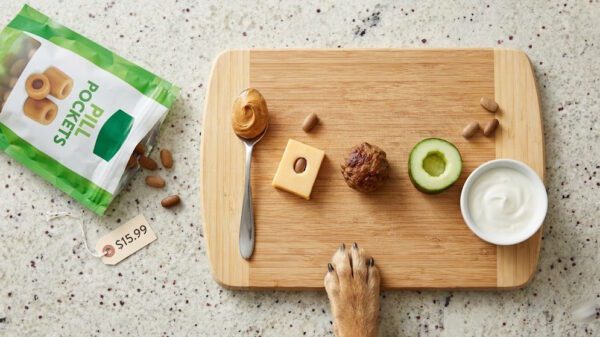
We give a biscuit for coming inside. A dental chew for their teeth. A piece of crust from our sandwich. A pill pocket for their medication.
For a 60lb Labrador, a single large milk bone and a slice of cheese can represent 25% of their entire daily calorie budget.
The veterinary “Golden Rule” is that treats should make up no more than 10% of a dog’s daily caloric intake. The other 90% needs to come from their nutritionally balanced food to ensure they get the vitamins and minerals required to support aging organs.
When treats exceed that 10%, two things happen:
- Nutritional Dilution: They get full on “empty calories” and miss out on the protein and nutrients in their actual food.
- Caloric Surplus: They eat their full dinner plus the treats, leading to immediate weight gain.
But who wants to sit there with a calculator and a food scale every time their dog looks cute?
Stop Guessing: The Treat Balancer Tool
I realized that telling people to “feed less” is easy, but doing the math in the kitchen at 6 PM is hard. If you gave your dog three biscuits and a hot dog piece today, exactly how much kibble should you scoop out of their dinner to keep them balanced?
To solve this, I built a tool right here on Golden Paws Care. It uses the standard veterinary formulas (WSAVA guidelines) for Resting Energy Requirements (RER) to calculate your dog’s specific needs and balances it against their treats.
This tool follows the WSAVA veterinary calorie calculation guidelines and precisely adjusts for your dog’s treat intake.
How to use it in your daily routine:
- Input Your Dog’s Profile: Enter their weight and activity level (be honest—most of our seniors are “Inactive”!).
- Check Your Food: Look at your dog food bag for the “kcal per cup” number and enter it.
- Log Treats as You Go: Did they get a dental chew this morning? Add it. Did the grandkids sneak them a nugget? Add it.
- The Magic Number: The tool will tell you exactly how much kibble to feed for dinner to stay calorie-neutral.
It doesn’t tell you to stop treating. It just helps you adjust the main meal to compensate. It allows you to be the “good guy” with the treats while still being the responsible guardian of their waistline.
The “High-Volume” Treating Strategy
If the calculator shows you’re constantly over your limit, it might be time to switch what you are treating.
We often think dogs love treats for their flavor, but behavioral research suggests much of the joy comes from the interaction and the texture. Your dog wants a moment of connection with you.
Did you know?
Over 55% of senior dogs are overweight or obese, and even a small daily treat habit
can add thousands of extra calories per year—leading to joint stress, pain, and reduced mobility.
You can provide that connection with “High Volume, Low Calorie” snacks. These are foods you can give frequently without blowing the calorie budget.
The Senior Superfoods Swap:
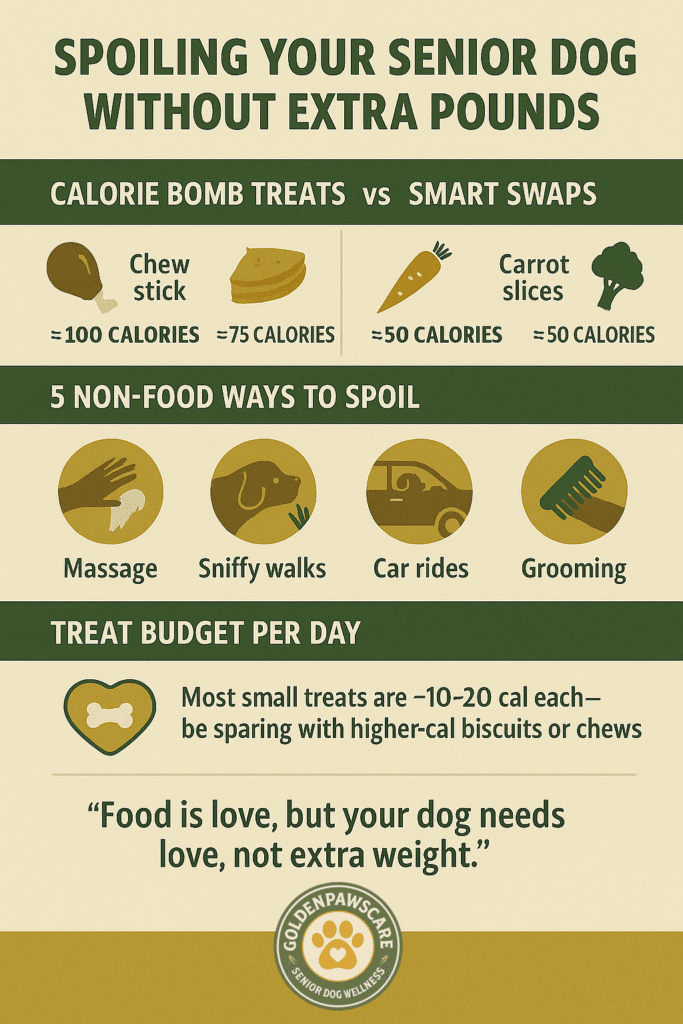
- Swap the Cheese (60 kcal) for Green Beans (2 kcal): Many dogs love the crunch of a frozen green bean.
- Swap the Biscuit (40 kcal) for Baby Carrots (4 kcal): The texture cleans their teeth, and the beta-carotene supports eye health.
- Swap the Bacon Strip (30 kcal) for Blueberries (1 kcal each): You can toss 10 blueberries for a game of “catch,” providing 10 moments of joy for the calorie price of one-third of a bacon strip.
(The Treat Balancer tool above has a “Quick Add” feature for these exact healthy snacks—try tapping the blueberry icon!)
“Even small amounts of excess weight can magnify joint pressure for senior dogs. A few extra treats each day can translate into thousands of surplus calories per year, which accelerates arthritis and mobility decline.”
— Dr. Sarah Kent, DVM Veterinarian & Pet Nutrition Specialist
🐾 Frequently Asked Questions
Why do senior dogs gain weight so easily?
Is it harmful to spoil my older dog with extra treats?
How many treats per day are safe for a senior dog?
What are healthier ways to spoil my senior dog?
Can small daily treats really cause weight gain over time?
How do I know if my senior dog’s weight is affecting their joints?
A Note on “The Last Act of Love”
I know some of you might be reading this thinking, “He’s 15. He’s struggling. I’m just going to let him eat the burger.”
And I want to validate that. There is a stage in senior care—hospice care—where appetite is the only thing that matters. If your dog is in their final weeks and struggling to eat at all, calories no longer matter. Joy matters. At that stage, you feed them whatever makes their tail wag.
But for the 8, 10, or 12-year-old dog who is slowing down but still has life to live? Weight management is the fountain of youth.
Keeping them lean effectively turns back the clock. It takes the burden off their hips. It lowers their risk of diabetes and heart strain. It gives them the energy to play one more round of fetch.
Use the calculator. Find the balance. Let them eat the treat, but respect the math. It’s the most loving way to ensure they stay around to beg for treats for years to come.
This tool and article are designed to assist with general weight management. Always consult your veterinarian before making drastic changes to your senior dog’s diet, especially if they have conditions like diabetes or kidney disease.
*Sources: American Animal Hospital Association (AAHA), ACVS Joint Health Guidelines, and current veterinary obesity research (2024).*
The Treat Balancer Tool

This is the Love-Weight Paradox. In our golden years with our dogs, food becomes our primary way of saying "I love you" when long hikes and ball chasing are no longer options. But there is a hard biological reality that we, as guardians of their twilight years, must face: The metabolism of a 12-year-old dog is not the engine it was at 2.
Price: 0.00
Operating System: Web
Application Category: UtilitiesApplication