Excess Weight on Dog Joints
Pain & Joint Health · Senior Dogs
Extra weight doesn’t just “sit” on a senior dog’s frame — it multiplies the pressure grinding through aging joints with every single step. This guide explains the 1-Pound Rule, why a few “cute” pounds can be brutal on knees and hips, and what you can do today to give your dog a lighter, more comfortable life.
If your dog is limping, slowing down, or “just getting old,” this is where you find out how much of that story is really about weight — and how to start turning it around.
It starts subtly. Maybe your dog hesitates for a fraction of a second before jumping into the car. Maybe they no longer greet you at the door with a full-body wiggle, but rather a slow, stiff rise from their bed. We often wave these moments away. We tell ourselves, “He’s just slowing down,” or “She’s getting older.” We might even chuckle at their “chunky” frame, calling them a “heckin’ chonk” or “more to love.”
But as someone who has spent years watching animals struggle to stand, I see something different. I see the physics of pain hiding in plain sight.
The single most significant, manageable factor in an animal’s orthopedic health is not the brand of glucosamine you buy or the softness of their orthopedic bed—though those help. It is the number on the scale. There is a concept in biomechanics that every pet owner needs to sear into their memory. It changes the way you look at that extra handful of kibble.
It is called the 1-Pound Rule, and it explains why “just a few pounds” is actually a massive physiological disaster waiting to happen.
How 1 Extra Pound Stresses Your Dog’s Joints
Biomechanics research in people and animals shows that every extra pound on the body can translate into roughly four extra pounds of force on weight-bearing joints like the hips, knees, and elbows—especially when moving, jumping, or turning.
- +1 lb of body weight ≈ +4 lbs of force on each step.
- Stairs, jumping off the couch, and sharp turns multiply that load even more.
- For a senior dog with arthritis, this extra force can mean more pain and faster joint wear.
That’s why even small weight loss goals (5–10% of body weight) can make a real, measurable difference in your dog’s comfort.
In This Guide
Key Takeaways: The 1-Pound Rule for Dog Joints
- Every extra pound a dog carries can translate to roughly four pounds of added force on weight-bearing joints with each step.
- Fat tissue isn’t inert storage — it releases inflammatory chemicals that make arthritis more painful from the inside out.
- Intentional weight loss is often the single most effective “treatment” for canine osteoarthritis, frequently outperforming medications alone.
- You can’t change your dog’s age, but you can remove dozens of pounds of joint load by trimming just a few pounds off the scale.
The Physics of Pain: The Multiplier Effect
When we look at a dog who is five pounds overweight, our human brains tend to minimize it. To us, five pounds is a heavy purse or a large bag of flour. It doesn’t seem very important. But biology doesn’t do simple addition; it does multiplication.
The general rule of thumb in biomechanics—often cited in human osteoarthritis studies and widely applied to quadrupedal anatomy—is that for every single pound of excess body weight, there is approximately four pounds of extra pressure applied to the weight-bearing joints (knees and hips) during movement.
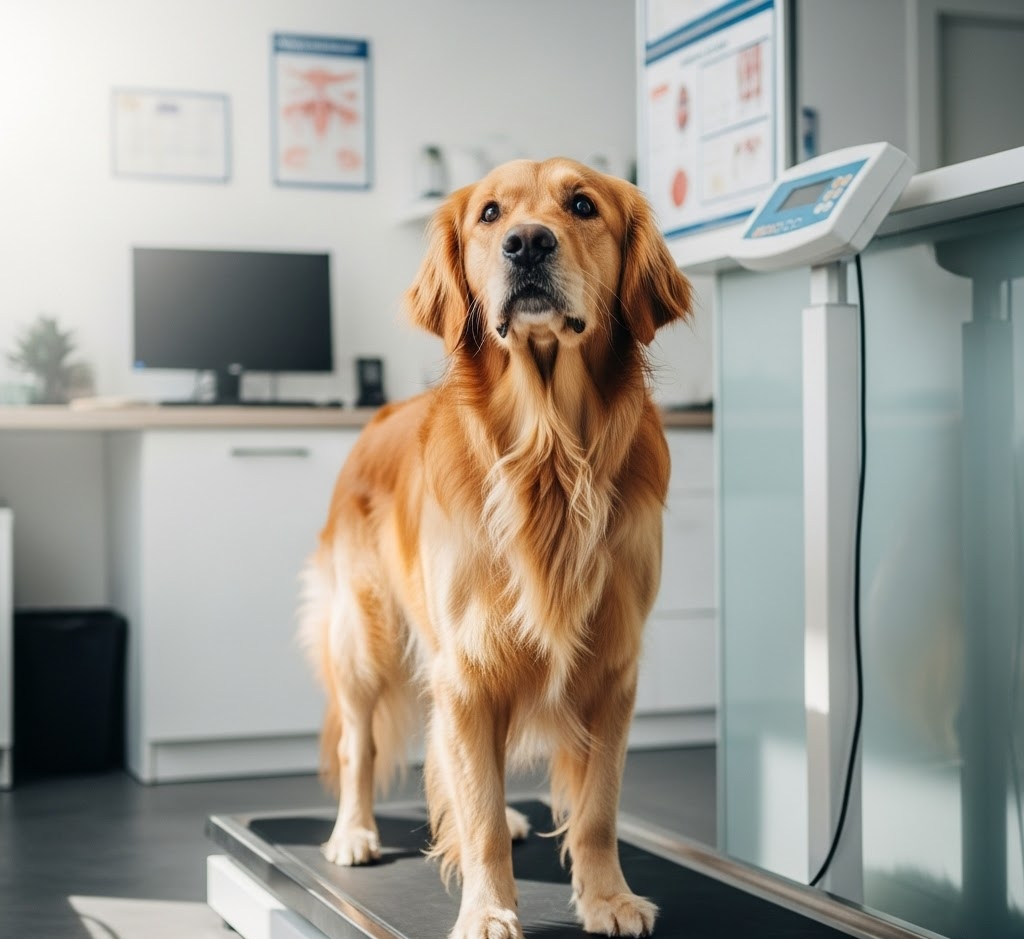
Let’s do the math on that “negligible” five pounds. If your Golden Retriever is carrying five extra pounds, he isn’t just carrying a five-pound weight. When he trots across the yard, his knees are absorbing 20 pounds of extra force with every single step.
Now, multiply that by the thousands of steps taken on a daily walk. That is tons—literally tons—of cumulative, crushing force grinding down the cartilage over the course of a week. If that same dog is 10 pounds overweight, the pressure skyrockets to 40 pounds per step.
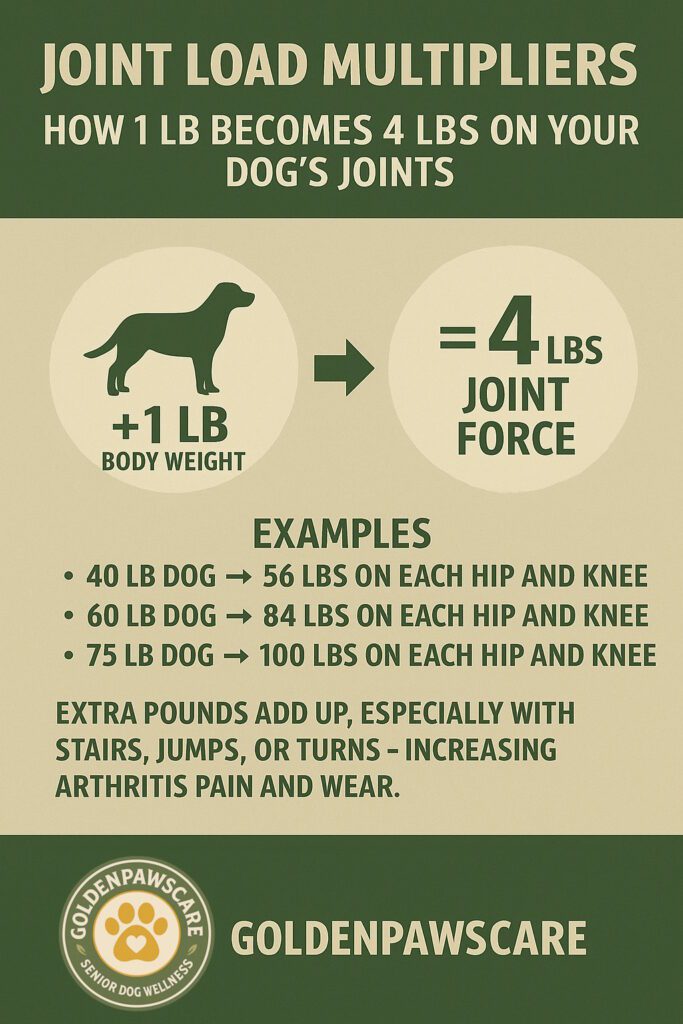
The 1-Pound Rule at a Glance
| Extra body weight | Approx. added joint load | What it feels like |
|---|---|---|
| 1 lb | ≈ 4 lb per step | A small ankle weight on every joint. |
| 5 lb | ≈ 20 lb per step | Like hiking with a heavy pack all day. |
| 10 lb | ≈ 40 lb per step | Constant, grinding pressure on every joint movement. |
These numbers are approximations based on biomechanics research, but they illustrate why an “extra few pounds” can feel like a disaster to aging joints.
| Dog’s Body Weight | Extra Weight Carried | Approx. Added Joint Load* |
|---|---|---|
| 40 lb senior dog | +1 lb | ≈ +4 lbs of joint force |
| 60 lb senior dog | +3 lbs | ≈ +12 lbs of joint force |
| 75 lb senior dog | +5 lbs | ≈ +20 lbs of joint force |
*Approximate load based on “1 extra pound ≈ 4 pounds of force” on weight-bearing joints during movement.
Did you know? Research in dogs and people suggests that losing just 10% of body weight can significantly reduce joint pain and improve mobility — because every pound lost removes multiple pounds of extra force from the hips, knees, and elbows.
This is why excess weight on dog joints is the silent killer of mobility. It accelerates cartilage breakdown, leading to bone-on-bone contact much faster than age alone would. The tragedy is that we often don’t see the connection until the damage is irreversible.
Inflammation: The Chemical War Inside
While the mechanical crushing of the joints is bad enough, the story gets darker when we look at the biology of fat itself.
For a long time, we treated body fat (adipose tissue) like a passive storage unit—like the trunk of a car where you store extra energy for a rainy day. We now know that fat is biologically active. It is, essentially, the largest endocrine organ in the body.
Excess adipose tissue secretes inflammatory hormones and proteins called cytokines. These chemicals circulate through the bloodstream, triggering chronic, low-grade inflammation throughout the body.
Think of it this way: An overweight dog isn’t just carrying a heavy backpack; they are wearing a backpack that is actively attacking their joints from the inside. This systemic inflammation exacerbates osteoarthritis, leading to more intense pain signals. Even if the mechanical load wasn’t an issue, the chemical environment created by obesity makes existing arthritis significantly more painful.
Did You Know?
In both human and veterinary medicine, excess adipose tissue is now recognized as a metabolically active organ, not just stored energy. The inflammatory signals it releases can increase joint pain even before visible limping appears — which is one reason some dogs seem “more sore” than their X-rays would suggest.
The “Food is Love” Paradox
I have sat in countless exam rooms with owners who clearly adore their dogs, yet those dogs are suffering from preventable obesity. I never judge these owners, because I understand the psychological trap they have fallen into.
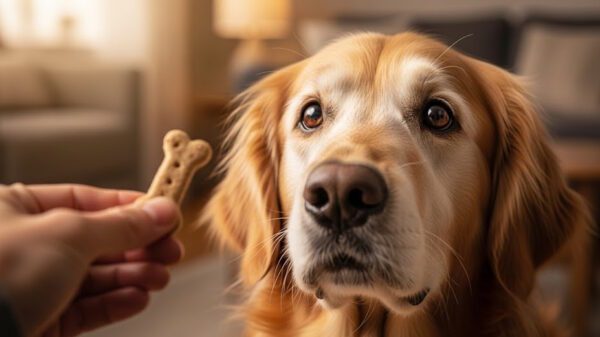
For humans, feeding is a primal language of care. When we come home from work and our dog looks at us with those soulful eyes, giving a treat feels like a bonding moment. It releases dopamine for both the dog and the human. We equate food with love. To withhold food feels, to many owners, like withholding affection.
Breaking this cycle requires a mindset shift. We have to realize that in modern pet ownership, food is not love—health is love. Protecting their joints is love. Ensuring they can run without pain is love.
Reframing this narrative is the hardest part of the journey. You aren’t being “mean” by measuring their kibble; you’re their guardian. You are the only thing standing between them and a torn cruciate ligament (CCL).
Identifying the “Silent” Sufferer
Dogs are stoic. They are evolutionarily programmed to hide weakness. By the time a dog yelps or limps significantly, they have likely been in pain for months or years.
As an owner, you need to look for the “micro-signs” of joint distress caused by weight:
- The “Bunny Hop”: When running, does your dog move both back legs together rather than independently? This often indicates hip pain.
- Slow Transitions: Watch how they get up. Do they pull themselves up with their front legs because their back legs are weak or painful?
- The reluctance to jump: Did they use to jump on the couch, and now they wait to be lifted?
- Behavioral Changes: Often, a “grumpy” older dog isn’t actually grumpy; they are just protecting a painful body. Aggression or withdrawal is often a symptom of chronic pain.
The Body Condition Score: Your New Bible
Forget the number on the scale for a moment, because breed standards vary wildly. You need to learn the Body Condition Score (BCS). This is a hands-on assessment.
Stand your dog up and run your hands along their ribcage.
- Ideal: You should be able to feel the ribs easily with the flat of your fingers, as if running your hand along the back of your hand.
- Overweight: If it feels like running your hand over your knuckles while making a fist, they are a bit heavy.
- Obese: If it feels like your palm—soft, squishy, and your ribs are hard to find, you are in the danger zone.
Also, look from above. Your dog should have an hourglass figure—a distinct waist tucked in behind the ribs. If they look like sausages or coffee tables, the joints are suffering.
The Solution: A Strategy for Relief
If you’ve realized your dog is carrying that dangerous extra weight, don’t panic. The body is forgiving, and weight loss remains the single most effective treatment for arthritis—more effective than any drug on the market.
Here is the strategic approach to canine osteoarthritis relief through weight management:
1. The precise measurement
Ditch the plastic scoop. Those “cups” vary wildly depending on how heaping they are. Get a kitchen scale and weigh the food in grams. It sounds obsessive, but it is the only way to ensure you aren’t accidentally overfeeding by 20% every day.
2. The “Green Bean” Hack
If your dog looks at you with tragic, starving eyes when you cut back their kibble, use high-volume, low-calorie fillers. Plain, frozen green beans are the secret weapon of veterinary weight loss. They add crunch and fill the stomach, signaling satiety without adding the calories that wreck the joints.
3. Rethink Exercise (The Goldilocks Zone)
When a dog needs to lose weight, the instinct is often to take them on a five-mile run. Do not do this. If the joints are already compromised, high-impact exercise acts like sandpaper on the cartilage. You need low-impact, consistent movement.
- Swimming: This is the gold standard. It builds muscle to support the joints without any concussive force.
- Controlled Leash Walks: Avoid the “weekend warrior” syndrome (no activity all week, huge hike on Saturday). Consistent, shorter walks daily are far better for joint lubrication than sporadic heavy exercise.
- Nose Work: Mental stimulation burns calories, too. Puzzle toys and scent games can tire a dog out without them having to pound the pavement.
4. Supplements with Science
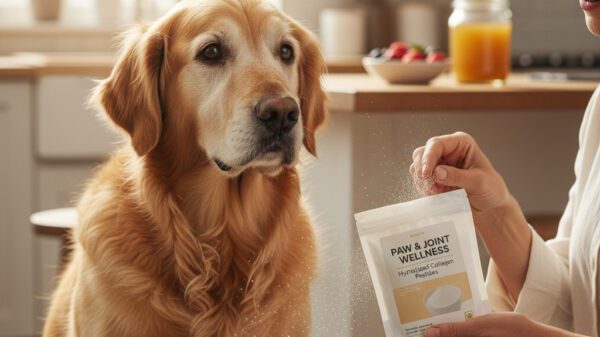
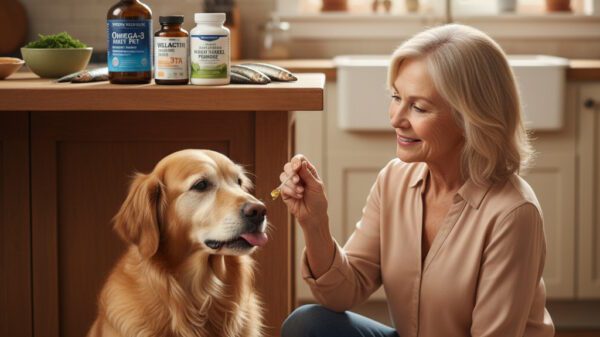
While weight loss is king, supplements are the knights that protect the castle. Look for Omega-3 fatty acids (fish oil). High doses of high-quality Omega-3s act as potent natural anti-inflammatories, combating the cytokines released by fat tissue. Glucosamine and Chondroitin are standard, but the anti-inflammatory properties of Omega-3s often yield more visible results for pain relief.
Clinical Reminder
Before making major changes to your senior dog’s diet or exercise routine, especially if they have heart, kidney, liver, endocrine, or joint disease, check in with your veterinarian. A safe weight-loss plan for older dogs usually involves slower calorie reductions, monitoring muscle mass, and periodic weigh-ins to ensure you’re trimming fat — not just shrinking a frail dog.
🐾 Pound Rule & Joint Stress FAQ
Is the “1 pound equals 4 pounds of force” rule exact science?
How fast should an overweight senior dog lose weight?
Will my dog’s joints feel better as soon as they lose a few pounds?
Is cutting food the only way to reduce joint stress?
Should I change my senior dog’s food before talking to a vet?
The Payoff: Reclaiming the Years
I want to share why this matters so much.
I have seen dogs who were scheduled for orthopedic surgery—dogs who could barely walk—simply melt the weight off. And a miracle happens. The surgery has been cancelled. The dog who hasn’t played with a toy in two years suddenly brings you a ball.
We often think of aging as a steep cliff our dogs fall off of. But so much of what we accept as “old age” is actually just “overweight.” When you apply the 1-Pound Rule in reverse, you realize that losing five pounds lifts 20 pounds of pressure off that painful knee. That is instant relief. That is freedom.
It is never too late to start. You cannot turn back the clock on your dog’s age, but by managing their weight, you can absolutely turn back the clock on their mobility. The next time those pleading eyes beg for a piece of cheese, remember: the greatest treat you can give them is the ability to run effortlessly again.
Give them the gift of a lighter life. They are worth the effort.
More Help for Senior-Dog Joints & Weight
If this 1-Pound Rule guide hit home, these senior-dog joint and supplement guides can help you turn insight into a concrete plan:
- The Joint Solution: Glucosamine vs. Chondroitin vs. MSM
- The Golden Drop: Unlocking Joint Health with Omega-3s for Senior Dogs
- DIY Ramps for Small Senior Dogs (Safe Angles & Materials)
- Unlocking Mobility: The Surprising Benefits of Collagen for Senior Dogs
- The Best Essential Supplements for Senior Dog Joint Health (2025 Guide)