Quick answer (so you can exhale)
A brief pause, then they sit normally—especially on slick floors, at night, or after a long day.
The pause is getting longer, shows up in new rooms, or they “test” the surface before committing.
You’re seeing a new limp, a yelp, repeated failed attempts to sit/stand, or they’re suddenly refusing normal routines.
GoldenPawsCare note: This page is about patterns you can observe—not diagnosing what’s “wrong.”
It usually happens when you’re not looking for it.
Your dog walks over like they always have. They respond to you. Nothing seems off. Then, right before sitting, they stop. Just for a second. Maybe they shift their weight. Maybe they look down. Then they sit—slowly, carefully, or with a soft exhale.
You notice it because it wasn’t there before.
And once you notice it, you can’t unsee it.
So you wonder: Is this normal for older dogs? Or is this the start of something I should be worried about?
That small pause—quiet, brief, easy to dismiss—is one of the most common changes caregivers notice as dogs age. It rarely looks dramatic. It doesn’t announce itself. But it often carries more information than people realize.
Yes, it can be normal.
But understanding why it happens—and what it’s actually telling you—matters more than the answer itself.
Does Your Older Dog Pause Before Sitting Down? Start Here
Why caregivers notice this before anyone else
Most age-related changes don’t show up all at once. They show up as moments that feel slightly different from how they used to.
A pause before sitting is one of those moments.
Caregivers see their dogs across real life: mornings and evenings, carpet and tile, good days and tired ones. Professionals usually see dogs briefly, in unfamiliar spaces, on unfamiliar floors. That difference matters.
You’re not noticing this because you’re anxious.
You’re noticing it because you’re present.
And because dogs sit down dozens of times a day, even a tiny change stands out quickly.
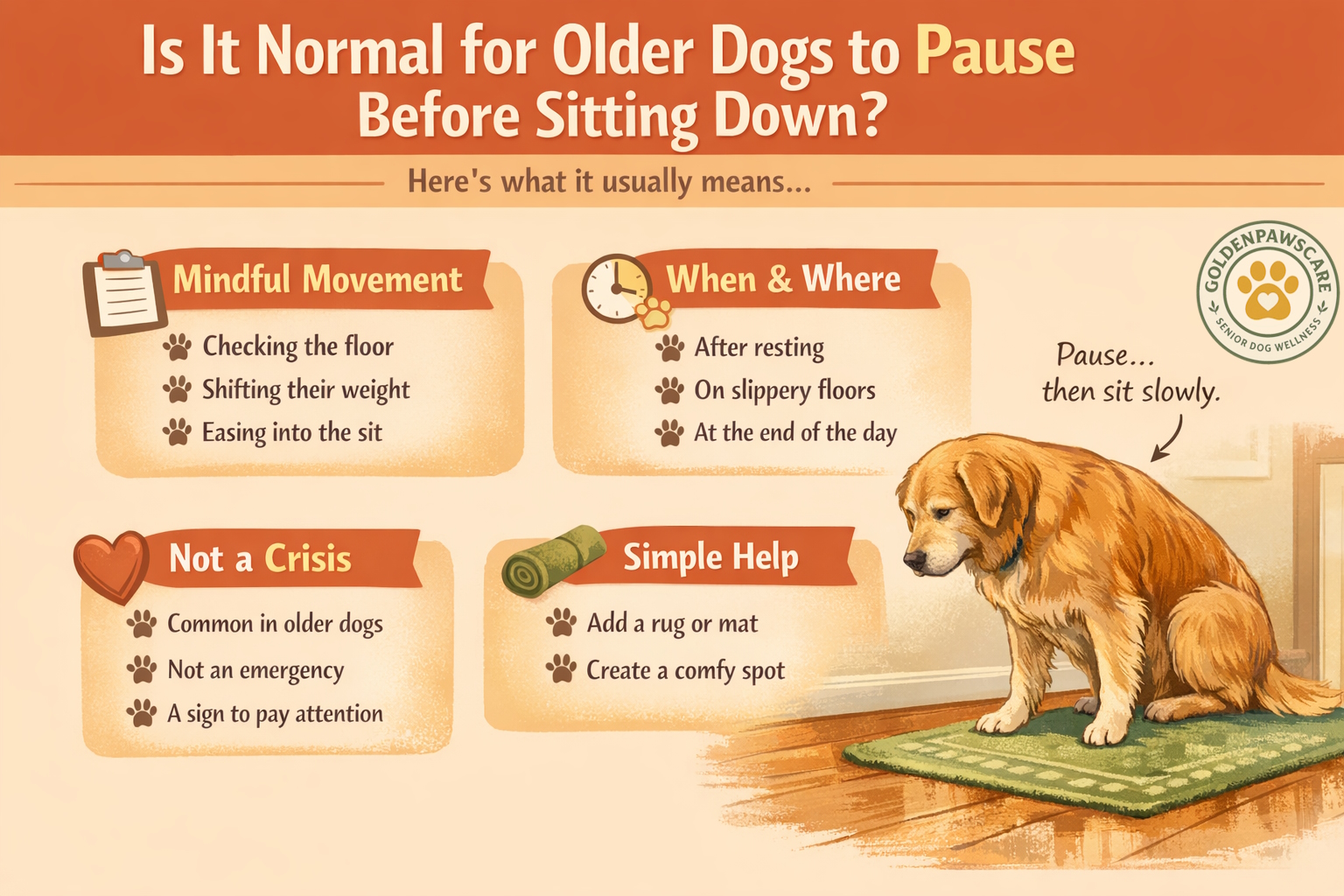
What that pause usually points to
When an older dog pauses before sitting down, it’s rarely about refusal or confusion.
It’s about calculation.
Your dog is quietly checking a few things:
- How stable does this surface feel?
- How controlled will the descent be?
- How much weight will land at once?
- Will I need to stand back up soon?
That calculation used to happen automatically. Now it’s conscious.
The pause isn’t a breakdown. It’s a shift—from instinctive movement to intentional movement. Many dogs make that shift gradually as they age, especially during transitions such as sitting, lying down, or standing up.
What it does not automatically mean
This is where worried late-night searches tend to spiral.
A pause before sitting does not automatically mean:
- Your dog is in constant distress
- Something urgent is happening
- You’ve missed a major warning sign
- Your dog is “going downhill”
Many dogs pause before sitting for months or years without the behavior becoming dramatic or limiting.
The pause itself is neutral. What matters is the pattern around it.
Why the pause shows up in some moments and not others
One of the most revealing things about this behavior is that it’s rarely constant.
Most caregivers notice that the pause:
- Shows up more at night than during the day
- Is more noticeable after long periods of rest
- Happens on tile or hardwood more than carpet
- Appears in unfamiliar rooms but not favorite spots
That inconsistency isn’t random.
Older dogs rely more heavily on predictability—especially during transitions. When the floor feels slick, when the lighting is low, or when their body feels stiff from rest, they slow down and think before committing to the movement.
This is why two things matter more than the pause itself:
- When it happens
- Where it happens
A dog who pauses only on slick flooring is giving you environmental feedback.
A dog who pauses only at the end of the day is responding to fatigue and stiffness.
In both cases, the dog is adapting—not failing.
The 2-minute fix (try this before you overthink it)
-
Cover the “decision spot” Put a non-slip runner, yoga mat, or bath mat exactly where they hesitate (tile-to-rug edges are common).
-
Brighten one corner Add a small nightlight near their favorite sitting zone so shadows don’t turn the floor into a guessing game.
-
Change the “landing” Offer a slightly higher, firmer bed (or folded blanket) so sitting isn’t a deep drop.
-
Give a wider approach Move a chair/table a few inches so they can turn and sit without tight pivots.
If you notice it most on certain surfaces, here’s a simple way to help right now
If your dog pauses before sitting mainly on tile, hardwood, or other slick floors, the most immediate way to support them isn’t correction or training.
It’s traction.
Many caregivers find that placing a runner, yoga mat, or non-slip rug in the spots where their dog typically sits changes the behavior almost immediately. Not because the dog suddenly feels different—but because the surface stops feeling unpredictable.
You’re not trying to eliminate the pause.
You’re removing the reason for it.
This kind of adjustment doesn’t commit you to anything long-term. It simply reduces the number of calculations your dog has to make before lowering themselves down.
If the pause softens or disappears on those surfaces, that’s useful information. Not a diagnosis—just feedback from your dog.
The difference between pausing and avoiding
There’s an important distinction that often gets overlooked.
A pause looks like:
- Stopping briefly
- Shifting weight
- Then sitting anyway
Avoidance looks like:
- Choosing to lie down instead
- Walking away
- Circling without committing
- Sitting only after repeated cues
Most older dogs start with pauses. Avoidance tends to develop later—often when the environment or routine hasn’t adjusted to match the dog’s new preferences.
Seeing a pause early gives you room to respond before avoidance becomes a habit.
Common ways this behavior gets misread
Because the change is subtle, it’s easy to interpret it emotionally.
Caregivers often think:
- “They’re being stubborn.”
- “They’re ignoring me.”
- “They’re just slowing down.”
- “I’m probably overthinking this.”
What’s actually happening is more straightforward.
Your dog isn’t testing limits.
They’re checking comfort.
They’re not being dramatic.
They’re being careful.
And noticing that difference isn’t overthinking—it’s awareness.
Why older dogs often sit differently than they used to
Many caregivers don’t just notice a pause—they notice how the sit itself has changed.
Instead of a smooth drop, you might see:
- A slower descent
- A wider stance before sitting
- A brief hesitation halfway
- Careful placement of the back legs
This doesn’t mean your dog has forgotten how to sit.
It means they’ve learned that control matters more than speed.
Once you notice this, you may see similar changes elsewhere—before lying down, stepping into the car, or climbing onto furniture. Sitting is just where the shift often becomes visible first.
What usually changes next if nothing is adjusted
If routines and environments stay exactly the same, the pause may gradually become more pronounced.
Not suddenly. Not dramatically. But subtly.
You might notice:
- Longer hesitation
- More frequent weight-shifting
- Preference for specific spots
- Sitting less often overall
These changes aren’t warnings—they’re communication. Older dogs express comfort preferences through behavior long before anything looks obviously wrong.
What to quietly monitor without turning it into a project
You don’t need to track every movement. Just stay observant.
Things worth noticing:
- Is the pause becoming longer over time?
- Is it happening in more places than before?
- Does your dog hesitate more when standing back up?
- Is the pause accompanied by tension or by repeated repositioning?
Single moments matter less than trends.
Which patterns matter more than one-off moments
If you’re deciding whether to bring up this behavior later, focus on consistency.
Patterns that carry more weight:
- The pause happens nearly every time
- It appears across multiple environments
- It’s paired with reluctance to stand back up
- It’s slowly becoming more deliberate
Patterns that usually don’t mean much on their own:
- A single bad day
- Hesitation on slick flooring only
- Pausing after an unusually long walk
- Changes during routine disruptions
Context turns observation into understanding.
When it’s reasonable to bring observations to a vet
There’s a difference between urgency and usefulness.
What to write down (so you don’t show up at the vet saying “it’s just… weird”)
It’s reasonable to mention this during a routine vet visit if:
- The pause has become a consistent pattern
- You can describe when and where it happens
- You’ve noticed changes in how your dog chooses to sit
You don’t need labels or conclusions. A simple description is enough:
“I’ve noticed they pause before sitting, especially on hard floors, and it’s been happening more often.”
That’s information—not alarm.
Quick questions people ask (and what usually matters)
Is my dog “in pain” if they pause before sitting?
Not automatically. A pause can be traction, lighting, or a “careful landing.” What matters is whether the pause is new, getting longer, or paired with a limp/yelp or repeated failed attempts.
Why does it happen on tile but not carpet?
Tile asks for more confidence. If traction feels unpredictable, older dogs will slow down and “calculate” the landing before they commit.
What’s the fastest thing I can do today?
Cover the exact hesitation spot with a non-slip mat/runner and add a small nightlight nearby. If the pause improves fast, that’s your clue.
When should I bring it up at a routine vet visit?
If it’s happening more often, in more locations, or the sit itself looks different (stiffer, angled, careful back-leg placement). Bring a short note: where/when/floor/what changes it.
Coming back to the original question
So, is it normal for older dogs to pause before sitting down?
Yes. Very.
It’s one of the most common, least dramatic, and most easily misunderstood changes caregivers notice in dogs as they age. On its own, it doesn’t mean something is wrong. It means your dog has shifted toward more deliberate movement.
The pause isn’t something to fear.
It’s something to understand.
And the fact that you noticed it early isn’t anxious—it’s responsible.