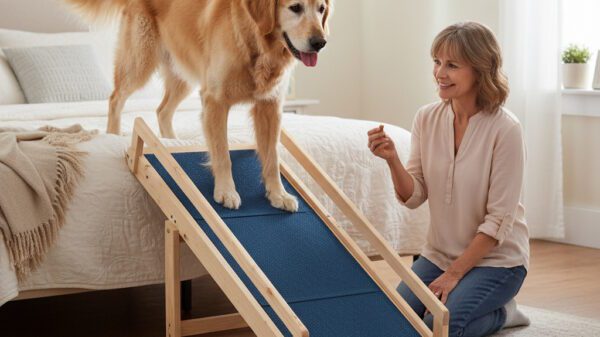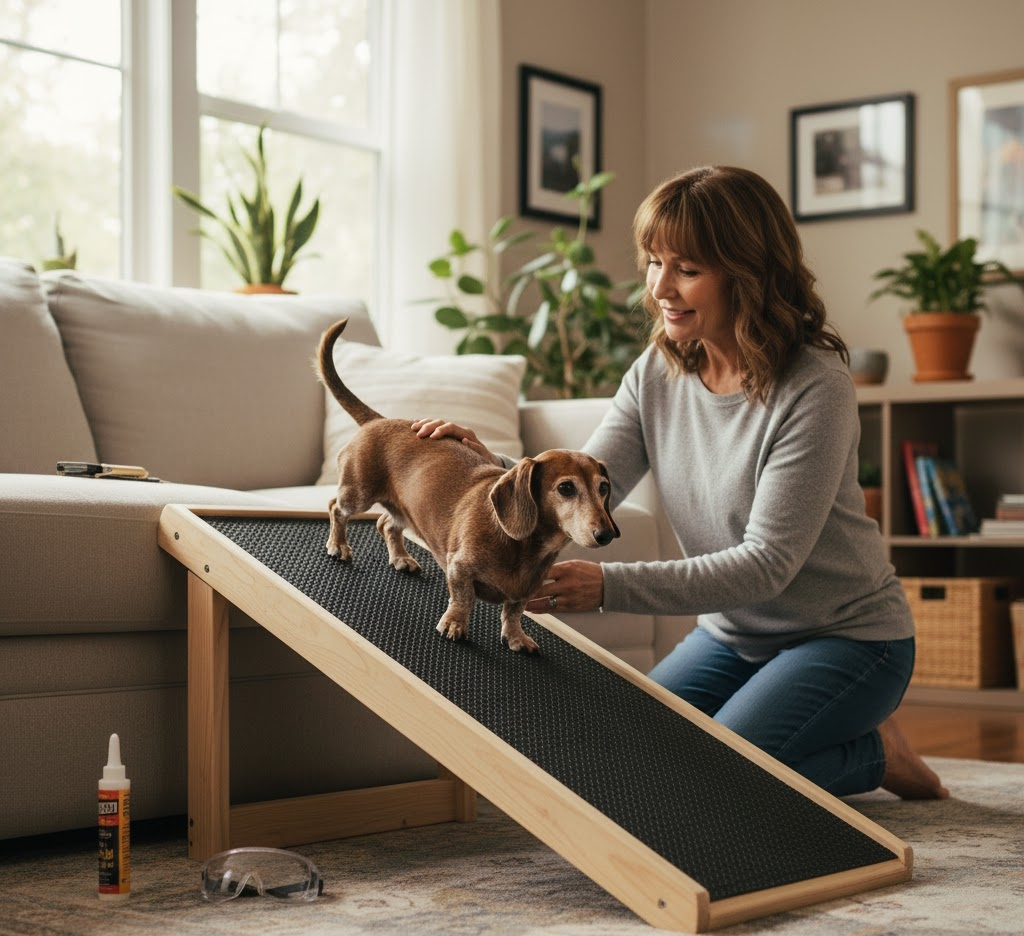
DIY Ramps for Small Senior Dogs
It’s a moment that can stop your heart.
You’re sitting on the sofa, reading a book, and you hear the familiar click-clack of your senior dog’s nails on the hardwood floor. Then, a pause. A little whine. You look over, and your old friend is standing there, looking up at the cushion, then looking at you. You see the hesitation, the calculation. They want to be with you, but they know the jump is going to hurt.
Sometimes they try anyway, landing with a heavy thud that makes you wince, or worse, scrambling and yelping as their back legs give out.
I’ve been there. And that feeling—that mix of sadness and helplessness for our aging companions—is what drives so many of us to find a better way. For small dogs, especially seniors, the world is built on a scale that’s unkind to their joints and spines. That sofa is a mountain. The bed is a sheer cliff.
While the market is flooded with pre-made pet ramps, I’ve found that many of them are a bitter disappointment. They’re often designed for agile, young animals or for convenient storage, not for the specific, delicate needs of a senior dog. They are frequently too steep, too narrow, and dangerously slippery.
The solution? A DIY indoor ramp or platform.
GoldenPawsCare Tool
Not Sure If Your Ramp Is Too Steep?
Guessing ramp angles is one of the most common causes of slips and joint strain in senior dogs. Our Dog Ramp Calculator shows you the **safe ramp length** based on height and mobility.
Building your own isn’t just about saving money. It’s about custom-building a piece of safety equipment, perfectly tailored to your dog’s needs, your furniture’s height, and your home’s layout. This guide is the distillation of years of trial, error, and research. We’re not just building a ramp; we’re building a bridge to a safer, more comfortable life for a family member.
Free DIY Ramp Blueprint (PDF)
Download our step-by-step DIY small-dog ramp guide, including safe incline charts, dimensions, materials, and sanding/traction tips.
In This Guide
🐾 DIY Senior Dog Ramp — Key Takeaways
- Gentle angle beats “space-saving” every time. Small seniors generally do best with an incline around 18–22°.
- Traction is non-negotiable. Carpet, EVA foam, or anti-slip tape help prevent slips and panic.
- Ramp width should match your dog’s stride. Most small seniors feel secure with 10–14 inches of walking space.
- Support the underside. A flexing or bouncing ramp can scare dogs and increase fall risk.
- Go slow with training. Let your dog sniff, explore, and earn treats for one step at a time.
Why a Ramp is Non-Negotiable for Small Seniors
Before we get to the sawdust and carpet, let’s understand why this is so critical. It’s not just about “convenience.” For many small senior dogs, it’s about preventing catastrophic injury.
- Arthritis and Joint Pain: The jarring impact of landing, even on a soft carpet, sends a shockwave through inflamed, arthritic joints. A ramp eliminates this impact.
- Intervertebral Disc Disease (IVDD): For breeds like Dachshunds, Corgis, and Shih Tzus, this is a constant threat. Their long backs and short legs make them highly susceptible to spinal injuries. A single awkward jump off a bed can lead to a ruptured disc, paralysis, and emergency surgery.
- Fading Senses: Senior dogs often have declining vision and proprioception (their sense of where their body is in space). They may misjudge a jump they’ve made a thousand times. A ramp is a predictable, stable pathway.
- Dignity and Happiness: These are the parts we often forget. Being “grounded” isolates your dog. They can no longer join you on the sofa or sleep at the foot of the bed. A ramp gives them back their independence and their favorite “spot.” It keeps them part of the pack.
The Single Most Important Detail: The Truth About Angles
If you take only one thing away from this article, let it be this: Most dog ramps are too steep.
Think about it from your dog’s perspective. Walking up a 25- or 30-degree slope isn’t a “walk.” It’s a climb. It puts immense strain on their hind legs and spine, which is what we’re trying to avoid. They will often refuse to use a ramp that feels unsafe or strenuous.
Veterinary Note: Senior dogs with arthritis, muscle loss, or neurological weakness struggle most with steep inclines. Physical rehab specialists typically recommend ramps with a 18–22° incline for small seniors to prevent slipping and joint strain.
The single biggest mistake people make—both manufacturers and well-intentioned DIYers—is prioritizing a small footprint over a safe angle of inclination.
Here is the math that matters.
- The Absolute Maximum: For a healthy, young, and agile dog, I would never recommend anything steeper than 25 degrees.
- The “Golden Zone” for Seniors: For any senior dog, a dog with arthritis, or any breed prone to IVDD, you must aim for an angle between 18 and 20 degrees.
What does that look like in the real world? It’s all about “rise over run.”
- The 18-Degree Rule (Safest): For every 1 inch of height (rise), you need 3.2 inches of length (run).
- The 20-Degree Rule (Good): For every 1 inch of height (rise), you need 2.8 inches of length (run).
Let’s make this practical. Your sofa is 18 inches high.
- A ramp at a 25-degree angle (too steep!) would be about 38 inches long (just over 3 feet).
- A ramp at a safe 18-degree angle needs to be 57.5 inches long (18 x 3.2).
Yes, that is almost 5 feet long. This is the moment of truth for most builders. Yes, it takes up space. But a ramp that is 3 feet long is a ramp your dog won’t use, or worse, one that could still hurt them. You are building for safety, not storage.
Source: Canine Rehabilitation Guidelines for Mobility Aids, 2024 – Recommended incline for senior dogs: 18–22° depending on weight-bearing tolerance.
A Note on Platforms
Don’t forget the humble platform! Sometimes a ramp isn’t the right solution. For a low windowsill or an ottoman, a simple, sturdy “half-step” platform might be all your dog needs.
A DIY platform is just a sturdy, carpeted box. It’s a fantastic starter project. Building a 10-inch-high, 2-foot-square platform can give your dog the “boost” they need to get on the sofa, breaking one big jump into two manageable steps.
Materials Matter: The Foundation of Trust
A ramp must be 100% stable and 100% slip-proof. Your dog must be able to trust it. If it wobbles, shifts, or lets their feet slide, they will never use it.
Part 1: The Frame (Stability)
The goal is zero wobble. A ramp for a 12-pound dog doesn’t need to hold a human, but it must feel like a solid, unmoving part of the floor.
- Best Material: 3/4-inch plywood. It’s the gold standard. It’s heavy, strong, and won’t warp or flex. You can use it for the ramp surface (the “deck”) and the side rails.
- Good Alternative: 1×4 or 1×6 solid wood for the side rails, with a 1/2-inch or 3/4-inch plywood deck on top.
- Avoid: Thin particleboard and MDF (it’s heavy but brittle); never use cardboard or plastic storage bins. They are not structurally sound.
DIY Ramp Materials & Cost Guide
| Material | Purpose | Approx. Cost |
|---|---|---|
| 1×8 or 1×10 Pine Board | Ramp platform | $6–$14 |
| Non-Slip Carpet Strip | Traction surface | $5–$15 |
| EVA Foam or Anti-Slip Tape | Optional extra grip | $8–$20 |
| Wood Screws | Securing support blocks | $3–$6 |
| Support Blocks (2×4) | Reinforce underside | $2–$5 |
Part 2: The Surface (Traction)
This is where most ramps fail. A dog’s paws and nails cannot grip smooth surfaces.
- The Enemy: Bare wood, smooth paint, varnish, and even many types of regular plush carpet.
- What About Cross-Slats? You will see many ramps with small wooden “slats” or “rungs” every few inches for grip. I strongly advise against these for small senior dogs. If your ramp is at a proper 18-20 degree angle, they are unnecessary. For a senior dog, these slats are uncomfortable, awkward to navigate around, and a major trip hazard.
- The Best Traction Surfaces:
- Rubber Sheeting/Matting: This is my personal favorite. A 1/8-inch sheet of textured rubber (available in rolls online or at hardware stores) provides outstanding, “grippy” traction. It’s also waterproof and incredibly easy to clean.
- High-Traction, Low-Pile Carpet: Look for “outdoor” or “industrial” carpet. You want a low, dense pile that their nails can’t snag on. (Avoid “berber” carpet, as the loops are a notorious nail-snagger).
- Paint with Non-Slip Additive: If you want a more “finished” look, use a high-quality porch paint and add a non-slip sand or polymer additive. It creates a fine-grit, sandpaper-like texture that offers excellent grip.
- Heavy-Duty Yoga Mats: A good, inexpensive option. You can glue a yoga mat (or two) to the ramp deck. The downside is that they can wear over time with nail traffic.
Source: American Kennel Club (AKC). “Dog Ramp & Stair Safety for Senior Pets,” 2023 – Emphasizes traction as the #1 factor preventing falls.
A Simple, Safe DIY Ramp & Platform Concept
I won’t provide a complex blueprint because every ramp will be a different size. Instead, here is the method to build a rock-solid, safe ramp.
1. The “Platform First” Method
The easiest and most stable ramp design has a dedicated landing platform at the top. This gives your dog a flat, level surface to get their bearings before stepping onto the furniture (or back onto the ramp).
- Step 1: Build the Platform. Build a sturdy, 3/4-inch plywood box. The size is up to you, but it should be at least as wide as the ramp (12-16 inches) and deep enough for your dog to stand on (12-16 inches). The height should be exactly the height of your sofa or bed.
- Step 2: Calculate Your Ramp. Measure the platform height. Let’s say it’s 20 inches. Multiply by 3.2 for the 18-degree rule. You need a ramp deck that is 64 inches long.
- Step 3: Build the Ramp. The simplest way is a “box beam.”
- Cut your 3/4-inch plywood deck: 64 inches long by (for example) 14 inches wide.
- Cut two side rails from 1×4 lumber, also 64 inches long.
- Secure the side rails to the edges of the plywood deck with wood glue and screws. This creates a U-shape that is incredibly strong and prevents any flexing. The 3.5-inch-high rails also serve as a safety “curb” to keep your dog from stepping off the side.
- Step 4: Attach the Surface. Glue and staple (or use short screws) your chosen traction material (rubber, carpet) to the plywood deck. Make sure it’s tight and wrinkle-free.
- Step 5: Assemble. Push the platform firmly against the furniture. Let the top of the ramp rest securely on the edge of the platform. You can add a small “lip” or bracket to lock it in place.
- Step 6: Finish. Sand all edges to prevent splinters. Add non-slip rubber feet to the bottom of the ramp and the platform.
DIY Ramp vs Ready-Made Ramp — Which Is Safer?
| Option | Pros | Cons |
|---|---|---|
| DIY Ramp | Custom size; inexpensive; easy fixes | Can be unsafe if incline/traction is incorrect |
| Ready-Made Ramp | Measured incline, weight-rated, built-in traction | Higher cost; limited sizes; may not fit furniture height |
Vet-Recommended Ready-Made Ramps for Small Seniors
| Product | Best For | Buy |
|---|---|---|
| PetSafe CozyUp Folding Ramp | Small seniors who need a low, gentle incline | Check Price |
| Gen7Pets Feather-Lite Ramp | Arthritic dogs who need higher-traction surfaces | Check Price |
Some links may be affiliate links. We may earn a small commission at no extra cost to you.
The Final Step: Training and Patience
You will build this beautiful, perfect ramp, and your dog will… walk right past it, confused, looking at you. This is normal.
Seniors are creatures of habit. You must teach them this new, safe way.
- Patience is Key: This may take days, not hours.
- Lure, Don’t Force: Use high-value treats (chicken, cheese, not their boring kibble). Never push or pull your dog onto the ramp. This will create a fear association, and it’s game over.
- Start Flat: If possible, lay the ramp on the floor (not inclined) and use treats to lure your dog onto it. Make it a fun game.
- Go Low: Prop the ramp up on a single book. Repeat the treat-luring process.
- Go to Full Height: Move the ramp to its final position. Place a trail of treats up the ramp. Give them massive praise for just putting one paw on it. Be patient.
- Block the Old Way: Once they are using it (even hesitantly), you must block their old “jumping” route. Use pillows, a box, or a pet gate to make the ramp the only option.
Senior-Dog Mobility & Comfort — Related Guides
Joint Pain & Arthritis
Comfort at Home
Explore the full series to build a safer, more comfortable world for your senior dog.
Small Dog Ramp — FAQ
What incline is safest for small senior dogs?
Most rehab specialists recommend an incline between 18–22°. Anything steeper increases slipping risk.
Should I choose carpet or anti-slip tape?
Carpet gives soft traction; anti-slip tape provides maximum grip. Many owners use both for stability.
Are ramps safer than stairs for seniors?
Yes. Stairs require more joint flexion; ramps allow steady forward movement and reduce strain.
How do I know if the ramp is too steep?
If your dog hesitates, digs claws in, or slides downward, the incline is too steep.
What’s the ideal ramp width for small seniors?
10–14 inches wide is generally ideal. It allows confident walking without wobbling.
“For small senior dogs, a ramp isn’t just about convenience—it’s a joint-saving tool. The safest designs are longer, lower, and covered in reliable traction, not steep boards that look tidy in the living room.”
— Dr. Sarah Kent, DVM · Senior Dog Mobility & Rehab
The first time you see your senior dog, who you thought was “grounded for life,” walk confidently up that ramp and curl up in their favorite spot on their own… that feeling is worth every hour of work. It’s more than a DIY project; it’s an act of love, and one of the best gifts you can give your aging friend.