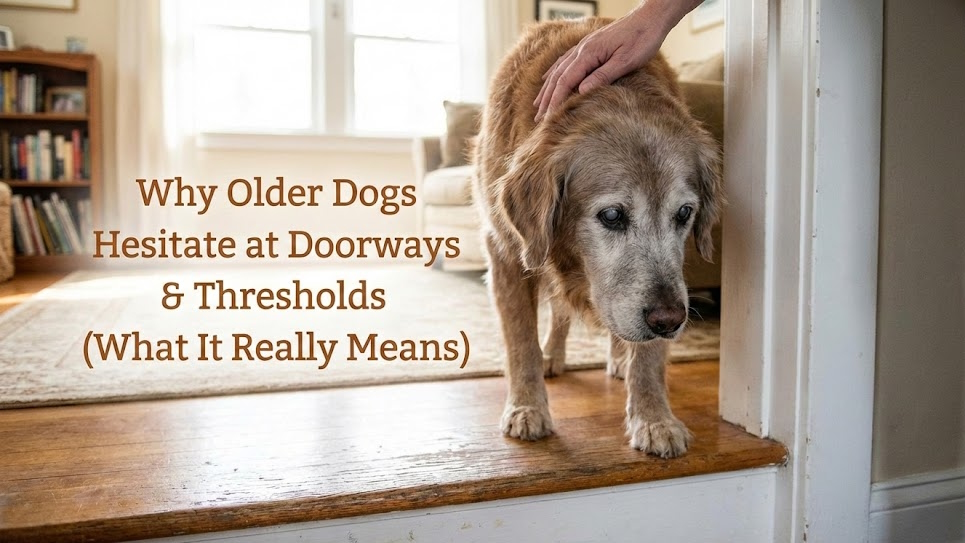
It’s usually late. The house is quiet. Your dog gets up to follow you into the next room—and then stops. One paw forward. Head lowered. A pause that feels longer than it should. You look back, expecting distraction. Instead, your older dog is standing at the doorway, staring at the floor like it’s changed.
Quick answer: why older dogs hesitate at doorways and thresholds
Most of the time, this pause isn’t “stubbornness.” It’s your dog double-checking a transition that now feels less certain—because of footing confidence, lighting/shadows, or a remembered slip. Doorways are where those small changes show up first.
The key isn’t the pause itself—it’s the pattern: where it happens, when it happens, and what makes it better or worse.
This moment is why people search for why older dogs hesitate at doorways and thresholds. Not because the behavior is dramatic, but because it’s new, subtle, and unsettling. You know your dog. This wasn’t happening a year ago.
What makes this behavior confusing is that it doesn’t announce itself as pain, fear, or stubbornness. It looks like thinking. Or uncertainty. Or a dog trying to decide whether a familiar space is still safe.
This article is written for that exact moment—when something small feels important, but not obvious.
3 ways to help your dog cross the doorway right now
If your older dog is hesitating at thresholds, start with the environment. These quick changes often reduce doorway freezing within a day or two because the “risky step” stops feeling unpredictable.
1) Bridge the surface change
Put a non-slip runner or a cut-to-size yoga mat so the texture doesn’t change right at the threshold.
2) Light the doorway
Add a nightlight or motion-sensor light to erase shadow lines that can look like holes at night.
3) Add traction confidence
If the floor is slick, try toe grips or non-slip socks so the first step doesn’t slide.
One rule that helps: don’t pull them through the freeze. Pause, then invite the next step with a calm cue and a treat held low and forward.
If Your Dog Freezes at Thresholds, Start Here
Why do owners notice doorway hesitation before anyone else?
Because doorway hesitation doesn’t show up on a leash or in a clinic room.
At home, you see patterns. You see repetition. You see the pause that happens only at certain thresholds, not everywhere. Professionals see snapshots. Caretakers see sequences.
Doorways are uniquely revealing because they combine several things older dogs quietly struggle with:
- A change in surface
- A change in lighting
- A change in depth perception
- A moment that requires confidence and commitment
To an observer who lives with the dog, hesitation here feels different from “slowing down.” It’s not about energy. It’s about uncertainty.
And uncertainty is something dogs communicate subtly.
What does doorway hesitation in senior dogs usually look like?
Owners often describe the same pattern using different words:
- “He stops like the floor might drop.”
- “She lifts one paw and freezes.”
- “He stretches his neck forward but won’t step.”
- “She circles, then backs up, then tries again.”
This isn’t refusal. It’s assessment.
The dog isn’t saying no. The dog is saying, I’m not sure what’s going to happen if I move.
That distinction matters.
Why do thresholds trigger this behavior specifically?
Doorways and thresholds are deceptively complex spaces for aging dogs.
They’re rarely flat in the way open rooms are. There may be:
- A slight lip or height change
- A different flooring texture
- A shadow line that wasn’t noticeable before
- A narrow space that requires precise foot placement
For a younger dog, these details are irrelevant. For an older dog, they become decision points.
Thresholds force a dog to commit weight forward while crossing something visually ambiguous. That’s harder when confidence in footing—or interpretation of space—starts to fade.
The doorway from your dog’s point of view
What looks like a normal doorway to you can feel very different to an older dog. Here’s how that transition may be registering.
- Room A: familiar carpet where footing feels safe and predictable.
- The danger zone: a metal strip or raised threshold that’s cold, slick, or visually dark.
- Room B: shiny tile or wood that looks slippery or uncertain.
When a dog pauses here, they’re not refusing — they’re deciding whether the next step is worth the risk.
How to use this map (three fixes that make doorways easier)
The doorway doesn’t need a big “training plan.” Most of the time, your dog just needs the transition to stop feeling slippery, shadowy, or uncertain. Start with the doorway they avoid most.
Step 1: Create a bridge (mats & runners)
Cover the “scary spot” directly — not the whole room. Place a non-slip runner or a cut-to-size yoga mat so it crosses the threshold by at least a foot on both sides. The goal is to hide the transition strip and remove the moment where your dog has to decide between two textures. If you want a deeper breakdown of what works on tile and wood, see our guide to flooring and runner setups that improve footing.
Step 2: Fix the lighting ( nightlights & shadow lines )
Put the light where the hesitation happens — not where you stand. A small nightlight or motion-sensor light aimed toward the floor near the doorway helps because it breaks up the dark “shadow band” that can look like a gap. If your dog hesitates more at night, start here first. A simple test: turn on the hallway light and watch whether the pause shortens.
Step 3: Add traction (toe grips, socks, and “no-slip feet”)
If your dog has ever slid at that threshold, confidence drops fast. Traction support can change everything because the first step stops feeling like a gamble. This is especially useful on smooth tile, glossy wood, or transitions that feel cold and slick.
If you’re deciding between options, we break it down in our guide to non-slip dog socks and paw grips for senior dogs (what works, what slides, and what tends to stay put).
Small handling tip: when your dog freezes, don’t pull. Pause, then invite the next step with a calm cue and a treat held low and forward. You’re helping them re-check the step — not forcing them through it.
Common home setups that trick older dogs at thresholds
These are the small, ordinary things that can make a familiar doorway suddenly look—or feel—less trustworthy.
If your dog only hesitates at one threshold, it’s often because that doorway has one of these quirks.
Is this a mobility issue or a fear response?
This is where many owners get stuck, because the behavior sits between categories.
Doorway hesitation in older dogs is often framed as either “joint trouble” or “anxiety.” In reality, it’s frequently neither in isolation.
What’s more accurate is this:
The dog no longer fully trusts the transition.
That loss of trust can come from physical discomfort, sensory confusion, or the memory of a single awkward moment.
If your dog once slipped, stumbled, or misjudged a threshold, the body remembers even a minor injury. Older dogs are more cautious because they have more experience being wrong.
That caution looks like fear, but it’s actually risk management.
One of the most common versions of this happens in the kitchen. The dog walks fine on carpet, follows you down the hall, then stops dead at the tile—right where a thin strip separates the rooms. In daylight, the pause is shorter. At night, when the hallway light throws a shadow across that strip, the dog stands there longer, lifts one paw, and waits like the floor is about to move. Nothing “big” changed in the house—except your dog now needs the transition to feel obvious before stepping through.
What this behavior usually points to in everyday terms
Without diagnosing anything, owners who observe this over time often notice a few common threads.
1. Confidence in footing has changed
Not collapsed. Changed.
Your dog may still walk, climb stairs, or move normally most of the time. But thresholds demand accuracy. If balance feels even slightly less reliable than it used to, hesitation appears there first.
2. Visual interpretation is less automatic
Doorways create sharp contrasts: light to dark, carpet to tile, room to hallway. Aging eyes don’t always interpret these transitions cleanly. What you see as a shadow, your dog may see as depth.
The hesitation is your dog asking, Is this solid?
3. Movement planning takes longer
Older dogs often need a moment to plan how their body will move. That pause isn’t confusion—it’s calculation. Thresholds interrupt momentum, so planning becomes visible.
What doorway hesitation does not automatically mean
This is where unnecessary panic often enters.
Doorway hesitation does not automatically mean:
- Sudden severe decline
- A painful emergency
- Cognitive loss
- That your dog is “giving up”
It also doesn’t mean your dog is being stubborn or dramatic.
Most dogs exhibiting this behavior remain engaged, responsive, and interested in their environment. They’re not withdrawing. They’re adapting.
What this pause does not automatically mean
A doorway pause can look scary because it’s new. But by itself, it doesn’t prove a worst-case story.
- It doesn’t automatically mean your dog is “being stubborn.”
- It doesn’t automatically mean your dog is in constant distress.
- It doesn’t automatically mean your dog is mentally “gone.”
- It doesn’t automatically mean a sudden, dramatic decline.
Most often, it means one simple thing: your dog is asking for a safer transition.
Why timing and environment matter more than the behavior itself
One of the most important questions isn’t that your dog hesitates—but when.
Consider these differences:
- Only at night vs. all day
- Only on hard floors vs. carpet
- Only when tired vs. after rest
- Only in certain doorways vs. every threshold
A dog who hesitates only in dim light may be reacting to visual ambiguity. A dog who hesitates only on tile may be responding to traction concerns. A dog who hesitates more at the end of the day may be signaling fatigue rather than fear.
Patterns tell stories. Single moments rarely do.
A simple “pattern decoder” for doorway hesitation
Use this like a sorting tray. You’re not labeling your dog—you’re narrowing down what the pause is responding to.
This is why owners often figure it out before anyone else: you’re seeing repeatable conditions, not a single moment.
Why repetition changes the meaning of the pause
A one-off pause is just a pause.
Repetition turns it into communication.
When doorway hesitation becomes consistent, it usually means the dog has learned that this transition requires extra care. Dogs don’t repeat caution unless it has paid off before.
That doesn’t mean something is “wrong.” It means something has changed enough to be remembered.
Common owner misinterpretations that make this harder
Even attentive caretakers sometimes unintentionally increase the stress around this behavior.
Rushing the dog
Calling, tugging, or stepping behind them can add pressure at the exact moment they’re trying to think. That can turn hesitation into refusal.
Lifting without warning
Sudden lifting removes the dog’s ability to assess the space themselves. Some dogs tolerate this. Others lose confidence because the outcome becomes unpredictable.
Assuming defiance
Treating hesitation as disobedience subtly changes your tone. Dogs pick up on that immediately.
Most dogs aren’t resisting. They’re checking.
What tends to change next if nothing is adjusted
If the environment stays the same and the dog continues hesitating, one of two things usually happens:
- The hesitation becomes longer.
The pause stretches. The dog waits for cues. Sometimes they choose a different route entirely. - The dog starts avoiding that doorway.
Not because it’s forbidden—but because it’s uncertain.
Avoidance is not stubbornness. It’s efficiency. Dogs conserve energy and risk as they age.
What quiet observation actually helps here
You don’t need charts or timers. Just awareness.
Things worth casually noting:
- Which doorways trigger hesitation most
- Whether lighting changes affect confidence
- Whether the dog hesitates more when carrying weight forward (like after lying down)
- Whether the hesitation resolves once the dog starts moving again
These details create a picture—not a diagnosis, but a context.
A quiet checklist: what to notice (without spiraling)
You’re looking for repeatable clues, not perfection.
If you can describe the pattern in one sentence—“Only at night on the kitchen threshold”—you’re already doing the useful part.
When it’s reasonable to bring observations to a vet
Not urgently. Not dramatically. Just clearly.
If you mention it to a vet, this wording tends to help
You’re not trying to name the issue. You’re bringing a clean observation.
“Over the last ___ weeks, my dog has started hesitating at doorways—especially ___.
It happens most when ___ (night / tile / after getting up), and improves when ___ (brighter / grippier / slower pace).”
That gives someone else something real to work with: timing, environment, repetition, and change.
If you choose to mention this, the most helpful approach isn’t “something is wrong,” but:
- This behavior is new
- This is where it shows up
- This is how often it happens
- This is what makes it better or worse
Veterinary conversations are most productive when they start with lived patterns, not labels.
How to help your older dog cross doorways and thresholds
If your dog is hesitating at a doorway, the goal isn’t to “make them obey.” It’s to make the transition feel obvious, grippy, and safe again. Small changes at the exact spot they freeze can fix the problem faster than any big lifestyle overhaul.
1) Bridge the gap (make the doorway one consistent surface)
Many dogs freeze because the doorway is where the texture changes—carpet to tile, rug to wood, dry to slick. Try laying a non-slip runner that crosses the threshold so the “decision point” disappears.
Caretaker shortcut: a yoga mat cut to length or a rubber-backed runner often solves the “tile doorway freeze” immediately.
2) Light the way (remove shadow lines that look like “holes”)
Doorways collect shadows. At night, that dark band can look like a drop-off. Add a nightlight near the hallway or doorway—or a cheap motion-sensor light so the path “turns on” as your dog approaches.
If hesitation is worse at night, this is one of the highest-payoff fixes.
3) Improve traction (confidence returns when feet stop sliding)
If your dog has ever slipped at that threshold, they may be “remembering” it. Traction fixes can be simple: toe grips, a grippy runner, or even keeping nails tidy so feet don’t skate.
The goal: your dog takes one step and feels, “Oh. I’ve got this.”
4) Use the “3-second rule” (don’t pull—reset the freeze)
When your dog freezes, pressure can turn caution into refusal. Instead, pause for three seconds. Then invite movement with a calm cue and a small lure (a treat held low and forward), like you’re helping them “find the next step.”
You’re not bribing. You’re guiding their eyes and feet through a moment of uncertainty.
A tiny “targeting” game that often helps within days
Pick one doorway your dog hesitates at. Stand on the “safe” side. Toss a treat one paw-length past the threshold. If they step and succeed, toss the next treat slightly farther. Keep it short—30 seconds, then stop. The point is to build a new memory: crossing equals success, not risk.
Why noticing this early is a good thing
Many dogs show doorway hesitation long before they struggle elsewhere. That makes it one of the earliest signals that a dog’s relationship with space is changing.
Noticing it doesn’t make you anxious. It makes you attentive.
Attentive caretakers don’t overreact—but they don’t ignore patterns either.
Doorway hesitation FAQ (real-life questions owners ask)
Why does my older dog hesitate at doorways but walk fine everywhere else?
Why is it worse at night or in darker hallways?
Is my dog scared, or just being careful?
Why does my dog lift one paw and freeze at the threshold?
What’s the difference between “one-off hesitation” and a real pattern?
What tends to happen next if nothing changes at home?
Closing: it’s a conversation—and you can answer it
If your older dog is hesitating at doorways and thresholds, they’re not being difficult. They’re telling you a familiar transition no longer feels automatic.
The good news is that this is one of the few senior-dog changes that often responds to small home tweaks: a grippy path across the doorway, better light at night, and a calmer “three-second pause” instead of pressure.
Noticing it early isn’t anxious—it’s responsible. It means you’re paying attention while the fix is still simple.