It’s late. The house is quiet.
Your dog hops down from the couch the way they always do. A familiar thud. A few steady steps.
Then — a hitch.
One uneven step. A limp. Gone.
They keep walking. They look fine. Maybe they even stretch and move on like nothing happened.
But you saw it.
Now you’re standing there thinking:
🔧 Here’s the confusing part: a senior dog can look completely normal while quietly avoiding one specific movement that suddenly feels risky. Stairs are one of the first places that risk shows up.
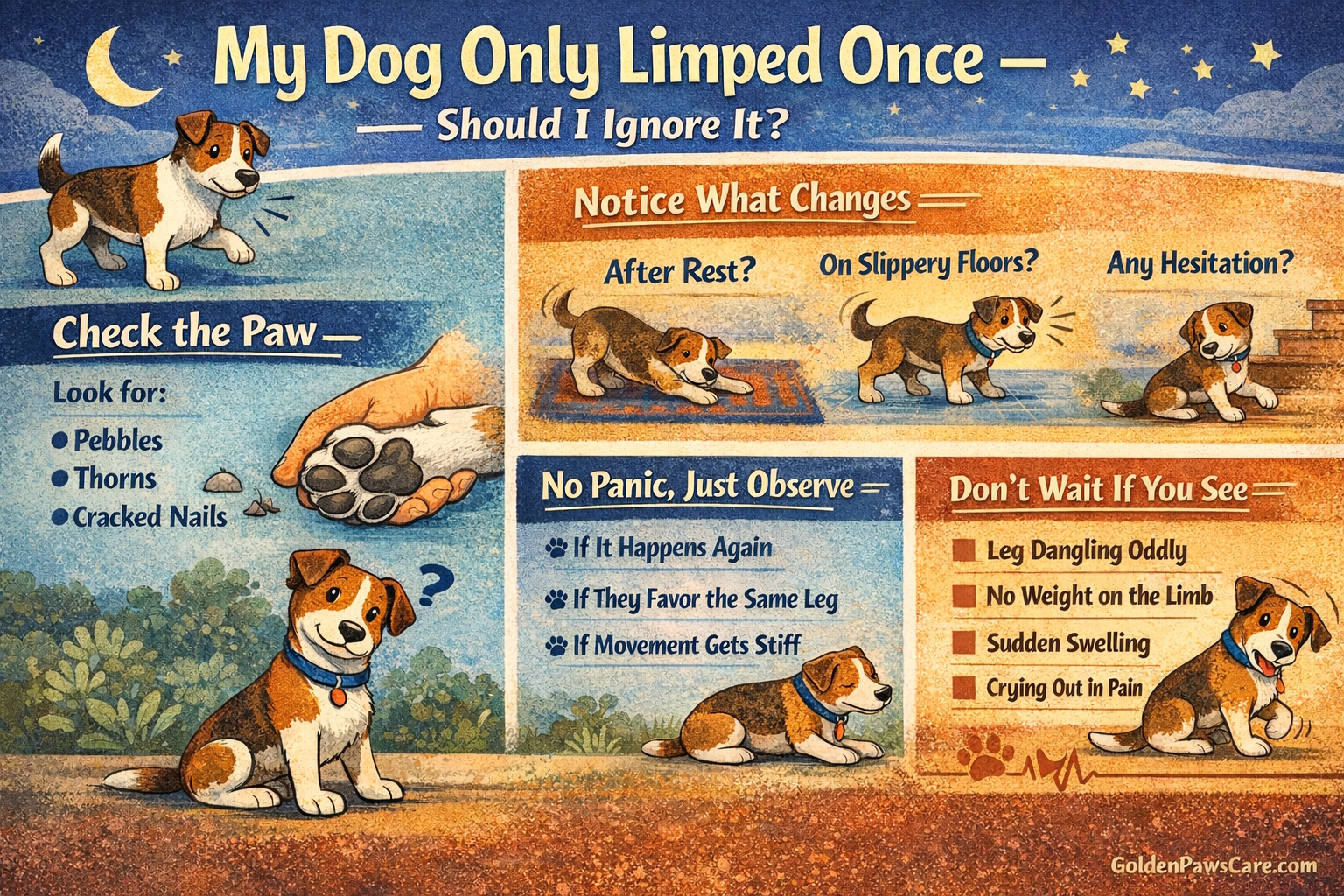
My dog only limped once — should I ignore it?
If you noticed it, it mattered.
Not because it means something dramatic — but because movement changes don’t appear out of nowhere. Even brief ones have a reason.
The goal isn’t to panic.
The goal isn’t to dismiss it either.
The goal is to understand what a single limp usually represents — and what turns it into something more.
Did Your Dog Limp Once? Start Here
Why You Noticed It Before Anyone Else Would
A vet might never see it.
A groomer wouldn’t catch it.
Even someone else in your home could miss it.
You noticed because you know your dog’s rhythm.
You know how they rise from a nap.
You know how they pivot at the hallway corner.
You know how they launch off furniture.
When that rhythm breaks — even for one step — it stands out.
That doesn’t make you anxious.
It makes you attentive.
And attentiveness is where responsible care begins.
What a One-Time Limp Usually Points To
When a dog limps once and immediately resumes normal movement, it’s most often a short-lived discomfort response.
Think of stepping off a curb at an odd angle. Your ankle feels wrong for two steps. Then it settles. You adjust and keep walking.
Dogs do the same thing.
Common real-life triggers for a single limp include:
- An awkward landing from a jump
- A brief muscle twinge
- A nail catching slightly on fabric
- A joint that felt stiff after resting
- A small object under the paw that shifted away
Dogs constantly redistribute weight through all four limbs. If something feels unstable for a moment, they automatically offload that limb. That reflex is protective, not dramatic.
If the limp lasted a step or two and then disappeared completely, that immediate correction is meaningful.
The body recalibrated.
Should You Check the Paw Right Away?
Yes. Calmly.
This is usually the first thing owners want to do — and it’s reasonable.
You’re not searching for something catastrophic. You’re looking for simple irritants:
- A pebble between the pads
- A burr or thorn
- A cracked nail
- A minor pad scrape
Gently handle the paw and watch your dog’s response.
If they allow touch without pulling away, freezing, or vocalizing, that’s reassuring.
If nothing stands out and your dog continues walking normally, you likely witnessed a passing mechanical adjustment.
If This Happened in a Senior Dog, Context Matters Earlier
For older dogs, a one-time limp often raises a different internal question:
“Is this the start of arthritis?”
Sometimes it is. Often, it isn’t.
In senior dogs, the first few steps after rest can look uneven because joints need a moment to reorient—something professionals describe as a proprioceptive adjustment, meaning the body re-establishes awareness of where each limb is in space after stillness.
That doesn’t automatically mean joint disease.
It means elasticity isn’t what it used to be.
The difference between normal age-related stiffness and progressive stiffness lies in frequency.
Once after a nap? Common.
Repeatedly in the same leg, several days a week? That’s a pattern worth noting.
What a Single Limp Does Not Automatically Mean
This is where late-night thinking can drift.
A single limp does not automatically signal:
- A torn ligament
- A fracture
- Sudden structural collapse
- Immediate decline
Significant structural problems rarely hide quietly.
They repeat.
They intensify.
They change posture.
If your dog walked normally afterward, sat comfortably, and resumed typical behavior, that stability tells you something important: the body compensated successfully.
That matters more than the single uneven step.
A Single Limp Is Information. A Repeated Limp Is a Pattern.
One uneven step is an event.
The same uneven step appearing again — especially in the same limb — becomes a pattern.
Patterns determine next steps.
If it never happens again, you likely observed a momentary adjustment.
If it reappears under similar circumstances, that’s useful data to carry forward.
You don’t need a formal log right now — just a mental note of the “where and when.”
Was it after rest?
After jumping?
During fast movement?
Those details matter more than the limp itself.
Many owners aren’t certain which leg they saw limp. That’s normal.
If it happens again, watch for:
- A head dip when a front paw touches down.
- A slight hip shift when a back leg bears weight.
- Favoring one side when sitting or standing.
You don’t have to diagnose it. Just notice whether the same side seems involved more than once.
How Timing and Surface Influence What You See
Movement isn’t the same everywhere.
Certain surfaces make small imbalances more visible. Smooth flooring offers less grip than carpet or grass, so even minor stiffness or hesitation can appear more pronounced for a step or two.
If the limp occurred during a quick turn, a jump, or the first few steps after lying still, context likely played a role.
If it happened during calm walking on stable ground and had no clear trigger, that’s a slightly different signal — not alarming, just worth remembering.
The key is consistency.
The body rarely sends the same message twice without reason.
What Owners Often Overlook After the Limp Disappears
Most people focus on the walk.
But subtle changes can show up elsewhere:
- How your dog lowers themselves to lie down
- Whether they shift weight while standing
- Whether they hesitate before stairs
- Whether they lean slightly to one side when sitting
Sometimes the limp vanishes, but quiet redistribution remains.
Those secondary cues tell a clearer story than the original moment.
What Tends to Change Next If It Wasn’t a Fluke
If the limp was the beginning of something developing, you’ll usually see gentle progression over days or weeks:
- Repeated stiffness after rest
- Favoring the same leg consistently
- Slower transitions from lying to standing
- Hesitation before jumping into the car
- Avoidance of stairs
Progression reveals itself through repetition, not drama.
If days pass and nothing repeats, that’s meaningful too.
Absence of pattern is information.
When the “Wait and Watch” Rule Doesn’t Apply
Most single limps can be observed calmly.
But there are clear exceptions.
Do not take a wait-and-see approach if:
- The leg hangs at an unusual angle
- Your dog refuses to bear weight at all
- Swelling appears quickly
- Your dog cries out when the limb is gently touched
- They cannot settle comfortably afterward
Those are structural changes, not minor adjustments.
When you see those, that’s not subtle.
That’s clear.
Why “Ignore It” Isn’t the Right Question
Ignore suggests dismissal.
Observe suggests responsibility.
A better internal shift is this:
“My dog only limped once — I’ll watch for patterns.”
That removes urgency without removing awareness.
If it never happens again, the body likely corrected a small imbalance.
If it reappears, you’ll recognize it sooner — and early recognition makes conversations clearer if you ever need them.
- Does it repeat in the same leg?
- Does it happen mostly after rest?
- Any hesitation before stairs or jumping?
- Any visible swelling or sensitivity to touch?
- Does everything else look completely normal?
So — Should You Ignore a Limp That Only Happened Once?
No.
But you don’t escalate it either.
A single limp that does not repeat, does not change behavior, and does not progress over the next several days usually resolves quietly.
Your role isn’t to diagnose.
It’s to notice patterns.
Right now, you don’t have a pattern.
You have a moment.
You noticed something small.
And early noticing is how small issues stay small.
That isn’t anxiety.
That’s attentive care.
Common Questions About a One-Time Limp