You open the door for your dog like you’ve done thousands of times.
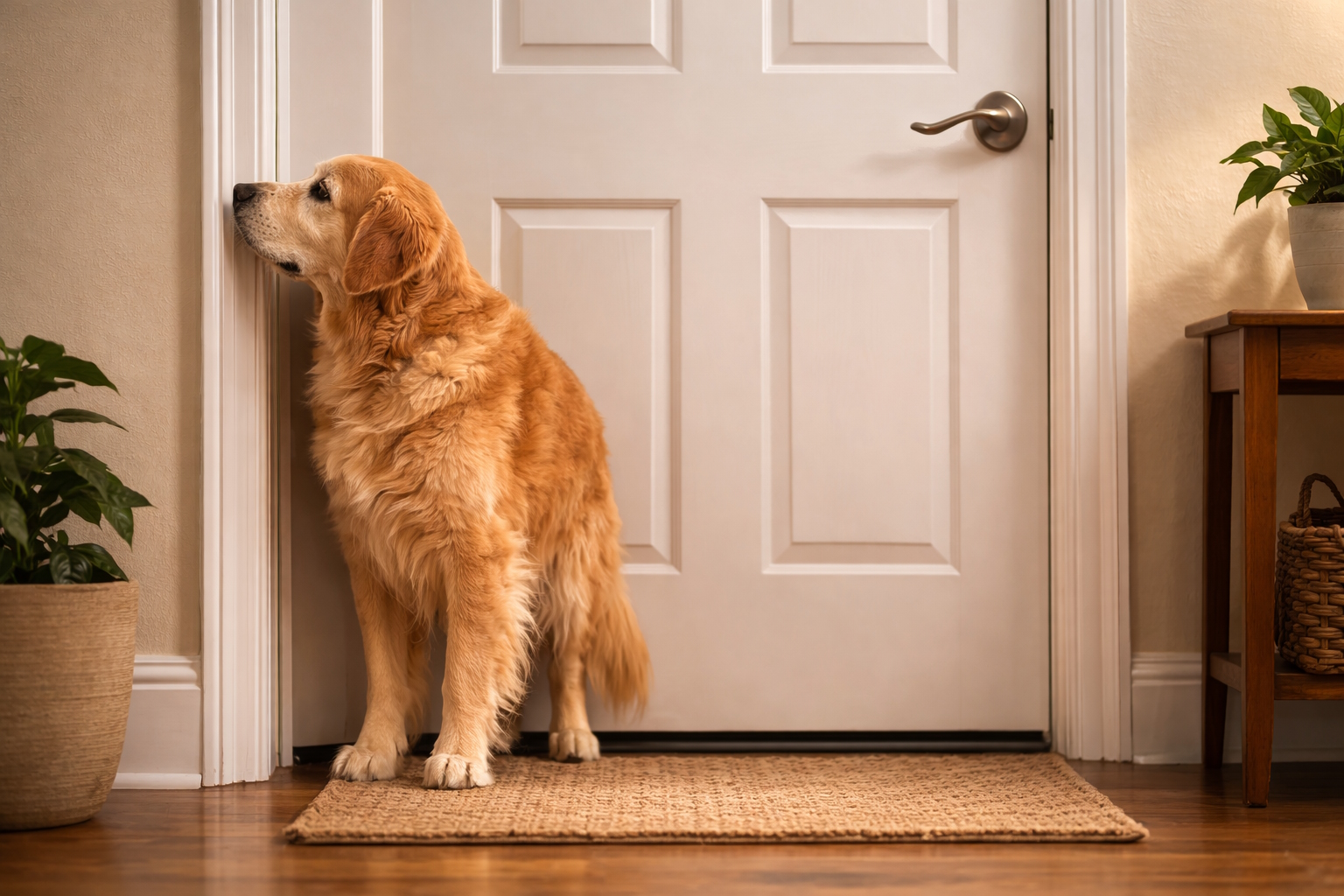
But instead of walking through the open space, your older dog stands pressed against the hinge side of the door — the one place where the door can’t open wider.
You gesture.
Why does an old dog stand at the hinge side of the door?
In many senior dogs, this usually points to a small navigation change rather than stubbornness. They still want to go outside, but they may orient to the fixed side of the doorway instead of the side that actually opens.
In plain English: the goal is still there, but the way they are reading the doorway has gotten a little less accurate.
You step aside.
You even widen the door more.
And still your dog just stands there, nose pointed at the hinge, waiting… almost like they’ve forgotten where the opening actually is.
If you searched for something like “old dog stands at hinge side of door to go out,” chances are this moment felt strangely unsettling. Not because it’s dramatic, but because it feels off. Your dog clearly wants to go outside — they just seem to be aiming at the wrong place.
This is one of those quiet senior-dog behaviors that owners often notice long before anyone else does.
And once you understand why it happens, the moment becomes much less mysterious.
Wondering Why Your Old Dog Stands at the Hinge Side of the Door to Go Out? Start Here
Why Do Some Senior Dogs Stand on the Hinge Side of the Door?
In most cases, the behavior isn’t about the door at all.
It’s about how older dogs process space, openings, and movement.
Young dogs tend to navigate doors by reading the entire scene:
the swinging door, the gap, the person opening it, the outdoor light, the pathway beyond.
Senior dogs often simplify that process.
Instead of scanning the whole doorway, they lock onto the door itself — the physical object they associate with going outside.
And the hinge side of the door is the most stable, predictable part of that object.
The opening moves.
The hinge does not.
So when an older dog approaches the door, they sometimes orient toward the fixed edge rather than the opening.
To them, they’re standing exactly where the door is.
From your perspective, they’re standing exactly where the door blocks the exit.
That mismatch is what creates the confusing moment.
Why Owners Notice This Pattern Before Anyone Else
Veterinary visits rarely capture this behavior.
Why?
Because the environment is different.
At home, dogs repeat the same door routine every day:
- same door
- same direction it swings
- same lighting
- same flooring
- same person is opening it
Small changes in how a dog processes that routine become visible quickly.
Caregivers start noticing patterns like:
- The dog waits at the hinge instead of the opening
- The dog pauses at the threshold longer than before
- The dog nudges the wrong side of the door
- The dog seems confused until the door is opened very wide
None of these moments look dramatic.
But they stand out because they didn’t happen before.
Owners often describe the first time they noticed it like this:
“He knew he wanted to go out… he was just standing in the wrong spot.”
That observation is extremely common with aging dogs.
What This Pattern Usually Points To
When a senior dog consistently stands at the hinge side of the door, the behavior usually reflects changes in spatial processing that come with aging.
In plain language, the dog still understands the goal — go outside — but the brain is simplifying how it navigates the physical environment.
Two things tend to happen with older dogs:
1. Moving gaps become harder to interpret
The opening of a door is not a fixed object.
It appears only when the door swings.
Older dogs sometimes rely more heavily on stationary reference points, which makes the hinge side feel like the safest place to orient.
2. Habit memory takes over
Dogs build strong environmental habits over the years.
If a dog spends most of their life approaching the door from a certain angle, that movement can become automatic, even when the door opens differently.
The hinge becomes the familiar landmark.
The opening becomes secondary.
Neither of these shifts means your dog has forgotten how doors work.
It simply means their brain is relying on simpler cues than it used to.
Veterinarians often describe small navigation changes like this as part of normal aging patterns in senior dogs. Caregivers usually notice them first at home, because daily routines reveal subtle shifts long before a clinic visit does.
Why the Hinge Side Specifically Becomes the “Target”
The hinge side of a door has three characteristics that older dogs gravitate toward:
It doesn’t move.
The hinge side stays fixed in the same position every time the door opens.
It’s physically solid.
Dogs can feel it with their nose or shoulder.
It’s predictable.
The door always swings away from that edge.
Older dogs sometimes navigate by touch rather than visual scanning.
Standing near the hinge gives them a stable reference point while they wait for the rest of the scene to make sense.
To us, the gap is obvious.
To them, the hinge is the anchor.
Why the hinge side feels easier for older dogs
To a younger dog, the doorway is interpreted as an open passage. But the opening only exists when the door swings.
The hinge side, on the other hand, is fixed and predictable. It does not move.
Many senior dogs begin orienting toward the most stable edge of the doorway rather than the moving gap.
What This Behavior Does Not Automatically Mean
When caregivers first notice this pattern, the mind often jumps to the worst-case explanation.
But hinge-side door standing does not automatically mean something serious is happening.
It does not automatically mean:
- Your dog is panicking
- Your dog has suddenly gone blind
- Your dog has forgotten the door entirely
- Your dog is losing their personality
Most of the time, it simply reflects how older brains simplify navigation tasks.
Think of it like an older person reaching for a light switch where it used to be, even after the room was remodeled.
The intention is correct.
The spatial cue just shifted slightly.
Why Timing and Environment Matter More Than the Behavior Itself
One hinge-side moment means very little.
Patterns matter.
Some environmental factors can make the behavior appear suddenly:
Lighting changes
Dim hallways or bright outdoor light can make the opening harder to interpret.
Door swing direction
If the door sometimes opens wider or narrower, the visual gap changes.
Flooring transitions
Dogs stepping from hardwood to tile often pause to reorient.
Narrow entryways
Older dogs sometimes prefer hugging a wall when approaching an opening.
Because of these factors, the behavior may appear inconsistently at first.
Owners often notice it:
- more at night
- more when the dog is tired
- more when the door opens only slightly
That inconsistency is normal.
Common Owner Misinterpretations
The hinge-side door moment often leads owners to conclusions that don’t match what the dog is actually experiencing.
“He’s being stubborn.”
Older dogs aren’t refusing to go out.
They’re usually waiting for the opening to become clearer.
“She forgot where outside is.”
In most cases, the dog knows exactly what they want.
They just need the path to feel obvious.
“He’s trying to push the door open.”
What looks like pushing is often just the dog using the hinge side as a reference point.
“She’s scared of the doorway.”
Fear behavior usually looks very different — hesitation, backing away, or avoiding the door entirely.
Dogs that stand at the hinge usually still want to go outside.
They’re simply aiming at the wrong spot.
What Tends to Change Next If Nothing Is Adjusted
If the hinge-side behavior becomes frequent, owners often notice a few related changes over time.
Not every dog shows all of these, but the patterns are common.
The dog may begin:
- pausing longer at thresholds
- walking along walls when approaching openings
- circling before choosing a direction
- hesitating in narrow spaces
These changes reflect the same underlying shift:
Older dogs sometimes rely more on edges and boundaries than open space.
Walls, furniture, and door frames feel easier to interpret than empty gaps.
Small Environmental Adjustments That Often Help
Caregivers naturally adapt without realizing it.
Simple changes often make door navigation easier for older dogs.
For example:
- Opening the door fully instead of halfway
- Standing on the hinge side and guiding them toward the opening
- Using consistent lighting near the door at night
- Avoiding sudden door swings toward the dog
None of these changes retrain the dog.
They simply make the environment clearer to interpret.
And clarity matters a lot to aging dogs.
- Open the door fully instead of halfway
- Pause for a second before asking your dog to move through
- Keep the doorway evenly lit if this happens more at night
- Notice whether your dog corrects easily once the opening is obvious
What Patterns Are Worth Quietly Watching
If your senior dog sometimes stands at the hinge side of the door, the most useful thing to do is simply observe the pattern over time.
What to watch over the next 7 days
One odd moment matters less than the pattern around it. These are the details worth noticing:
| What to note | Why it matters |
| Only one door or several doors? | Shows whether it is a single routine issue or a broader navigation pattern |
| More common at night? | Lighting often changes how clearly a doorway is interpreted |
| Does your dog correct quickly? | Fast correction is different from staying stuck and unsure |
| Does it happen when tired? | Fatigue often makes these small orientation quirks more obvious |
| Any other threshold pauses lately? | Helps you see whether this is part of a larger change in movement confidence |
Pay attention to things like:
- Does it happen only at one specific door?
- Does it happen more at night?
- Do the dogs correct themselves quickly once the door opens wider?
- Does the dog still move confidently through the doorway once they find the opening?
These observations tell you far more than the behavior itself.
A dog who quickly adjusts and walks through normally is experiencing something very different from a dog who remains stuck and unsure.
When It Makes Sense to Mention It to a Vet
Most hinge-side door moments are simply part of normal aging patterns.
But they can still be helpful observations to share during a routine visit.
Not because the behavior alone signals a problem.
But because small navigation changes sometimes appear before larger ones.
If you’re already tracking what you’re seeing, a vet can better understand the overall picture.
The key thing to remember is this:
Owners notice the early patterns because they see the same environment every day.
That kind of familiarity makes subtle changes visible.
Situations where it’s reasonable to bring it up sooner
- Your dog also gets stuck in corners or narrow spaces
- The dog hesitates at multiple doorways or thresholds
- Nighttime pacing or confusion appears suddenly
- Your dog seems unsure how to navigate familiar rooms
- The behavior appears alongside appetite or sleep changes
These patterns do not automatically mean something serious is happening. They simply provide helpful context for a veterinarian to evaluate the bigger picture.
Why Noticing This Early Is Actually a Good Sign
Many caregivers worry that noticing small behavioral changes means they’re overthinking things.
In reality, it usually means the opposite.
You’re paying attention.
Senior dogs rarely announce dramatic signs of aging.
They reveal them in small, ordinary moments:
- where they stand
- how they approach a doorway
- how long they pause before moving
Those details matter because they reveal how your dog experiences the world.
And when you understand the hinge-side door behavior — why your old dog stands at the hinge side of the door to go out — the moment stops feeling mysterious.
Your dog isn’t being stubborn.
They aren’t forgetting the door.
They’re simply orienting to the most stable part of the doorway while they figure out the rest.
Once you see it that way, the behavior makes sense.
And like many small senior-dog changes, it becomes just another quiet adjustment in a long relationship that’s still very much intact.
Frequently Asked Questions
Why does my old dog stand on the wrong side of the door?
Is my dog being stubborn when this happens?
Does this mean my senior dog forgot where outside is?
Should I mention this to my vet?
What can I do at home that actually helps?