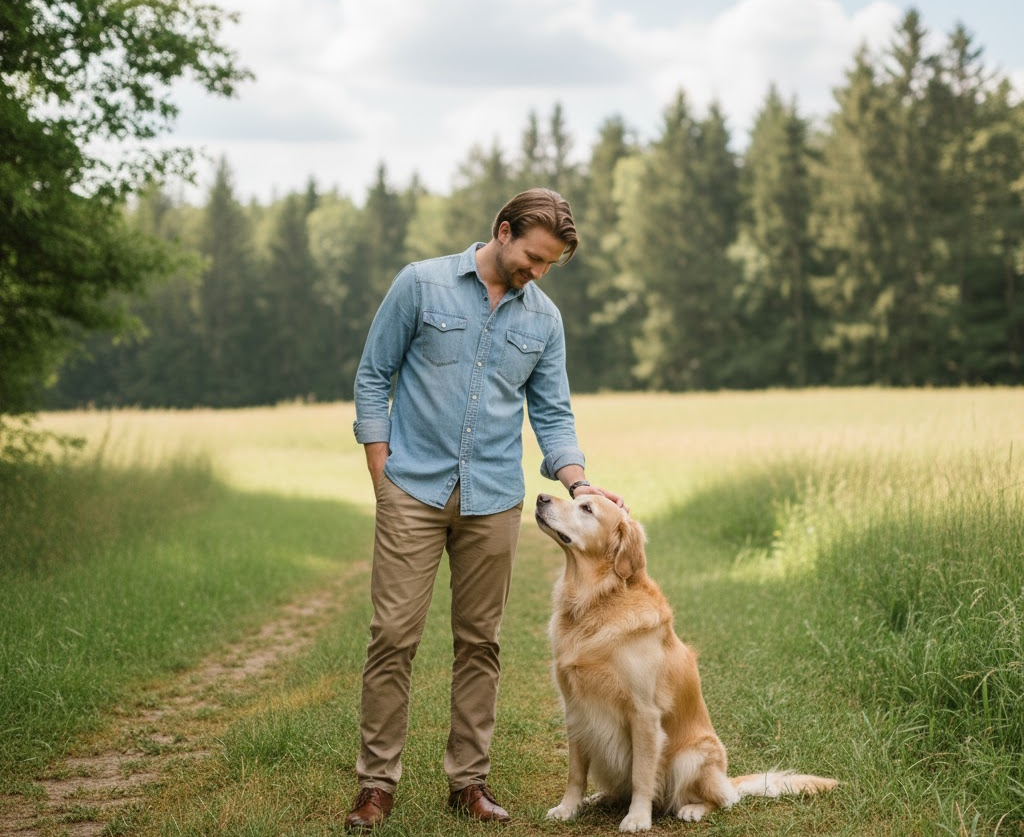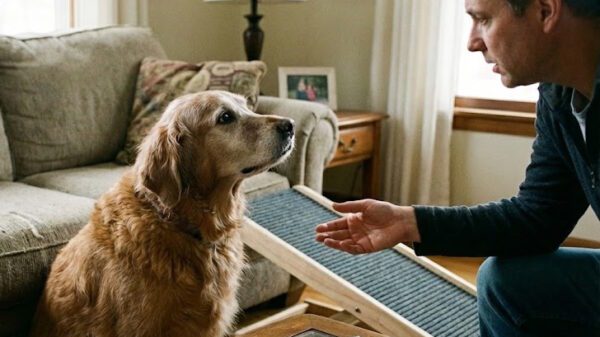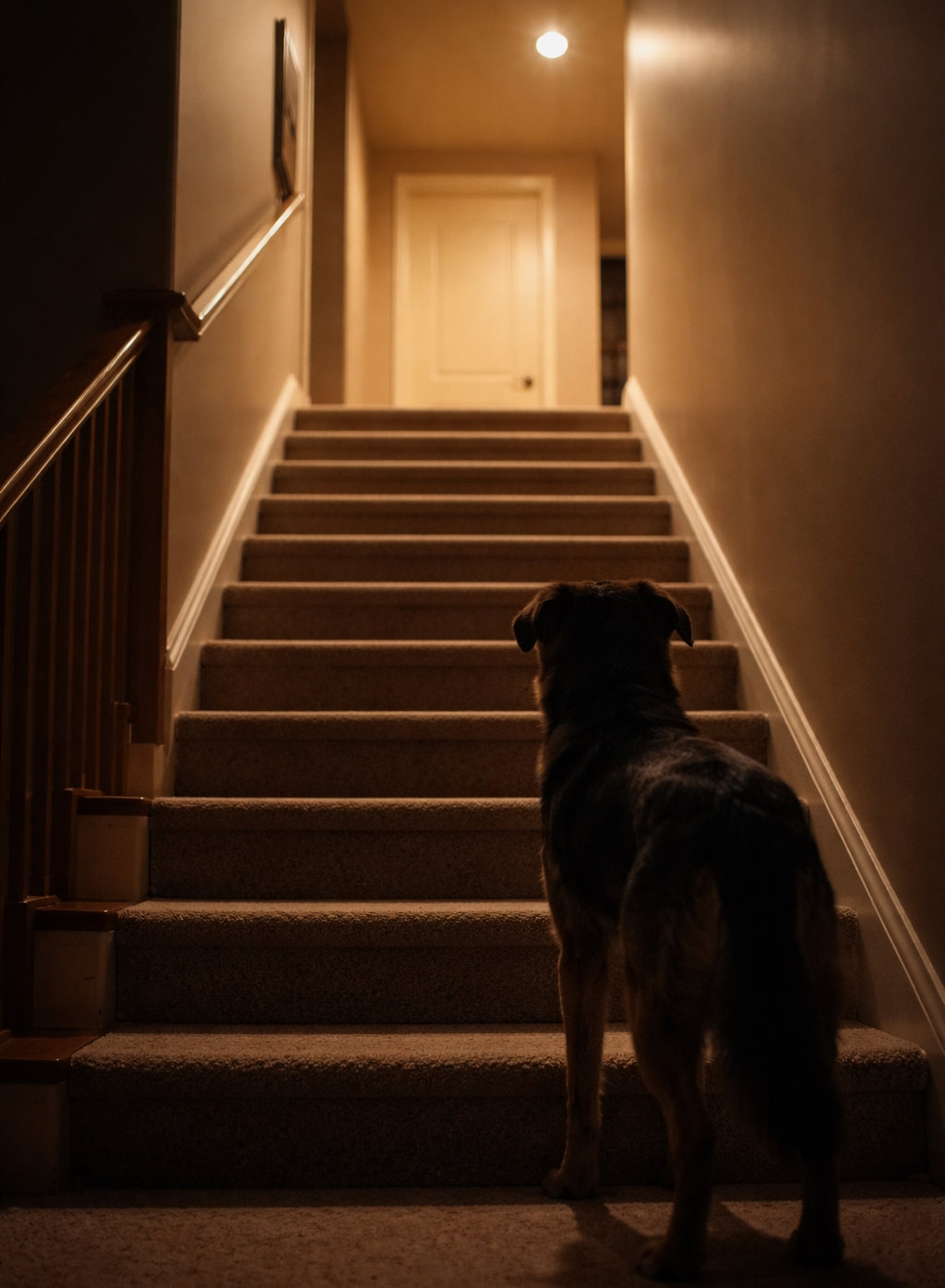
It usually happens at night.
You’re halfway through your routine—lights off, house quiet—when you notice your dog pause at the bottom of the stairs. Not slipping. Not crying. Just… stopping. You call their name. Their tail moves. They look up at you like nothing’s wrong.
Earlier that day, they ate normally. Went outside. Followed you from room to room. Maybe even trotted for a treat.
So why won’t they take the stairs anymore?
That question—why my senior dog won’t use the stairs but seems fine—creates a specific kind of worry. It doesn’t feel like an emergency. It doesn’t feel like nothing, either. It sits in that uncomfortable middle space where your instincts say, something changed, but there’s no obvious sign pointing to what.
This article is for that moment. Not to diagnose. Not to label. But to help you understand what this pattern usually means, what it doesn’t automatically mean, and how experienced caregivers interpret it when it shows up quietly like this.
A quick reality check before you keep reading
If your senior dog stopped using the stairs but seems “otherwise fine,” this is how experienced caretakers separate a one-off moment from a pattern worth bringing up.
Common scenario: your dog is still themselves, but stairs suddenly feel like “too much.”
- Still walks normally on flat ground
- Hesitates more at night or when tired
- Eats, drinks, and acts alert like usual
This often points to load, balance, or confidence—not a crisis.
This is where context matters more than the single moment.
- The change appeared suddenly (not gradually)
- Going down is harder than going up
- They seem unsure of footing on certain surfaces
- Recovery after normal activity is noticeably slower
Not panic—just a signal to watch for repetition.
Sometimes “seems fine” is how dogs mask a silent change.
- A slip, fall, yelp, or “weird moment” you witnessed (or suspect happened)
- New confusion: bumping into things or hesitating in familiar spaces
- New weakness, dragging, or loss of coordination
- They refuse to move in a way that’s new and persistent
Bring these observations up—your details help more than guesses.
Here’s the confusing part: a senior dog can look completely normal while quietly avoiding one specific movement that suddenly feels risky. Stairs are one of the first places that risk shows up.
Has Your Senior Dog Stopped Using the Stairs? Start here.
Why do owners notice stair changes before anything else?
Stairs are where subtle changes first show up—long before walks, meals, or playtime look different.
That’s because stairs combine several demands at once:
- Lifting body weight vertically
- Shifting balance without a wide base
- Coordinating timing between front and back legs
- Committing to a movement that’s hard to reverse
On flat ground, a dog can adjust. Slow down. Take smaller steps. Compensate without you noticing.
On stairs, there’s nowhere to hide hesitation.
Many owners say the same thing in different words:
“He still does everything else, but the stairs suddenly became a problem.”
That’s not a contradiction. It’s a clue.
What does it usually mean when a senior dog avoids stairs but acts normal otherwise?
When an older dog stops using stairs but seems otherwise fine, it often points to load-related discomfort rather than constant pain.
In plain terms:
They can still move—but they’re avoiding movements that ask more of their body than they’re comfortable giving.
Stairs are optional, whereas walking isn’t. Your dog can choose to wait, ask for help, or take a different route. And older dogs are remarkably practical once something feels off.
This pattern often shows up as:
- Hesitation rather than refusal
- Waiting at the bottom or top of stairs
- Taking stairs very slowly after encouragement
- Using stairs only when highly motivated
- Avoiding them at night or when tired
What matters here isn’t the refusal itself—it’s the change in decision-making.
Your dog isn’t confused. They’re evaluating effort versus comfort.
Why does this show up even when they’re eating, playing, and acting “normal”?
Because most daily behaviors don’t require the same joint load as stairs.
Eating involves standing or sitting—no lifting.
Walking is forward motion with momentum.
Playing is optional bursts with breaks.
Stairs are repetitive, vertical, and unavoidable once started.
Many caregivers assume discomfort must be obvious to be real. But older dogs often manage discomfort through selective avoidance, not by showing visible distress.
That’s why the phrase “otherwise fine” shows up so often in searches like:
- senior dog won’t use stairs but seems fine
- older dog avoiding stairs suddenly
- dog stopped going upstairs but acts normal
The behavior isn’t loud. It’s strategic.
What this pattern does not automatically mean
This is where anxiety tends to fill in gaps that don’t need filling.
A dog avoiding stairs does not automatically mean:
- They’re in constant pain
- Something catastrophic happened overnight
- They can’t walk safely at all
- They’re declining rapidly
Many dogs live comfortably for a long time after this change appears—especially when caregivers notice it early and adjust expectations rather than pushing through it.
The mistake isn’t noticing.
The mistake is assuming the worst or assuming it’s nothing.
What stair avoidance often means — and what it doesn’t
| If your dog does this… | It often points to… | It does NOT automatically mean… |
|---|---|---|
| Pauses at the stairs but moves normally elsewhere | Selective load avoidance | They’re in constant pain |
| Uses stairs earlier in the day but not at night | Fatigue affecting confidence or comfort | Sudden decline overnight |
| Goes up but hesitates going down | Balance and controlled lowering | Loss of strength everywhere |
| Waits or looks back instead of attempting | Decision-making, not refusal | Stubbornness or laziness |
| Avoids slick stairs but uses carpeted ones | Footing awareness | Fear without reason |
Why timing and environment matter more than the behavior itself
When owners describe stair avoidance, the details of when it occurs often matter more than that it occurs.
Ask yourself:
- Is it worse at night than in the morning?
- Does it happen after long walks or busy days?
- Is going down harder than going up—or vice versa?
- Does it happen more on certain stair surfaces?
A dog who avoids stairs at night but not in the morning is telling you something about fatigue and recovery, not confusion.
A dog who avoids slick stairs but uses carpeted ones isn’t being stubborn—they’re choosing stability.
Patterns like these help you understand why the behavior changed, without needing labels.
Why going downstairs often changes before going up
Many caregivers notice the same odd detail:
“He’ll go up the stairs, but coming down is a problem.”
That’s common—and it makes sense.
Going downstairs asks for:
- Controlled lowering of body weight
- Braking rather than propulsion
- Confidence in footing without seeing every step
For older dogs, that combination can feel risky even if strength is still there.
Avoidance here often looks like stopping at the top, pacing, or waiting to be carried. It’s not defiance. It’s self-preservation.
Common owner misinterpretations that make this harder than it needs to be
Because the change is subtle, it’s easy to misread what your dog is doing.
Here are a few interpretations that don’t hold up in real-life caregiving:
“They’re just being lazy.”
Older dogs conserve energy differently. Avoiding high-load movement isn’t laziness—it’s efficiency.
“If it were serious, they’d limp.”
Many dogs adjust their posture and movement long before limping appears.
“They’ll push through if I encourage them.”
Encouragement can override caution temporarily, but it doesn’t change how the movement feels to them.
“They used to do this yesterday.”
Yesterday’s comfort doesn’t guarantee today’s capacity. Small changes accumulate quietly.
None of these interpretations means you’ve done anything wrong. They just don’t explain what’s actually happening.
What tends to change next if nothing is adjusted
When stair avoidance shows up, and the environment stays the same, one of three things usually happens:
- The avoidance becomes consistent.
What started as hesitation becomes a firm decision. - Compensation shows up elsewhere.
You may notice slower walks, longer rest times, or stiffness after activity. - Confidence decreases.
Even if ability remains, uncertainty around stairs can grow.
None of this means decline is inevitable. It means your dog is communicating a limit—and waiting to see if you’ll notice.
What to quietly monitor without turning it into a project
You don’t need charts or measurements. You just need attention.
Over the next couple of weeks, notice:
- How often stair hesitation happens
- Whether it’s worse at certain times of day
- If your dog chooses alternate routes
- Whether encouragement changes the outcome
- How long it takes them to recover after activity
These observations matter more than any single moment.
One refusal doesn’t define a pattern. Repetition does.
Which patterns matter more than one-off events
If you’re deciding what’s meaningful, prioritize consistency over intensity.
A single day of stair avoidance after heavy activity is information.
Repeated avoidance under normal conditions is a pattern.
Patterns worth noting:
- Gradual increase in hesitation
- Refusal without environmental changes
- Avoidance paired with longer rest periods
- Changes in posture before stairs
These don’t require urgency—but they do support informed decisions later.
When it’s reasonable to bring observations to a vet—without panic
There’s a difference between reacting and reporting.
If you do choose to talk with a vet, what helps most isn’t a dramatic description—it’s a calm, specific one.
Statements like:
- “He’s stopped using the stairs consistently over the last few weeks.”
- “It’s worse in the evening after activity.”
- “He still walks normally on flat ground.”
Those details allow a professional to understand context without you needing to frame it as an emergency.
You’re not overreacting by noticing. You’re being precise.
Why noticing early is a sign of good caregiving, not anxiety
Many caregivers second-guess themselves in this moment.
Am I reading too much into this?
Should I wait until it’s obvious?
The truth is, experienced caregivers don’t wait for the obvious. They respond to change.
A senior dog stopping stair use while seeming otherwise fine is one of those changes that rewards attention—not alarm, not dismissal, just awareness.
Your dog isn’t failing. They’re adapting. And they’re trusting you to adapt with them.
Common questions owners ask in this situation
Can a senior dog stop using the stairs and still be okay?
Yes. Many senior dogs selectively avoid stairs while remaining comfortable and active in other parts of daily life. Stairs place more load on joints and balance than flat walking, so they’re often the first activity dogs quietly opt out of.
Why does my dog seem fine during the day but struggle with stairs at night?
Fatigue matters. By evening, muscles and joints have already absorbed a full day of use. What feels manageable in the morning can feel risky later, especially when lighting is lower and footing feels less certain.
Is avoiding stairs a sign of pain if my dog isn’t limping?
Not necessarily. Dogs often adjust behavior before limping appears. Avoiding one high-effort movement can be a way of staying comfortable without showing obvious distress.
Should I encourage my dog to keep using the stairs?
Gentle encouragement can help you learn what your dog is capable of, but repeated hesitation usually means they’re weighing effort against comfort. Pushing through doesn’t change how the movement feels to them.
When does stair avoidance become something I should bring up?
When it becomes consistent, worsens over time, or appears alongside other changes—like uncertainty, weakness, or recovery taking longer— it’s reasonable to share those observations with a vet. Specific patterns are more useful than isolated moments.
Closing: the quiet shift that deserves respect
When a senior dog stops using the stairs but still looks like themselves, it creates a strange emotional dissonance. Everything appears normal—except the thing that suddenly isn’t.
That moment doesn’t demand fear. It doesn’t demand certainty. It asks for respect.
Respect for how dogs manage discomfort.
Respect for how small changes speak loudly when you know where to listen.
Respect for the fact that noticing early is not being anxious—it’s being present.
If you’re here because your dog paused at the stairs and looked back at you, you’re already doing the right thing.
You noticed.
🌅 Sundown Mapper Evening Anxiety Pattern Map Track when and how sundowning shows up so you can spot patterns and plan calmer evenings for your senior dog.