It usually begins with something small.
Your senior dog walks toward the couch like he always has. He pauses, studies it for a moment, maybe shifts his weight forward — and then turns away. Later, you notice his bed by the window hasn’t been touched. He settles somewhere new. Somewhere he’s never chosen before.
That’s when the question forms quietly in your head:
Why is my senior dog avoiding his favorite spot?
If you noticed this shift, it’s because something changed. And when older dogs change patterns, there is almost always a practical reason rooted in comfort, effort, or confidence — not mood.
What this shift usually means (in plain language)
If your senior dog is avoiding a favorite spot, they’re usually recalculating one of these four comfort “tests.”
| The Change | What your dog is calculating | The quick win to try |
|---|---|---|
| Avoiding the couch | Jump impact + landing confidence | Add a low ottoman or midway step |
| Avoiding the bed | Rising from compressed padding | Refresh the cushion or add a bolster edge |
| Pacing or hesitation on the way | Unreliable footing on slick floors | Lay down a runner, yoga mat, or grippy rug |
| Leaving sunny spots | Temperature comfort over time | Check drafts / shift the bed a few feet |
Is Your Senior Dog Avoiding Their Favorite Spot? Start Here
Why Owners Notice This Before Anyone Else
Veterinarians see appointments. Owners see routines.
You know how your dog normally approaches the couch. You know the exact rhythm of how he circles before lying down, how confidently he used to hop onto the bed, how long he rests in that patch of afternoon sun. When that rhythm changes, you feel it immediately.
A senior dog rarely announces discomfort dramatically. Instead, you see small edits:
- A pause before climbing
- Standing beside the bed without lowering down
- Choosing the hallway instead of the living room
- Sleeping on tile when a cushion is nearby
These are not random decisions. They are adjustments. And because you live inside your dog’s daily flow, you’re the first to see when the adjustment becomes a pattern.
When a Senior Dog Avoids the Couch, What Is He Calculating?
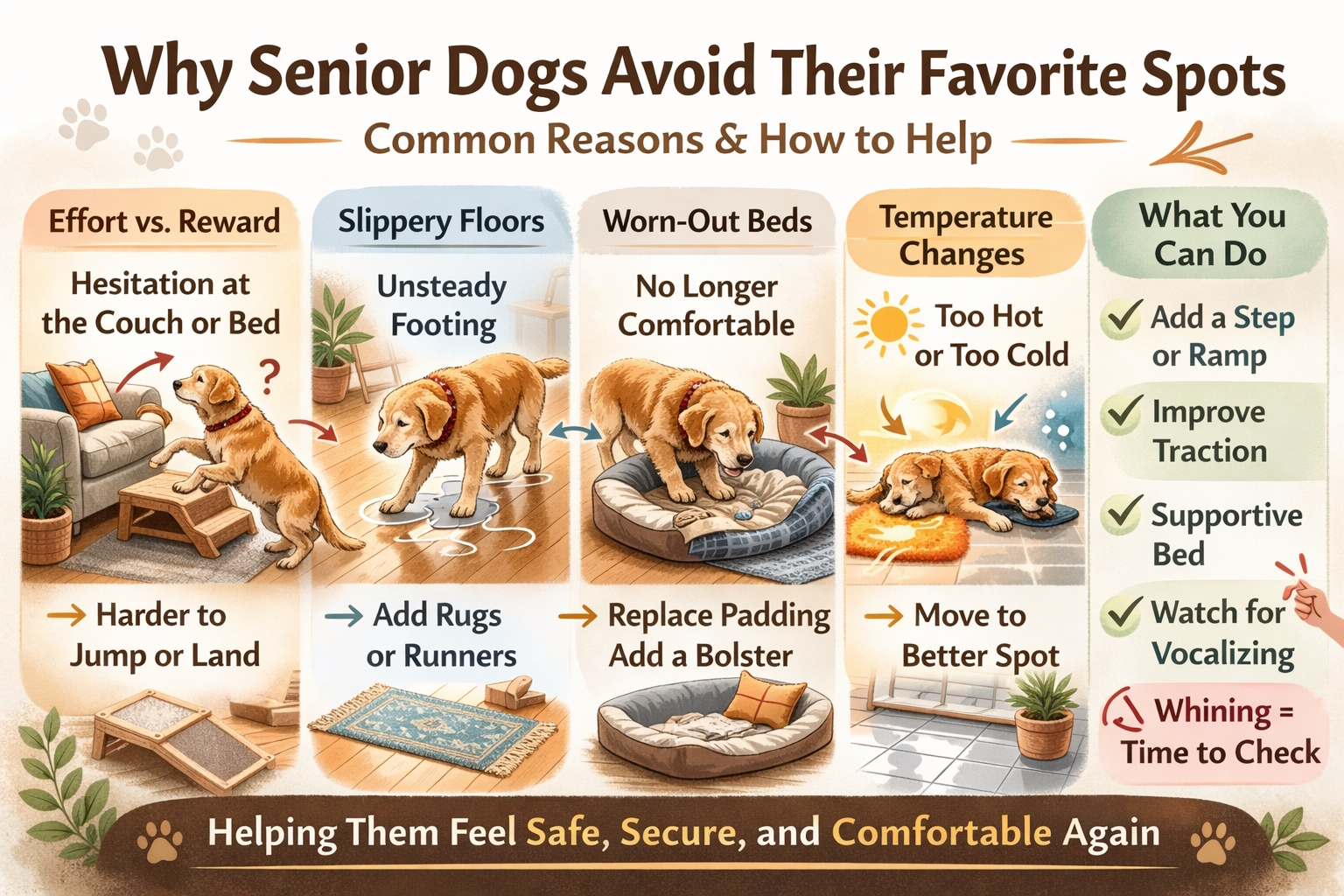
The most useful way to understand this behavior is through a simple lens: effort versus reward.
The couch still represents comfort. The window seat still represents warmth. The familiar bed still holds meaning. What changes is the calculation required to reach it.
Jumping up requires balance and confidence. Jumping down requires absorbing impact. Rising again later requires strength and stability. If any part of that sequence feels uncertain, your dog adjusts.
Avoidance, in this context, is not rejection. It is canine risk management. Older dogs begin choosing certainty over nostalgia when elevation feels unpredictable.
That shift is thoughtful, not emotional.
Why Would a Senior Dog Suddenly Stop Sleeping in His Bed?
Beds wear down gradually. So do bodies.
Padding compresses over time. Edges become harder to step into. Drafts feel colder. Rising from deep cushioning may require more leverage than it once did.
You might notice your dog standing over the bed, circling once, and then lying down somewhere else. You may see him choose firmer flooring or lean against walls or furniture for support.
When a senior dog avoids his favorite resting place, it often means the setup no longer matches his physical comfort needs. The attachment to the space usually remains. The ease of using it may not.
Why the Journey Matters More Than the Spot
Many owners focus on the destination — the couch, the bed, the sunny window. But often, it’s the journey that has changed.
If your dog must cross hardwood or tile to reach the couch and then jump once he gets there, he is performing multiple confidence tests in sequence. For an aging body, that can be enough to discourage the attempt.
You may notice shorter strides on slick floors, walking close to walls, hesitating at room transitions, or avoiding rooms without rugs. These details point to uncertainty about traction, not mood.
Sometimes the favorite spot isn’t the problem at all. The path to it feels unreliable.
When footing feels unstable, dogs choose safer resting locations. That decision is practical. It is not personal.
If your old dog won’t jump on the bed anymore
When a senior dog stops jumping onto the bed, it’s often about the descent — not the climb. Getting down can feel more unpredictable than getting up, especially if the landing area is slick or the drop is steep.
If you notice your dog staring at the bed, pacing near it, or waiting for you to assist, that usually isn’t confusion. It’s a confidence check — a quiet moment of “Is this worth the impact?”
Lowering the height gap, adding a stable stepping surface, or creating a gradual transition often restores confidence quickly because it changes the calculation, not the dog.
Why Temperature Sensitivity Shifts With Age
Another reason senior dogs avoid their favorite spots is to regulate their temperature.
A sunny window that once felt soothing may now feel too warm. A bed near a draft may feel colder than it used to. Tile that once seemed uncomfortable may now feel supportive and cool.
Older dogs often rotate between warm and cool surfaces more frequently. You may notice them leaving a sunny spot after twenty minutes and relocating without any other visible change. This is not confusion. It is fine-tuning comfort.
As thermoregulation shifts, so do location preferences.
What This Behavior Does Not Automatically Mean
It’s easy to interpret this change emotionally. Many owners worry their dog is depressed, distancing himself, or losing interest in family time.
Selective spot avoidance is different from global behavioral change. If your dog is still eating normally, greeting you, following you from room to room, and engaging in daily rituals, this is unlikely to be social withdrawal.
Location-specific avoidance typically reflects comfort, footing, or effort. Emotional detachment tends to appear broader and more pervasive.
The distinction matters, especially when worry fills in the blanks.
What emotional withdrawal actually looks like
Owners often worry: “Is he pulling away from us?” That fear makes sense — but a dog avoiding one specific spot is usually making a physical confidence decision, not a relationship decision.
True social withdrawal tends to look broader, like:
- Avoiding eye contact or interaction
- Not responding to your voice the way they usually do
- Skipping meals or losing interest in favorite routines
- No longer greeting you or following you around
Why Repetition Tells the Real Story
One missed jump is nothing.
Three weeks of hesitation is something.
When asking why senior dogs start avoiding their favorite spots, look for consistency. Is your dog avoiding all elevated spaces or just one? Does the hesitation happen every evening? Has it gradually increased?
Patterns reveal adaptation. Single incidents rarely do.
Aging unfolds incrementally. So, what adjustments do dogs make in response to it?
Small Environmental Adjustments That Often Restore Confidence
Observation becomes useful when it leads to small, thoughtful changes.
If traction seems to be the issue, laying down a runner or yoga mat along the path to the couch can immediately reduce hesitation. Adding non-slip rugs in high-traffic areas shortens the uncertain stretch between rooms and restores confidence during movement.
If height is the barrier, a low ottoman placed beside the couch can serve as a step in the middle. Rearranging furniture to reduce a large jump into smaller transitions often makes the space usable again. Refreshing a flattened bed with supportive cushioning or adding a bolster for bracing can also change how easy it feels to lie down and stand up.
These adjustments are not dramatic. They simply lower the effort side of the equation. When effort decreases, favorite spots often become inviting again.
What to Quietly Monitor Over Time
You don’t need to solve everything in one day. Instead, watch.
Does improving traction reduce hesitation? Does adding a step increase couch usage? Does relocating the bed change sleep patterns? Are mornings noticeably slower than evenings?
Focus on direction rather than perfection. If small adjustments shift behavior in a positive direction, you’ve learned something useful. If hesitation continues or expands despite changes, that information is equally valuable.
Neither outcome requires panic. Both support clarity.
When It Makes Sense to Share These Observations
It is reasonable to mention these patterns during a routine veterinary visit if avoidance spreads to multiple areas, rising from rest becomes consistently slower, or slipping becomes more frequent.
There is one clearer threshold to watch for: vocalizing during movement. If your dog begins whining, grunting, or yelping when trying to stand, climb, or lie down — especially if that sound repeats — the internal calculation has likely become uncomfortable enough to express. Audible effort marks a different level of strain than silent hesitation.
A clearer threshold: If your dog starts whining, grunting, or yelping when trying to stand, climb, or lie down — especially if it repeats — that’s worth bringing up as a specific observation. Silent hesitation is often caution. Audible effort suggests the calculation has become uncomfortable enough to express.
Specific descriptions help more than vague concerns. Saying, “He stopped getting on the couch about a month ago, now prefers tile, and has started grunting when standing,” provides clarity. You are not offering a diagnosis. You are describing observable behavior.
That distinction keeps the conversation grounded.
The Meaning Behind the Shift
When senior dogs start avoiding their favorite spots, it is not a sign of abandoning comfort. They are redefining it.
The couch may still represent closeness. The window bed may still carry familiarity. The sunny rug may still hold a memory. But if reaching those places feels uncertain, dogs choose safety over sentiment.
That choice is thoughtful. It reflects adaptation, not withdrawal.
If Nothing Changes, What Tends to Happen Next
If hesitation continues and no environmental changes are made, you may gradually notice:
- Longer pauses before lying down
- More frequent floor sleeping
- Reduced use of elevated furniture
- Slower morning transitions
These shifts usually unfold over months, not days.
The earlier you respond with small environmental adjustments, the longer your dog maintains independence.
FAQ: Senior dogs avoiding favorite spots
Why is my senior dog avoiding his favorite spot all of a sudden?
Most of the time, it’s not sudden — it’s the first time the pattern became obvious. Older dogs quietly re-calculate effort versus comfort, especially when the spot involves height, slick flooring, or a bed that has flattened over time.
My old dog stares at the couch but won’t jump. What does that mean?
That pause is often a confidence test. Your dog may still want the couch, but the jump and landing may feel less predictable than before. If the path is slippery or the drop is steep, hesitation tends to increase.
Why is my senior dog sleeping on the floor instead of his bed?
Firmer surfaces can feel more stable when rising, and cool flooring may feel better than deep cushioning. If a bed has compressed, it can become harder to stand up from — even if it still looks comfortable to you.
Is my dog depressed if he stopped cuddling on the couch?
Spot avoidance is usually about effort and comfort, not emotional distance. If your dog still eats normally, greets you, follows you, and engages in daily routines, the change is more likely physical confidence than social withdrawal.
What’s one small change that often helps immediately?
Start with traction. A simple runner or yoga mat along the “approach path” to the couch or bed can reduce hesitation fast, because it makes the journey feel steady again.
When is it worth mentioning this to a veterinarian?
It’s reasonable to share observations if the avoidance spreads, slipping becomes frequent, or your dog starts making sounds (whining, grunting, yelping) when standing, climbing, or lying down — especially if it repeats. Concrete examples help a lot.
What You Can Do Tonight
If this question brought you here, take one quiet step before bed.
Look at the path to your dog’s favorite spot. Notice the flooring. Notice the height. Notice the landing. Notice the condition of the bed.
Place a mat. Move a chair. Add a step. Replace flattened cushioning.
You don’t need to overhaul your home. You need to reduce hesitation.
What you can do tonight
Before bed, look at the path to your dog’s favorite spot. Notice the flooring, the height, the landing, and the condition of the bed itself. Older dogs often stop using “favorite” places when the journey feels uncertain — not because the comfort stopped mattering.
If you’d rather get local eyes on what you’re seeing, this tool helps readers search for a veterinary clinic by location.
Find a veterinarian near you Official AVMA pet-owner resourceUnderstanding why senior dogs start avoiding their favorite spots often reveals something simple: the comfort hasn’t disappeared. The calculation has changed.
And noticing that change early isn’t anxious.
It’s responsible care.