
Senior Dog End-of-Life Care Costs
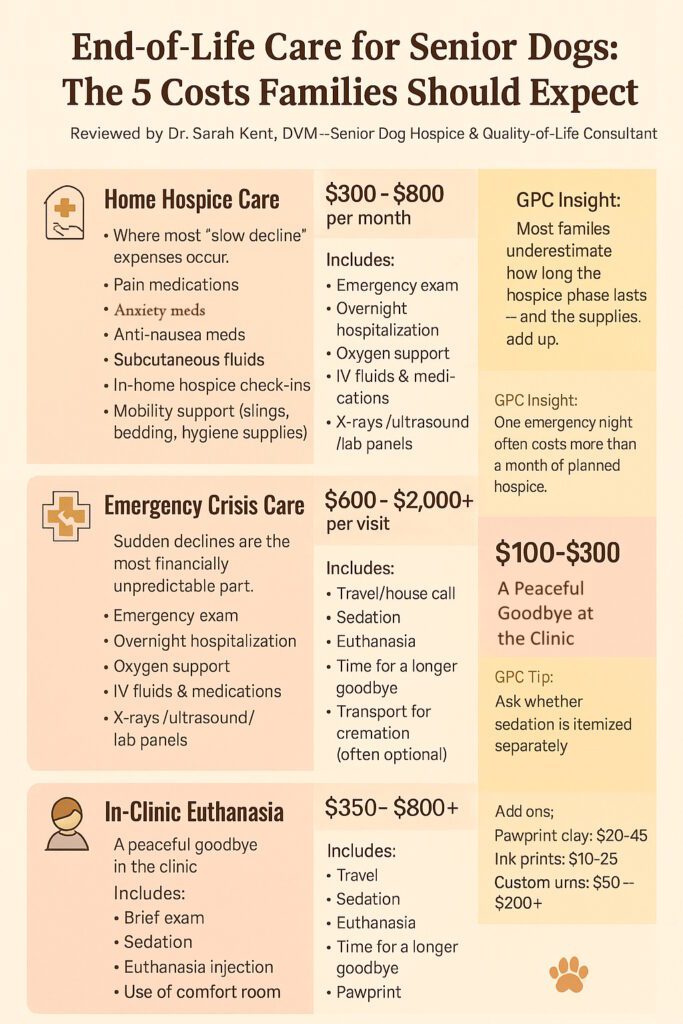
Caring for a senior dog in their final chapter is one of the most emotional responsibilities we face as pet parents — and one of the most financially unpredictable. End-of-life care can range from a few hundred dollars to several thousand, depending on your dog’s medical needs, your region, the level of comfort care you choose, and the aftercare arrangements you prefer.
This guide breaks down realistic cost ranges, the choices that affect those costs, and what “compassionate planning” truly looks like when you’re doing everything you can to give your dog a gentle, dignified goodbye. It is not about choosing the cheapest path — it’s about being informed, prepared, and emotionally supported so you can make decisions that honor your dog and your family.
Below, you’ll find a clear cost map for the final stages of senior-dog care:
• Home hospice & comfort care — what it includes and typical monthly ranges
• Emergency declines & crisis stabilization — when costs spike and why
• In-home vs in-clinic euthanasia — fees, what’s included, and how to choose
• Cremation, burial & memorial options — complete aftercare cost breakdown
• How to prepare financially — budgeting, savings pressures, and payment options
You won’t find judgment here. Every family, every dog, and every final chapter looks different. This article exists so you never feel blindsided — financially or emotionally — when you’re already carrying so much.
In This Guide
Realistic End-of-Life Cost Ranges (U.S.)
These ranges reflect typical U.S. costs based on veterinary pricing reports, pet hospice resources, and cremation fee data. Actual prices vary by region, dog size, and service provider.
| Category | Typical Cost Range | What It Usually Includes |
|---|---|---|
| Home hospice care | $300–$800/month | In-home quality-of-life visits, pain meds, anxiety meds, appetite stimulants, fluids, nursing support, and follow-up check-ins. |
| Emergency crisis care | $600–$2,000+ | Emergency exam, overnight hospitalization, oxygen therapy, IV fluids, imaging (x-rays/ultrasound), bloodwork, and short-term stabilization. |
| In-clinic euthanasia | $100–$300 | Veterinary exam, sedation (sometimes itemized separately), euthanasia injection, and brief use of a comfort room. Aftercare is often billed separately. |
| In-home euthanasia | $350–$800+ | House call fee, sedation, euthanasia, time for a private goodbye at home, and sometimes transport for cremation. |
| Cremation / burial | $75–$700+ | Communal cremation at the low end; private cremation with urn, pawprint, or burial plot at the higher end. Heavier dogs and home pickup increase cost. |
Tip: Ask for a line-item estimate so you can see what is included (sedation, cremation, urn, pawprint, home pickup) and what would be an additional fee.
Veterinary Note — Dr. Sarah Kent, DVM: These are typical ranges, not quotes. I regularly see families spend less than the low end and more than the high end depending on how many emergencies occur, how long hospice lasts, and which aftercare options they choose. Use this chart to start planning and then ask your own veterinarian and local cremation providers for written estimates.
The Three Phases of the “Long Goodbye”
Budgeting for a senior dog isn’t a flat line; it’s a curve that steepens as they age. To prepare effectively, we must break down senior dog care costs into three distinct financial phases.
💸 The Three Phases of the “Long Goodbye” (Financially)
- Phase 1 — Maintenance: Most spending goes toward managing chronic disease: pain control, “senior panels,” prescription diets, and dental work.
- Phase 2 — Modification: Costs shift to your home: ramps, non-slip flooring, washable bedding, incontinence supplies, and occasional medical boarding or specialized pet-sitting.
- Phase 3 — Hospice & Goodbye: The highest one-time expenses: hospice consults, emergency crises, euthanasia (in-clinic or at home), and cremation or burial.
Planning move: Even if you can’t save for everything at once, earmark a small monthly amount for each phase so you’re not blindsided when the curve steepens.
Phase 1: The Maintenance Phase (Geriatric Care)
The Shift: This is when your dog is still happy and active, but the “machinery” starts to wear down. The vet visits shift from “annual vaccines” to “monitoring chronic conditions.”
- The Medical Reality: You are no longer paying for prevention; you are paying for management. This often involves the “Senior Triad”: Arthritis, Dental Disease, and Organ Function (Kidneys/Heart).
- The Monthly Burn:
- Pain Management: NSAIDs (like Carprofen or Galliprant) and joint supplements (Glucosamine/Chondroitin) become monthly staples. Estimated Cost: $60–$150/month.
- Prescription Diets: Kidney-support or weight-management foods are significantly more expensive than standard kibble. Estimated Cost: $80–$120/bag.
- The “Senior Panel”: Vets will recommend bloodwork every 6 months instead of annually to catch organ failure early. Estimated Cost: $200–$400 per visit.
- The Hidden Shock: Dental Disease. A senior dog often requires a dental cleaning under anesthesia to prevent systemic infection. Because this involves bloodwork, anesthesia, and likely extractions, the bill is often the single largest expense in this phase. Estimated Cost: $800–$2,000.
Phase 2: The Modification Phase (Comfort & Hygiene)
The Shift: This phase is less about the vet and more about your home. Your dog’s mobility declines, and “sundowning” (Canine Cognitive Dysfunction) may set in.
- The “Home Retrofit”: You become a specialized contractor for your dog. You are buying yoga mats for slippery hardwood floors, ramps for the SUV, and orthopedic beds for every room.
- The Hygiene Tax: Incontinence is a common, heartbreaking reality. The cost of diapers, belly bands, “pee pads,” and increased laundry loads adds up quickly.
- The “Night Shift” Cost: This is the most overlooked expense. When a senior dog becomes medically fragile (seizures, incontinence, confusion), you cannot board them. Standard kennels will not take them, and pet sitters charge a premium for “medical boarding.”
- The Result: You stop traveling. If you must travel, you are hiring specialized veterinary technicians to pet-sit, which can cost triple the standard rate.
Phase 3: The Hospice Phase (The Final Transition)
The Shift: The goal changes from “extending life” to “quality of life.” This is where pet hospice costs and euthanasia decisions come into play.
- The Pet Hospice Model: Unlike human hospice, where Medicare pays, pet hospice is fully out-of-pocket. A “Quality of Life Consultation” with a specialized hospice veterinarian involves an in-home assessment of your dog’s pain levels and environment. Estimated Cost: $300–$500.
- Average Cost of Dog Euthanasia: You have two choices, and they carry vastly different price tags.
- In-Clinic Euthanasia: The most affordable option, but often stressful for a frightened senior dog. Estimated Cost: $100–$300.
- In-Home Dog Euthanasia Cost: The “gold standard” for a peaceful goodbye. A vet comes to your home, allowing your dog to pass on their favorite bed, surrounded by family, without the fear of the exam room. Estimated Cost: $400–$800 (depending on size and travel).
- Aftercare (Cremation):
- Communal: Ashes are not returned. Cost: $75–$150.
- Private: Ashes are returned to you in an urn or cedar box. Cost: $250–$500.
Where These Cost Ranges Come From — Dr. Sarah Kent, DVM
The hospice, euthanasia, and aftercare ranges in the cost table above are midpoints pulled from:
- Hospice & in-home euthanasia: Pricing pages from in-home hospice providers and in-home euthanasia services in multiple U.S. regions (house-call fees, hospice visit bundles, and combined euthanasia + cremation packages).
- In-clinic euthanasia: Cost summaries from PetMD and GoodRx on typical in-clinic euthanasia fees, including sedation and use of a comfort room.
- Cremation & aftercare: CareCredit and GoodRx cost guides for communal versus private cremation, plus sample pricing from independent pet cremation services.
These sources are used to create realistic planning ranges for most U.S. families. Actual pricing can be higher or lower in your area, so always ask your veterinarian and local aftercare providers for written estimates.
The Insurance Trap: The “Pre-Existing” Wall
“Should I get pet insurance for my 12-year-old Lab?”
This is the most common question experts receive regarding senior dog vet bills, and the answer is a painful “probably not.” Unlike some human insurance, which cannot deny coverage for pre-existing conditions, pet insurance lives and dies by them.
If your dog has ever shown a sign of limping in their medical records, no new policy will cover their arthritis. If they had a high kidney value three years ago, kidney failure is excluded. For a senior dog, almost every ailment you need coverage for is likely already “pre-existing.”
Senior-Dog End-of-Life Financial Planning Checklist
- Set aside a dedicated end-of-life budget (even small amounts help).
- Request written estimates for hospice, euthanasia, and aftercare fees.
- Clarify what is included in sedation, euthanasia, and cremation packages.
- Ask your vet for a “comfort plan” outlining expected meds and prices.
- Create a separate emergency fund for crisis declines or sudden hospitalizations.
- Check local cremation providers — prices vary widely by region.
- Plan transportation if choosing in-home euthanasia or private cremation.
- Use the Golden Years QOL Tracker to decide when to spend vs. stabilize.
The Strategic Pivot: Instead of paying $150/month for a limited insurance policy, open a high-yield savings account named “The [Dog’s Name] Fund.” Auto-deposit that premium into the account. When the emergency comes, you are your own insurance company, with no claim denials.
The Hidden Expenses No One Mentions
The receipts tell only half the story. The true cost of caring for a senior dog is often found in the “invisible” column.
- The “Carpet” Economy: Between incontinence and vomiting, many senior dog owners find themselves replacing rugs or hiring professional carpet cleaners multiple times a year.
- The “Special” Food: When a senior dog loses their appetite, desperate owners will cook chicken, buy expensive wet toppers, or rotisserie chickens just to get them to eat a pill.
- The Grief Counseling: Losing a pet is a “disenfranchised grief”—society often tells us “it’s just a dog.” Many owners find immense value in paying for a session with a pet loss counselor to navigate the guilt of the euthanasia decision.
A Compassionate Action Plan
You cannot pause time, but you can prepare for it. Here is a strategic triage plan for the senior dog owner.
- The “Quality of Life” Fund: Start it today. Even $50 a month creates a buffer. The goal is to ensure that when the bad day comes, you are making a decision based on mercy, not money.
- The “Good Days” Calendar: Download a “Quality of Life Scale” (like the HHHHHMM Scale). Track your dog’s good and bad days on a calendar. This data costs nothing but is priceless when you are gaslighting yourself about whether “it’s time.”
- Research “CareCredit” & “Scratchpay”: These are financing options specifically for veterinary care. Apply for them before the emergency happens, so you know your credit limit.
- Have the “Script” Ready: Call mobile vet services now. Ask them: “What is your availability? Do you come on weekends? What is the total in-home dog euthanasia cost for a dog of [Weight]?” Write this down. When the moment comes, you will not be able to see your phone screen through your tears. You need the number on the fridge.
More Guides on End-of-Life Support
❓ End-of-Life Cost & Planning: Frequently Asked Questions
Tap a question to reveal the answer.
How much does in-home euthanasia cost?
Most families pay between $350 and $800 for in-home euthanasia, depending on region, travel distance, dog size, and whether aftercare (cremation and transport) is included. Some hospice services offer bundled packages that roll the euthanasia visit and private cremation into one price.
Is private cremation more expensive than communal cremation?
Yes. Communal cremation (ashes not returned) is typically in the $75–$150 range for most dogs. Private cremation, where your dog is cremated individually and ashes are returned in an urn or box, usually falls between $250 and $500, with heavier dogs at the higher end.
Can I pre-pay for aftercare services?
Many cremation providers and a growing number of vet clinics allow pre-planning and pre-payment for euthanasia and aftercare. This can lock in pricing, reduce day-of decision fatigue, and ensure your wishes are followed even if other family members are overwhelmed.
How do I know when it’s time to say goodbye?
There is rarely a single “perfect” day. Instead, look at trends: Is your dog still eating, moving, and enjoying their people most days, or are bad days outnumbering good ones? Using the Golden Years Quality-of-Life Tracker and discussing the results with your vet gives you an objective foundation for an incredibly emotional decision.
Reviewed by Dr. Sarah Kent, DVM — Senior Dog Hospice & Quality-of-Life Consultant.
“Talking about money in the same breath as euthanasia feels harsh, but planning ahead is one of the kindest things you can do for your dog. When the hard day comes, you want your decisions guided by comfort and compassion—not panic over a bill.”
— Dr. Sarah Kent, DVM • Senior Dog Hospice & Quality-of-Life Consultant
The Return on Investment
Why do we do it? Why do we spend thousands on a creature who will break our hearts?
Because they gave us their best years, they gave us their athleticism, their loyalty, and their unshakeable joy. Now, in their twilight, they are asking us to carry the burden they can no longer bear.
Budgeting for their end-of-life care is not cold; it is the ultimate act of gratitude. It is buying them a soft landing. It is ensuring that their final memory is not of pain or stress, but of your hand on their head, telling them they were the best dog, the good dog, the only dog. And that is worth every penny.