🩺 Dr. Kent’s End-of-Life Questions for Senior Dogs
What are the most reliable indicators it’s time to say goodbye?
When your dog shows sustained decline in mobility, appetite, and joy for more than a week—even with treatment—it’s time to discuss comfort-based decisions with your vet.
How do I prepare emotionally for this decision?
Allow yourself to feel anticipatory grief—it is a reflection of your love. Talk openly, journal small moments of joy, and lean on trusted support groups.
What grief resources are available for pet loss?
Consider local pet-loss support hotlines, online groups with certified grief specialists, and keeping a memory journal for your dog’s legacy.
Audience responses reviewed by Dr. Sarah Kent, DVM — Veterinary Behavior & Geriatric Specialist.
— Dr. Sarah Kent, DVM
Navigating Your Own Heart
The decision is agonizing because your love is so deep. Be gentle with yourself. The feelings of guilt, doubt, and overwhelming sadness are not a sign of weakness; they are a sign of that love.
Anticipatory grief is real. It is the sorrow of the impending loss, and it is profoundly painful. Allow yourself to feel it. Talk to friends or family who understand.
And please, absolve yourself of the burden of finding the “perfect” time. There is no perfect time. The goal is to prevent suffering. Many veterinarians will tell you that it is better to say goodbye a week too soon than a day too late. This is not giving up. This is giving them the final, most courageous gift you can: a peaceful end to a life filled with love.
This decision is the final, most selfless act of love you will ever perform for your cherished companion. You are choosing to take their pain onto yourself, in the form of grief, so that they no longer have to suffer. You have given them a lifetime of joy, and in doing so, you have given them the ultimate gift of peace. Their love will be a part of you forever.
If you’re struggling with this decision, remember: love and peace —not guilt —define the end of a good life.
🔗 More Support for Your Journey
🩺 Dr. Kent’s End-of-Life Questions for Senior Dogs
What are the most reliable indicators it’s time to say goodbye?
When your dog shows sustained decline in mobility, appetite, and joy for more than a week—even with treatment—it’s time to discuss comfort-based decisions with your vet.
How do I prepare emotionally for this decision?
Allow yourself to feel anticipatory grief—it is a reflection of your love. Talk openly, journal small moments of joy, and lean on trusted support groups.
What grief resources are available for pet loss?
Consider local pet-loss support hotlines, online groups with certified grief specialists, and keeping a memory journal for your dog’s legacy.
Audience responses reviewed by Dr. Sarah Kent, DVM — Veterinary Behavior & Geriatric Specialist.
— Dr. Sarah Kent, DVM
Navigating Your Own Heart
The decision is agonizing because your love is so deep. Be gentle with yourself. The feelings of guilt, doubt, and overwhelming sadness are not a sign of weakness; they are a sign of that love.
Anticipatory grief is real. It is the sorrow of the impending loss, and it is profoundly painful. Allow yourself to feel it. Talk to friends or family who understand.
And please, absolve yourself of the burden of finding the “perfect” time. There is no perfect time. The goal is to prevent suffering. Many veterinarians will tell you that it is better to say goodbye a week too soon than a day too late. This is not giving up. This is giving them the final, most courageous gift you can: a peaceful end to a life filled with love.
This decision is the final, most selfless act of love you will ever perform for your cherished companion. You are choosing to take their pain onto yourself, in the form of grief, so that they no longer have to suffer. You have given them a lifetime of joy, and in doing so, you have given them the ultimate gift of peace. Their love will be a part of you forever.
If you’re struggling with this decision, remember: love and peace —not guilt —define the end of a good life.
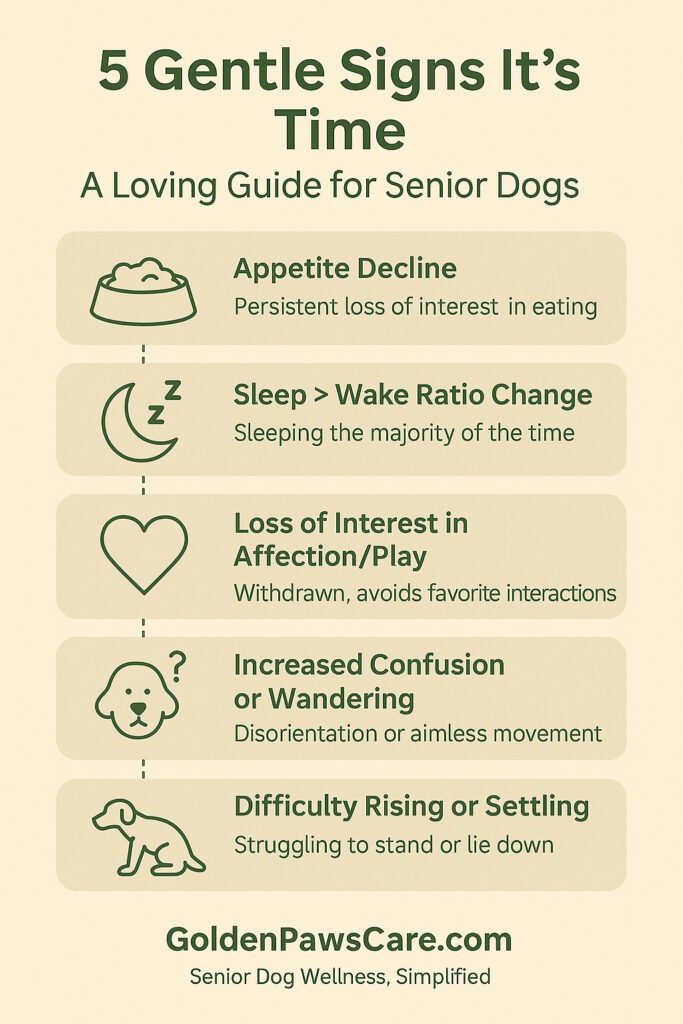
| Marker | What You See | Recommended Action |
|---|---|---|
| Mobility Decline | Difficulty standing, slower rise, stairs avoided | Consult vet for pain/arthritis review; consider quality-of-life tracker |
| Loss of Appetite | Eating less than half usual, refusal of fav treat | Vet check for organ/gastro issues; monitor weight & hydration |
| Chronic Pain Indicators | Vocalizing, shifting positions, inability to settle comfortably | Discuss pain management and comfort care plan |
| Emotional Withdrawal | Becomes less interactive, hides, changes routine preference | Ensure mental-wellness support; offer gentle engagement; vet check for cognitive signs |
Your Most Important Ally: Your Veterinarian
You do not have to walk this path alone. Your veterinarian is your partner in this journey. They can provide a clear medical prognosis, explain the progression of an illness, and offer an objective perspective on your dog’s level of suffering.
Have a frank and heartfelt conversation with them. Ask them the hard questions: “Is my dog in pain?” “If this were your dog, what would you be thinking?” Their compassionate and professional insight is an invaluable source of support and validation.
“When mobility or appetite changes become daily struggles, I ask owners to journal small moments — joy, play, comfort. The pattern speaks louder than any single day.”
— Dr. Sarah Kent, DVM, Veterinary Rehab Specialist
🔗 More Support for Your Journey
🩺 Dr. Kent’s End-of-Life Questions for Senior Dogs
What are the most reliable indicators it’s time to say goodbye?
When your dog shows sustained decline in mobility, appetite, and joy for more than a week—even with treatment—it’s time to discuss comfort-based decisions with your vet.
How do I prepare emotionally for this decision?
Allow yourself to feel anticipatory grief—it is a reflection of your love. Talk openly, journal small moments of joy, and lean on trusted support groups.
What grief resources are available for pet loss?
Consider local pet-loss support hotlines, online groups with certified grief specialists, and keeping a memory journal for your dog’s legacy.
Audience responses reviewed by Dr. Sarah Kent, DVM — Veterinary Behavior & Geriatric Specialist.
— Dr. Sarah Kent, DVM
Navigating Your Own Heart
The decision is agonizing because your love is so deep. Be gentle with yourself. The feelings of guilt, doubt, and overwhelming sadness are not a sign of weakness; they are a sign of that love.
Anticipatory grief is real. It is the sorrow of the impending loss, and it is profoundly painful. Allow yourself to feel it. Talk to friends or family who understand.
And please, absolve yourself of the burden of finding the “perfect” time. There is no perfect time. The goal is to prevent suffering. Many veterinarians will tell you that it is better to say goodbye a week too soon than a day too late. This is not giving up. This is giving them the final, most courageous gift you can: a peaceful end to a life filled with love.
This decision is the final, most selfless act of love you will ever perform for your cherished companion. You are choosing to take their pain onto yourself, in the form of grief, so that they no longer have to suffer. You have given them a lifetime of joy, and in doing so, you have given them the ultimate gift of peace. Their love will be a part of you forever.
If you’re struggling with this decision, remember: love and peace —not guilt —define the end of a good life.
🩺 Vet Insight: Quality of Life in Aging Dogs
“When a dog begins spending more time lying down, struggling to rise, or losing interest in favorite activities, these are consistent predictors of declining quality of life. Early veterinary conversations can allow a more peaceful transition.” — Dr. Kathryn Worsley, DVM, PhD – Canine Geriatric Specialist
🐾 Free Resource for Pet Parents
You can download our printable HHHHHMM Quality-of-Life Scale (PDF) to help track your senior dog’s comfort level, mobility, and happiness — a gentle tool to guide meaningful conversations with your veterinarian.
⬇️ Download the HHHHHMM Tracker (PDF)Recommended by Dr. Sarah Kent, DVM – for peaceful, informed decision-making.
| Marker | What You See | Recommended Action |
|---|---|---|
| Mobility Decline | Difficulty standing, slower rise, stairs avoided | Consult vet for pain/arthritis review; consider quality-of-life tracker |
| Loss of Appetite | Eating less than half usual, refusal of fav treat | Vet check for organ/gastro issues; monitor weight & hydration |
| Chronic Pain Indicators | Vocalizing, shifting positions, inability to settle comfortably | Discuss pain management and comfort care plan |
| Emotional Withdrawal | Becomes less interactive, hides, changes routine preference | Ensure mental-wellness support; offer gentle engagement; vet check for cognitive signs |
Your Most Important Ally: Your Veterinarian
You do not have to walk this path alone. Your veterinarian is your partner in this journey. They can provide a clear medical prognosis, explain the progression of an illness, and offer an objective perspective on your dog’s level of suffering.
Have a frank and heartfelt conversation with them. Ask them the hard questions: “Is my dog in pain?” “If this were your dog, what would you be thinking?” Their compassionate and professional insight is an invaluable source of support and validation.
“When mobility or appetite changes become daily struggles, I ask owners to journal small moments — joy, play, comfort. The pattern speaks louder than any single day.”
— Dr. Sarah Kent, DVM, Veterinary Rehab Specialist
🔗 More Support for Your Journey
🩺 Dr. Kent’s End-of-Life Questions for Senior Dogs
What are the most reliable indicators it’s time to say goodbye?
When your dog shows sustained decline in mobility, appetite, and joy for more than a week—even with treatment—it’s time to discuss comfort-based decisions with your vet.
How do I prepare emotionally for this decision?
Allow yourself to feel anticipatory grief—it is a reflection of your love. Talk openly, journal small moments of joy, and lean on trusted support groups.
What grief resources are available for pet loss?
Consider local pet-loss support hotlines, online groups with certified grief specialists, and keeping a memory journal for your dog’s legacy.
Audience responses reviewed by Dr. Sarah Kent, DVM — Veterinary Behavior & Geriatric Specialist.
— Dr. Sarah Kent, DVM
Navigating Your Own Heart
The decision is agonizing because your love is so deep. Be gentle with yourself. The feelings of guilt, doubt, and overwhelming sadness are not a sign of weakness; they are a sign of that love.
Anticipatory grief is real. It is the sorrow of the impending loss, and it is profoundly painful. Allow yourself to feel it. Talk to friends or family who understand.
And please, absolve yourself of the burden of finding the “perfect” time. There is no perfect time. The goal is to prevent suffering. Many veterinarians will tell you that it is better to say goodbye a week too soon than a day too late. This is not giving up. This is giving them the final, most courageous gift you can: a peaceful end to a life filled with love.
This decision is the final, most selfless act of love you will ever perform for your cherished companion. You are choosing to take their pain onto yourself, in the form of grief, so that they no longer have to suffer. You have given them a lifetime of joy, and in doing so, you have given them the ultimate gift of peace. Their love will be a part of you forever.
If you’re struggling with this decision, remember: love and peace —not guilt —define the end of a good life.
If you are reading this, your heart is likely weighed down by this very burden. Please know, first and foremost, that the pain and uncertainty you feel are a testament to the profound love you share. This is a journey of anticipatory grief, a grieving for a friend who is still by your side, and it is one of the most difficult paths to walk.
There is no single, magical sign, no universal right answer. This decision is a deeply personal one, made in the quiet space between you and the companion who has given you a lifetime of unconditional love. This guide is not meant to give you an answer. Instead, it is meant to offer a framework for clarity, to help you navigate your thoughts and feelings, and to see this impossibly difficult choice for what it truly is: the last, most profound, and most compassionate act of love we can ever offer.
In This Article
The Core Question: Shifting from “Survival” to “Quality of Life”
As pet owners, our first instinct is to do everything we can to fix things, to extend the precious time we have. Modern veterinary medicine often provides us with incredible tools to prolong life. But our ultimate responsibility as their guardians is not just to preserve life, but to protect their quality of life.
What is quality of life from a dog’s perspective? It’s more than just a beating heart and breathing lungs. It’s the freedom from debilitating pain. It’s the ability to eat, drink, and use the bathroom with dignity. It’s the capacity to find joy in the simple things that once defined their happiness—a wagging tail at your arrival, a gentle stroll in the sun, the comfort of a soft bed, the simple pleasure of a good meal.
Often, there isn’t one dramatic moment, but rather a slow, subtle erosion of this quality. The good moments become fewer and farther between, while the moments of struggle and discomfort begin to fill the spaces in between. Our task is to learn to see this shift clearly, through the fog of our own love and hope.
Practical Tools for Assessment: Finding Clarity Through Observation
When emotions are overwhelming, having a gentle, objective framework can be a gift. These tools are not intended to provide a score or a definitive answer, but rather to help you organize your observations and gain a broader perspective.
1. The “Five Good Things” Rule
Think back over your dog’s life and list five things they have always loved to do. These don’t have to be grand adventures; they are the simple, defining joys of their existence.
- Example:
- Greeting you ecstatically at the door.
- Devouring their favorite meal.
- Going for a slow walk around the block.
- Playing with a specific toy.
- Snuggling beside you on the couch.
Now, honestly assess how many of these things your dog can still genuinely enjoy. If they can no longer find pleasure in three or more of these activities, it is a strong indicator that their quality of life has been significantly compromised.
2. The “Good Days vs. Bad Days” Journal
This is a simple but powerful tool. Get a calendar and, at the end of each day, mark it as “good day,” “bad day,” or “neutral day.” A “good day” might be one with minimal pain, a decent appetite, and moments of engagement. A “bad day” might be marked by pain, incontinence, distress, or complete withdrawal.
Over the course of a few weeks, a pattern will emerge that is clearer than our day-to-day emotional memories. When you see that the bad days are consistently starting to outnumber the good, you are gaining an objective and compassionate view of their reality.
When you begin noticing changes day to day, start writing them down.
Even small notes add up. Over a few weeks, patterns become clear.
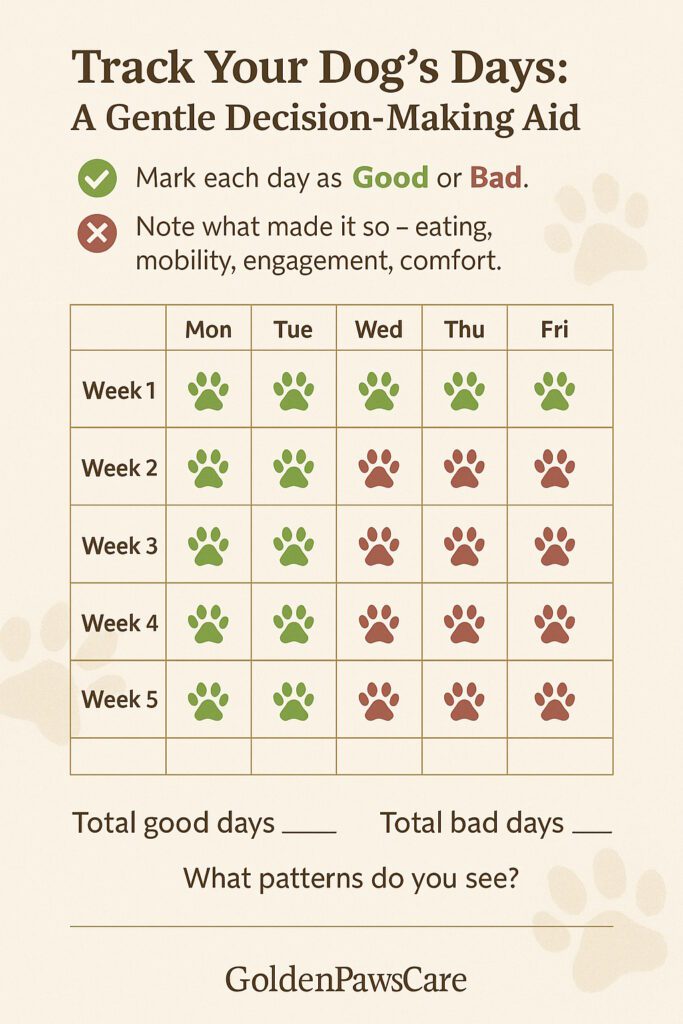
If you’d like a printable version, download our free “Good Days vs. Bad Days Tracker. (CLICK HERE)”
You can also bring it to your vet to discuss what you’re seeing.
3. The HHHHHMM Quality of Life Scale
Developed by veterinarian Dr. Alice Villalobos, this compassionate framework is used by professionals to assess a pet’s well-being. Consider each category on a scale of 1 to 10.
- Hurt: Is their pain being successfully managed? Are they breathing easily and without distress? Some signs of pain are subtle: panting, hiding, reluctance to move, and irritability.
- Hunger: Are they eating enough? Does it require hand-feeding or coaxing? Do they vomit after eating?
- Hydration: Are they drinking enough water to stay hydrated?
- Hygiene: Can they be kept clean? Are they soiling themselves, leading to skin sores or infections?
- Happiness: Do they express joy and interest in their environment, in you, in other pets? Or are they withdrawn, anxious, or fearful?
- Mobility: Can they get up and walk on their own? Do they need significant help? Are they at risk of falling and hurting themselves?
- More: (The summary question) Do they have more good days than bad?
This scale isn’t a test. It is a guided meditation on your dog’s daily experience, helping you see beyond your own hope and focus on their present reality.
🩺 Vet Insight: Quality of Life in Aging Dogs
“When a dog begins spending more time lying down, struggling to rise, or losing interest in favorite activities, these are consistent predictors of declining quality of life. Early veterinary conversations can allow a more peaceful transition.” — Dr. Kathryn Worsley, DVM, PhD – Canine Geriatric Specialist
🐾 Free Resource for Pet Parents
You can download our printable HHHHHMM Quality-of-Life Scale (PDF) to help track your senior dog’s comfort level, mobility, and happiness — a gentle tool to guide meaningful conversations with your veterinarian.
⬇️ Download the HHHHHMM Tracker (PDF)Recommended by Dr. Sarah Kent, DVM – for peaceful, informed decision-making.
| Marker | What You See | Recommended Action |
|---|---|---|
| Mobility Decline | Difficulty standing, slower rise, stairs avoided | Consult vet for pain/arthritis review; consider quality-of-life tracker |
| Loss of Appetite | Eating less than half usual, refusal of fav treat | Vet check for organ/gastro issues; monitor weight & hydration |
| Chronic Pain Indicators | Vocalizing, shifting positions, inability to settle comfortably | Discuss pain management and comfort care plan |
| Emotional Withdrawal | Becomes less interactive, hides, changes routine preference | Ensure mental-wellness support; offer gentle engagement; vet check for cognitive signs |
Your Most Important Ally: Your Veterinarian
You do not have to walk this path alone. Your veterinarian is your partner in this journey. They can provide a clear medical prognosis, explain the progression of an illness, and offer an objective perspective on your dog’s level of suffering.
Have a frank and heartfelt conversation with them. Ask them the hard questions: “Is my dog in pain?” “If this were your dog, what would you be thinking?” Their compassionate and professional insight is an invaluable source of support and validation.
“When mobility or appetite changes become daily struggles, I ask owners to journal small moments — joy, play, comfort. The pattern speaks louder than any single day.”
— Dr. Sarah Kent, DVM, Veterinary Rehab Specialist
🔗 More Support for Your Journey
🩺 Dr. Kent’s End-of-Life Questions for Senior Dogs
What are the most reliable indicators it’s time to say goodbye?
When your dog shows sustained decline in mobility, appetite, and joy for more than a week—even with treatment—it’s time to discuss comfort-based decisions with your vet.
How do I prepare emotionally for this decision?
Allow yourself to feel anticipatory grief—it is a reflection of your love. Talk openly, journal small moments of joy, and lean on trusted support groups.
What grief resources are available for pet loss?
Consider local pet-loss support hotlines, online groups with certified grief specialists, and keeping a memory journal for your dog’s legacy.
Audience responses reviewed by Dr. Sarah Kent, DVM — Veterinary Behavior & Geriatric Specialist.
— Dr. Sarah Kent, DVM
Navigating Your Own Heart
The decision is agonizing because your love is so deep. Be gentle with yourself. The feelings of guilt, doubt, and overwhelming sadness are not a sign of weakness; they are a sign of that love.
Anticipatory grief is real. It is the sorrow of the impending loss, and it is profoundly painful. Allow yourself to feel it. Talk to friends or family who understand.
And please, absolve yourself of the burden of finding the “perfect” time. There is no perfect time. The goal is to prevent suffering. Many veterinarians will tell you that it is better to say goodbye a week too soon than a day too late. This is not giving up. This is giving them the final, most courageous gift you can: a peaceful end to a life filled with love.
This decision is the final, most selfless act of love you will ever perform for your cherished companion. You are choosing to take their pain onto yourself, in the form of grief, so that they no longer have to suffer. You have given them a lifetime of joy, and in doing so, you have given them the ultimate gift of peace. Their love will be a part of you forever.
If you’re struggling with this decision, remember: love and peace —not guilt —define the end of a good life.
There is a conversation that no one who has ever loved a dog wants to have. It’s a quiet, internal dialogue, filled with the heaviest questions a loving heart can carry. We watch our old friends, our loyal shadows, as their steps become slower, their breath more labored, their bright eyes clouded with age or illness. And the question begins to surface, whispered and unwelcome: Is it time?
If you are reading this, your heart is likely weighed down by this very burden. Please know, first and foremost, that the pain and uncertainty you feel are a testament to the profound love you share. This is a journey of anticipatory grief, a grieving for a friend who is still by your side, and it is one of the most difficult paths to walk.
There is no single, magical sign, no universal right answer. This decision is a deeply personal one, made in the quiet space between you and the companion who has given you a lifetime of unconditional love. This guide is not meant to give you an answer. Instead, it is meant to offer a framework for clarity, to help you navigate your thoughts and feelings, and to see this impossibly difficult choice for what it truly is: the last, most profound, and most compassionate act of love we can ever offer.
In This Article
The Core Question: Shifting from “Survival” to “Quality of Life”
As pet owners, our first instinct is to do everything we can to fix things, to extend the precious time we have. Modern veterinary medicine often provides us with incredible tools to prolong life. But our ultimate responsibility as their guardians is not just to preserve life, but to protect their quality of life.
What is quality of life from a dog’s perspective? It’s more than just a beating heart and breathing lungs. It’s the freedom from debilitating pain. It’s the ability to eat, drink, and use the bathroom with dignity. It’s the capacity to find joy in the simple things that once defined their happiness—a wagging tail at your arrival, a gentle stroll in the sun, the comfort of a soft bed, the simple pleasure of a good meal.
Often, there isn’t one dramatic moment, but rather a slow, subtle erosion of this quality. The good moments become fewer and farther between, while the moments of struggle and discomfort begin to fill the spaces in between. Our task is to learn to see this shift clearly, through the fog of our own love and hope.
Practical Tools for Assessment: Finding Clarity Through Observation
When emotions are overwhelming, having a gentle, objective framework can be a gift. These tools are not intended to provide a score or a definitive answer, but rather to help you organize your observations and gain a broader perspective.
1. The “Five Good Things” Rule
Think back over your dog’s life and list five things they have always loved to do. These don’t have to be grand adventures; they are the simple, defining joys of their existence.
- Example:
- Greeting you ecstatically at the door.
- Devouring their favorite meal.
- Going for a slow walk around the block.
- Playing with a specific toy.
- Snuggling beside you on the couch.
Now, honestly assess how many of these things your dog can still genuinely enjoy. If they can no longer find pleasure in three or more of these activities, it is a strong indicator that their quality of life has been significantly compromised.
2. The “Good Days vs. Bad Days” Journal
This is a simple but powerful tool. Get a calendar and, at the end of each day, mark it as “good day,” “bad day,” or “neutral day.” A “good day” might be one with minimal pain, a decent appetite, and moments of engagement. A “bad day” might be marked by pain, incontinence, distress, or complete withdrawal.
Over the course of a few weeks, a pattern will emerge that is clearer than our day-to-day emotional memories. When you see that the bad days are consistently starting to outnumber the good, you are gaining an objective and compassionate view of their reality.
When you begin noticing changes day to day, start writing them down.
Even small notes add up. Over a few weeks, patterns become clear.
If you’d like a printable version, download our free “Good Days vs. Bad Days Tracker. (CLICK HERE)”
You can also bring it to your vet to discuss what you’re seeing.
3. The HHHHHMM Quality of Life Scale
Developed by veterinarian Dr. Alice Villalobos, this compassionate framework is used by professionals to assess a pet’s well-being. Consider each category on a scale of 1 to 10.
- Hurt: Is their pain being successfully managed? Are they breathing easily and without distress? Some signs of pain are subtle: panting, hiding, reluctance to move, and irritability.
- Hunger: Are they eating enough? Does it require hand-feeding or coaxing? Do they vomit after eating?
- Hydration: Are they drinking enough water to stay hydrated?
- Hygiene: Can they be kept clean? Are they soiling themselves, leading to skin sores or infections?
- Happiness: Do they express joy and interest in their environment, in you, in other pets? Or are they withdrawn, anxious, or fearful?
- Mobility: Can they get up and walk on their own? Do they need significant help? Are they at risk of falling and hurting themselves?
- More: (The summary question) Do they have more good days than bad?
This scale isn’t a test. It is a guided meditation on your dog’s daily experience, helping you see beyond your own hope and focus on their present reality.
🩺 Vet Insight: Quality of Life in Aging Dogs
“When a dog begins spending more time lying down, struggling to rise, or losing interest in favorite activities, these are consistent predictors of declining quality of life. Early veterinary conversations can allow a more peaceful transition.” — Dr. Kathryn Worsley, DVM, PhD – Canine Geriatric Specialist
🐾 Free Resource for Pet Parents
You can download our printable HHHHHMM Quality-of-Life Scale (PDF) to help track your senior dog’s comfort level, mobility, and happiness — a gentle tool to guide meaningful conversations with your veterinarian.
⬇️ Download the HHHHHMM Tracker (PDF)Recommended by Dr. Sarah Kent, DVM – for peaceful, informed decision-making.
| Marker | What You See | Recommended Action |
|---|---|---|
| Mobility Decline | Difficulty standing, slower rise, stairs avoided | Consult vet for pain/arthritis review; consider quality-of-life tracker |
| Loss of Appetite | Eating less than half usual, refusal of fav treat | Vet check for organ/gastro issues; monitor weight & hydration |
| Chronic Pain Indicators | Vocalizing, shifting positions, inability to settle comfortably | Discuss pain management and comfort care plan |
| Emotional Withdrawal | Becomes less interactive, hides, changes routine preference | Ensure mental-wellness support; offer gentle engagement; vet check for cognitive signs |
Your Most Important Ally: Your Veterinarian
You do not have to walk this path alone. Your veterinarian is your partner in this journey. They can provide a clear medical prognosis, explain the progression of an illness, and offer an objective perspective on your dog’s level of suffering.
Have a frank and heartfelt conversation with them. Ask them the hard questions: “Is my dog in pain?” “If this were your dog, what would you be thinking?” Their compassionate and professional insight is an invaluable source of support and validation.
“When mobility or appetite changes become daily struggles, I ask owners to journal small moments — joy, play, comfort. The pattern speaks louder than any single day.”
— Dr. Sarah Kent, DVM, Veterinary Rehab Specialist
🔗 More Support for Your Journey
🩺 Dr. Kent’s End-of-Life Questions for Senior Dogs
What are the most reliable indicators it’s time to say goodbye?
When your dog shows sustained decline in mobility, appetite, and joy for more than a week—even with treatment—it’s time to discuss comfort-based decisions with your vet.
How do I prepare emotionally for this decision?
Allow yourself to feel anticipatory grief—it is a reflection of your love. Talk openly, journal small moments of joy, and lean on trusted support groups.
What grief resources are available for pet loss?
Consider local pet-loss support hotlines, online groups with certified grief specialists, and keeping a memory journal for your dog’s legacy.
Audience responses reviewed by Dr. Sarah Kent, DVM — Veterinary Behavior & Geriatric Specialist.
— Dr. Sarah Kent, DVM
Navigating Your Own Heart
The decision is agonizing because your love is so deep. Be gentle with yourself. The feelings of guilt, doubt, and overwhelming sadness are not a sign of weakness; they are a sign of that love.
Anticipatory grief is real. It is the sorrow of the impending loss, and it is profoundly painful. Allow yourself to feel it. Talk to friends or family who understand.
And please, absolve yourself of the burden of finding the “perfect” time. There is no perfect time. The goal is to prevent suffering. Many veterinarians will tell you that it is better to say goodbye a week too soon than a day too late. This is not giving up. This is giving them the final, most courageous gift you can: a peaceful end to a life filled with love.
This decision is the final, most selfless act of love you will ever perform for your cherished companion. You are choosing to take their pain onto yourself, in the form of grief, so that they no longer have to suffer. You have given them a lifetime of joy, and in doing so, you have given them the ultimate gift of peace. Their love will be a part of you forever.
If you’re struggling with this decision, remember: love and peace —not guilt —define the end of a good life.
🔗 More Support for Your Journey
🩺 Dr. Kent’s End-of-Life Questions for Senior Dogs
What are the most reliable indicators it’s time to say goodbye?
When your dog shows sustained decline in mobility, appetite, and joy for more than a week—even with treatment—it’s time to discuss comfort-based decisions with your vet.
How do I prepare emotionally for this decision?
Allow yourself to feel anticipatory grief—it is a reflection of your love. Talk openly, journal small moments of joy, and lean on trusted support groups.
What grief resources are available for pet loss?
Consider local pet-loss support hotlines, online groups with certified grief specialists, and keeping a memory journal for your dog’s legacy.
Audience responses reviewed by Dr. Sarah Kent, DVM — Veterinary Behavior & Geriatric Specialist.
— Dr. Sarah Kent, DVM
Navigating Your Own Heart
The decision is agonizing because your love is so deep. Be gentle with yourself. The feelings of guilt, doubt, and overwhelming sadness are not a sign of weakness; they are a sign of that love.
Anticipatory grief is real. It is the sorrow of the impending loss, and it is profoundly painful. Allow yourself to feel it. Talk to friends or family who understand.
And please, absolve yourself of the burden of finding the “perfect” time. There is no perfect time. The goal is to prevent suffering. Many veterinarians will tell you that it is better to say goodbye a week too soon than a day too late. This is not giving up. This is giving them the final, most courageous gift you can: a peaceful end to a life filled with love.
This decision is the final, most selfless act of love you will ever perform for your cherished companion. You are choosing to take their pain onto yourself, in the form of grief, so that they no longer have to suffer. You have given them a lifetime of joy, and in doing so, you have given them the ultimate gift of peace. Their love will be a part of you forever.
If you’re struggling with this decision, remember: love and peace —not guilt —define the end of a good life.
There is a conversation that no one who has ever loved a dog wants to have. It’s a quiet, internal dialogue, filled with the heaviest questions a loving heart can carry. We watch our old friends, our loyal shadows, as their steps become slower, their breath more labored, their bright eyes clouded with age or illness. And the question begins to surface, whispered and unwelcome: Is it time?
If you are reading this, your heart is likely weighed down by this very burden. Please know, first and foremost, that the pain and uncertainty you feel are a testament to the profound love you share. This is a journey of anticipatory grief, a grieving for a friend who is still by your side, and it is one of the most difficult paths to walk.
There is no single, magical sign, no universal right answer. This decision is a deeply personal one, made in the quiet space between you and the companion who has given you a lifetime of unconditional love. This guide is not meant to give you an answer. Instead, it is meant to offer a framework for clarity, to help you navigate your thoughts and feelings, and to see this impossibly difficult choice for what it truly is: the last, most profound, and most compassionate act of love we can ever offer.
In This Article
The Core Question: Shifting from “Survival” to “Quality of Life”
As pet owners, our first instinct is to do everything we can to fix things, to extend the precious time we have. Modern veterinary medicine often provides us with incredible tools to prolong life. But our ultimate responsibility as their guardians is not just to preserve life, but to protect their quality of life.
What is quality of life from a dog’s perspective? It’s more than just a beating heart and breathing lungs. It’s the freedom from debilitating pain. It’s the ability to eat, drink, and use the bathroom with dignity. It’s the capacity to find joy in the simple things that once defined their happiness—a wagging tail at your arrival, a gentle stroll in the sun, the comfort of a soft bed, the simple pleasure of a good meal.
Often, there isn’t one dramatic moment, but rather a slow, subtle erosion of this quality. The good moments become fewer and farther between, while the moments of struggle and discomfort begin to fill the spaces in between. Our task is to learn to see this shift clearly, through the fog of our own love and hope.
Practical Tools for Assessment: Finding Clarity Through Observation
When emotions are overwhelming, having a gentle, objective framework can be a gift. These tools are not intended to provide a score or a definitive answer, but rather to help you organize your observations and gain a broader perspective.
1. The “Five Good Things” Rule
Think back over your dog’s life and list five things they have always loved to do. These don’t have to be grand adventures; they are the simple, defining joys of their existence.
- Example:
- Greeting you ecstatically at the door.
- Devouring their favorite meal.
- Going for a slow walk around the block.
- Playing with a specific toy.
- Snuggling beside you on the couch.
Now, honestly assess how many of these things your dog can still genuinely enjoy. If they can no longer find pleasure in three or more of these activities, it is a strong indicator that their quality of life has been significantly compromised.
2. The “Good Days vs. Bad Days” Journal
This is a simple but powerful tool. Get a calendar and, at the end of each day, mark it as “good day,” “bad day,” or “neutral day.” A “good day” might be one with minimal pain, a decent appetite, and moments of engagement. A “bad day” might be marked by pain, incontinence, distress, or complete withdrawal.
Over the course of a few weeks, a pattern will emerge that is clearer than our day-to-day emotional memories. When you see that the bad days are consistently starting to outnumber the good, you are gaining an objective and compassionate view of their reality.
When you begin noticing changes day to day, start writing them down.
Even small notes add up. Over a few weeks, patterns become clear.
If you’d like a printable version, download our free “Good Days vs. Bad Days Tracker. (CLICK HERE)”
You can also bring it to your vet to discuss what you’re seeing.
3. The HHHHHMM Quality of Life Scale
Developed by veterinarian Dr. Alice Villalobos, this compassionate framework is used by professionals to assess a pet’s well-being. Consider each category on a scale of 1 to 10.
- Hurt: Is their pain being successfully managed? Are they breathing easily and without distress? Some signs of pain are subtle: panting, hiding, reluctance to move, and irritability.
- Hunger: Are they eating enough? Does it require hand-feeding or coaxing? Do they vomit after eating?
- Hydration: Are they drinking enough water to stay hydrated?
- Hygiene: Can they be kept clean? Are they soiling themselves, leading to skin sores or infections?
- Happiness: Do they express joy and interest in their environment, in you, in other pets? Or are they withdrawn, anxious, or fearful?
- Mobility: Can they get up and walk on their own? Do they need significant help? Are they at risk of falling and hurting themselves?
- More: (The summary question) Do they have more good days than bad?
This scale isn’t a test. It is a guided meditation on your dog’s daily experience, helping you see beyond your own hope and focus on their present reality.
🩺 Vet Insight: Quality of Life in Aging Dogs
“When a dog begins spending more time lying down, struggling to rise, or losing interest in favorite activities, these are consistent predictors of declining quality of life. Early veterinary conversations can allow a more peaceful transition.” — Dr. Kathryn Worsley, DVM, PhD – Canine Geriatric Specialist
🐾 Free Resource for Pet Parents
You can download our printable HHHHHMM Quality-of-Life Scale (PDF) to help track your senior dog’s comfort level, mobility, and happiness — a gentle tool to guide meaningful conversations with your veterinarian.
⬇️ Download the HHHHHMM Tracker (PDF)Recommended by Dr. Sarah Kent, DVM – for peaceful, informed decision-making.
| Marker | What You See | Recommended Action |
|---|---|---|
| Mobility Decline | Difficulty standing, slower rise, stairs avoided | Consult vet for pain/arthritis review; consider quality-of-life tracker |
| Loss of Appetite | Eating less than half usual, refusal of fav treat | Vet check for organ/gastro issues; monitor weight & hydration |
| Chronic Pain Indicators | Vocalizing, shifting positions, inability to settle comfortably | Discuss pain management and comfort care plan |
| Emotional Withdrawal | Becomes less interactive, hides, changes routine preference | Ensure mental-wellness support; offer gentle engagement; vet check for cognitive signs |
Your Most Important Ally: Your Veterinarian
You do not have to walk this path alone. Your veterinarian is your partner in this journey. They can provide a clear medical prognosis, explain the progression of an illness, and offer an objective perspective on your dog’s level of suffering.
Have a frank and heartfelt conversation with them. Ask them the hard questions: “Is my dog in pain?” “If this were your dog, what would you be thinking?” Their compassionate and professional insight is an invaluable source of support and validation.
“When mobility or appetite changes become daily struggles, I ask owners to journal small moments — joy, play, comfort. The pattern speaks louder than any single day.”
— Dr. Sarah Kent, DVM, Veterinary Rehab Specialist
🔗 More Support for Your Journey
🩺 Dr. Kent’s End-of-Life Questions for Senior Dogs
What are the most reliable indicators it’s time to say goodbye?
When your dog shows sustained decline in mobility, appetite, and joy for more than a week—even with treatment—it’s time to discuss comfort-based decisions with your vet.
How do I prepare emotionally for this decision?
Allow yourself to feel anticipatory grief—it is a reflection of your love. Talk openly, journal small moments of joy, and lean on trusted support groups.
What grief resources are available for pet loss?
Consider local pet-loss support hotlines, online groups with certified grief specialists, and keeping a memory journal for your dog’s legacy.
Audience responses reviewed by Dr. Sarah Kent, DVM — Veterinary Behavior & Geriatric Specialist.
— Dr. Sarah Kent, DVM
Navigating Your Own Heart
The decision is agonizing because your love is so deep. Be gentle with yourself. The feelings of guilt, doubt, and overwhelming sadness are not a sign of weakness; they are a sign of that love.
Anticipatory grief is real. It is the sorrow of the impending loss, and it is profoundly painful. Allow yourself to feel it. Talk to friends or family who understand.
And please, absolve yourself of the burden of finding the “perfect” time. There is no perfect time. The goal is to prevent suffering. Many veterinarians will tell you that it is better to say goodbye a week too soon than a day too late. This is not giving up. This is giving them the final, most courageous gift you can: a peaceful end to a life filled with love.
This decision is the final, most selfless act of love you will ever perform for your cherished companion. You are choosing to take their pain onto yourself, in the form of grief, so that they no longer have to suffer. You have given them a lifetime of joy, and in doing so, you have given them the ultimate gift of peace. Their love will be a part of you forever.
If you’re struggling with this decision, remember: love and peace —not guilt —define the end of a good life.
| Marker | What You See | Recommended Action |
|---|---|---|
| Mobility Decline | Difficulty standing, slower rise, stairs avoided | Consult vet for pain/arthritis review; consider quality-of-life tracker |
| Loss of Appetite | Eating less than half usual, refusal of fav treat | Vet check for organ/gastro issues; monitor weight & hydration |
| Chronic Pain Indicators | Vocalizing, shifting positions, inability to settle comfortably | Discuss pain management and comfort care plan |
| Emotional Withdrawal | Becomes less interactive, hides, changes routine preference | Ensure mental-wellness support; offer gentle engagement; vet check for cognitive signs |
Your Most Important Ally: Your Veterinarian
You do not have to walk this path alone. Your veterinarian is your partner in this journey. They can provide a clear medical prognosis, explain the progression of an illness, and offer an objective perspective on your dog’s level of suffering.
Have a frank and heartfelt conversation with them. Ask them the hard questions: “Is my dog in pain?” “If this were your dog, what would you be thinking?” Their compassionate and professional insight is an invaluable source of support and validation.
“When mobility or appetite changes become daily struggles, I ask owners to journal small moments — joy, play, comfort. The pattern speaks louder than any single day.”
— Dr. Sarah Kent, DVM, Veterinary Rehab Specialist
🔗 More Support for Your Journey
🩺 Dr. Kent’s End-of-Life Questions for Senior Dogs
What are the most reliable indicators it’s time to say goodbye?
When your dog shows sustained decline in mobility, appetite, and joy for more than a week—even with treatment—it’s time to discuss comfort-based decisions with your vet.
How do I prepare emotionally for this decision?
Allow yourself to feel anticipatory grief—it is a reflection of your love. Talk openly, journal small moments of joy, and lean on trusted support groups.
What grief resources are available for pet loss?
Consider local pet-loss support hotlines, online groups with certified grief specialists, and keeping a memory journal for your dog’s legacy.
Audience responses reviewed by Dr. Sarah Kent, DVM — Veterinary Behavior & Geriatric Specialist.
— Dr. Sarah Kent, DVM
Navigating Your Own Heart
The decision is agonizing because your love is so deep. Be gentle with yourself. The feelings of guilt, doubt, and overwhelming sadness are not a sign of weakness; they are a sign of that love.
Anticipatory grief is real. It is the sorrow of the impending loss, and it is profoundly painful. Allow yourself to feel it. Talk to friends or family who understand.
And please, absolve yourself of the burden of finding the “perfect” time. There is no perfect time. The goal is to prevent suffering. Many veterinarians will tell you that it is better to say goodbye a week too soon than a day too late. This is not giving up. This is giving them the final, most courageous gift you can: a peaceful end to a life filled with love.
This decision is the final, most selfless act of love you will ever perform for your cherished companion. You are choosing to take their pain onto yourself, in the form of grief, so that they no longer have to suffer. You have given them a lifetime of joy, and in doing so, you have given them the ultimate gift of peace. Their love will be a part of you forever.
If you’re struggling with this decision, remember: love and peace —not guilt —define the end of a good life.
There is a conversation that no one who has ever loved a dog wants to have. It’s a quiet, internal dialogue, filled with the heaviest questions a loving heart can carry. We watch our old friends, our loyal shadows, as their steps become slower, their breath more labored, their bright eyes clouded with age or illness. And the question begins to surface, whispered and unwelcome: Is it time?
If you are reading this, your heart is likely weighed down by this very burden. Please know, first and foremost, that the pain and uncertainty you feel are a testament to the profound love you share. This is a journey of anticipatory grief, a grieving for a friend who is still by your side, and it is one of the most difficult paths to walk.
There is no single, magical sign, no universal right answer. This decision is a deeply personal one, made in the quiet space between you and the companion who has given you a lifetime of unconditional love. This guide is not meant to give you an answer. Instead, it is meant to offer a framework for clarity, to help you navigate your thoughts and feelings, and to see this impossibly difficult choice for what it truly is: the last, most profound, and most compassionate act of love we can ever offer.
In This Article
The Core Question: Shifting from “Survival” to “Quality of Life”
As pet owners, our first instinct is to do everything we can to fix things, to extend the precious time we have. Modern veterinary medicine often provides us with incredible tools to prolong life. But our ultimate responsibility as their guardians is not just to preserve life, but to protect their quality of life.
What is quality of life from a dog’s perspective? It’s more than just a beating heart and breathing lungs. It’s the freedom from debilitating pain. It’s the ability to eat, drink, and use the bathroom with dignity. It’s the capacity to find joy in the simple things that once defined their happiness—a wagging tail at your arrival, a gentle stroll in the sun, the comfort of a soft bed, the simple pleasure of a good meal.
Often, there isn’t one dramatic moment, but rather a slow, subtle erosion of this quality. The good moments become fewer and farther between, while the moments of struggle and discomfort begin to fill the spaces in between. Our task is to learn to see this shift clearly, through the fog of our own love and hope.
Practical Tools for Assessment: Finding Clarity Through Observation
When emotions are overwhelming, having a gentle, objective framework can be a gift. These tools are not intended to provide a score or a definitive answer, but rather to help you organize your observations and gain a broader perspective.
1. The “Five Good Things” Rule
Think back over your dog’s life and list five things they have always loved to do. These don’t have to be grand adventures; they are the simple, defining joys of their existence.
- Example:
- Greeting you ecstatically at the door.
- Devouring their favorite meal.
- Going for a slow walk around the block.
- Playing with a specific toy.
- Snuggling beside you on the couch.
Now, honestly assess how many of these things your dog can still genuinely enjoy. If they can no longer find pleasure in three or more of these activities, it is a strong indicator that their quality of life has been significantly compromised.
2. The “Good Days vs. Bad Days” Journal
This is a simple but powerful tool. Get a calendar and, at the end of each day, mark it as “good day,” “bad day,” or “neutral day.” A “good day” might be one with minimal pain, a decent appetite, and moments of engagement. A “bad day” might be marked by pain, incontinence, distress, or complete withdrawal.
Over the course of a few weeks, a pattern will emerge that is clearer than our day-to-day emotional memories. When you see that the bad days are consistently starting to outnumber the good, you are gaining an objective and compassionate view of their reality.
When you begin noticing changes day to day, start writing them down.
Even small notes add up. Over a few weeks, patterns become clear.
If you’d like a printable version, download our free “Good Days vs. Bad Days Tracker. (CLICK HERE)”
You can also bring it to your vet to discuss what you’re seeing.
3. The HHHHHMM Quality of Life Scale
Developed by veterinarian Dr. Alice Villalobos, this compassionate framework is used by professionals to assess a pet’s well-being. Consider each category on a scale of 1 to 10.
- Hurt: Is their pain being successfully managed? Are they breathing easily and without distress? Some signs of pain are subtle: panting, hiding, reluctance to move, and irritability.
- Hunger: Are they eating enough? Does it require hand-feeding or coaxing? Do they vomit after eating?
- Hydration: Are they drinking enough water to stay hydrated?
- Hygiene: Can they be kept clean? Are they soiling themselves, leading to skin sores or infections?
- Happiness: Do they express joy and interest in their environment, in you, in other pets? Or are they withdrawn, anxious, or fearful?
- Mobility: Can they get up and walk on their own? Do they need significant help? Are they at risk of falling and hurting themselves?
- More: (The summary question) Do they have more good days than bad?
This scale isn’t a test. It is a guided meditation on your dog’s daily experience, helping you see beyond your own hope and focus on their present reality.
🩺 Vet Insight: Quality of Life in Aging Dogs
“When a dog begins spending more time lying down, struggling to rise, or losing interest in favorite activities, these are consistent predictors of declining quality of life. Early veterinary conversations can allow a more peaceful transition.” — Dr. Kathryn Worsley, DVM, PhD – Canine Geriatric Specialist
🐾 Free Resource for Pet Parents
You can download our printable HHHHHMM Quality-of-Life Scale (PDF) to help track your senior dog’s comfort level, mobility, and happiness — a gentle tool to guide meaningful conversations with your veterinarian.
⬇️ Download the HHHHHMM Tracker (PDF)Recommended by Dr. Sarah Kent, DVM – for peaceful, informed decision-making.
| Marker | What You See | Recommended Action |
|---|---|---|
| Mobility Decline | Difficulty standing, slower rise, stairs avoided | Consult vet for pain/arthritis review; consider quality-of-life tracker |
| Loss of Appetite | Eating less than half usual, refusal of fav treat | Vet check for organ/gastro issues; monitor weight & hydration |
| Chronic Pain Indicators | Vocalizing, shifting positions, inability to settle comfortably | Discuss pain management and comfort care plan |
| Emotional Withdrawal | Becomes less interactive, hides, changes routine preference | Ensure mental-wellness support; offer gentle engagement; vet check for cognitive signs |
Your Most Important Ally: Your Veterinarian
You do not have to walk this path alone. Your veterinarian is your partner in this journey. They can provide a clear medical prognosis, explain the progression of an illness, and offer an objective perspective on your dog’s level of suffering.
Have a frank and heartfelt conversation with them. Ask them the hard questions: “Is my dog in pain?” “If this were your dog, what would you be thinking?” Their compassionate and professional insight is an invaluable source of support and validation.
“When mobility or appetite changes become daily struggles, I ask owners to journal small moments — joy, play, comfort. The pattern speaks louder than any single day.”
— Dr. Sarah Kent, DVM, Veterinary Rehab Specialist
🔗 More Support for Your Journey
🩺 Dr. Kent’s End-of-Life Questions for Senior Dogs
What are the most reliable indicators it’s time to say goodbye?
When your dog shows sustained decline in mobility, appetite, and joy for more than a week—even with treatment—it’s time to discuss comfort-based decisions with your vet.
How do I prepare emotionally for this decision?
Allow yourself to feel anticipatory grief—it is a reflection of your love. Talk openly, journal small moments of joy, and lean on trusted support groups.
What grief resources are available for pet loss?
Consider local pet-loss support hotlines, online groups with certified grief specialists, and keeping a memory journal for your dog’s legacy.
Audience responses reviewed by Dr. Sarah Kent, DVM — Veterinary Behavior & Geriatric Specialist.
— Dr. Sarah Kent, DVM
Navigating Your Own Heart
The decision is agonizing because your love is so deep. Be gentle with yourself. The feelings of guilt, doubt, and overwhelming sadness are not a sign of weakness; they are a sign of that love.
Anticipatory grief is real. It is the sorrow of the impending loss, and it is profoundly painful. Allow yourself to feel it. Talk to friends or family who understand.
And please, absolve yourself of the burden of finding the “perfect” time. There is no perfect time. The goal is to prevent suffering. Many veterinarians will tell you that it is better to say goodbye a week too soon than a day too late. This is not giving up. This is giving them the final, most courageous gift you can: a peaceful end to a life filled with love.
This decision is the final, most selfless act of love you will ever perform for your cherished companion. You are choosing to take their pain onto yourself, in the form of grief, so that they no longer have to suffer. You have given them a lifetime of joy, and in doing so, you have given them the ultimate gift of peace. Their love will be a part of you forever.
If you’re struggling with this decision, remember: love and peace —not guilt —define the end of a good life.
🩺 Vet Insight: Quality of Life in Aging Dogs
“When a dog begins spending more time lying down, struggling to rise, or losing interest in favorite activities, these are consistent predictors of declining quality of life. Early veterinary conversations can allow a more peaceful transition.” — Dr. Kathryn Worsley, DVM, PhD – Canine Geriatric Specialist
🐾 Free Resource for Pet Parents
You can download our printable HHHHHMM Quality-of-Life Scale (PDF) to help track your senior dog’s comfort level, mobility, and happiness — a gentle tool to guide meaningful conversations with your veterinarian.
⬇️ Download the HHHHHMM Tracker (PDF)Recommended by Dr. Sarah Kent, DVM – for peaceful, informed decision-making.
| Marker | What You See | Recommended Action |
|---|---|---|
| Mobility Decline | Difficulty standing, slower rise, stairs avoided | Consult vet for pain/arthritis review; consider quality-of-life tracker |
| Loss of Appetite | Eating less than half usual, refusal of fav treat | Vet check for organ/gastro issues; monitor weight & hydration |
| Chronic Pain Indicators | Vocalizing, shifting positions, inability to settle comfortably | Discuss pain management and comfort care plan |
| Emotional Withdrawal | Becomes less interactive, hides, changes routine preference | Ensure mental-wellness support; offer gentle engagement; vet check for cognitive signs |
Your Most Important Ally: Your Veterinarian
You do not have to walk this path alone. Your veterinarian is your partner in this journey. They can provide a clear medical prognosis, explain the progression of an illness, and offer an objective perspective on your dog’s level of suffering.
Have a frank and heartfelt conversation with them. Ask them the hard questions: “Is my dog in pain?” “If this were your dog, what would you be thinking?” Their compassionate and professional insight is an invaluable source of support and validation.
“When mobility or appetite changes become daily struggles, I ask owners to journal small moments — joy, play, comfort. The pattern speaks louder than any single day.”
— Dr. Sarah Kent, DVM, Veterinary Rehab Specialist
🔗 More Support for Your Journey
🩺 Dr. Kent’s End-of-Life Questions for Senior Dogs
What are the most reliable indicators it’s time to say goodbye?
When your dog shows sustained decline in mobility, appetite, and joy for more than a week—even with treatment—it’s time to discuss comfort-based decisions with your vet.
How do I prepare emotionally for this decision?
Allow yourself to feel anticipatory grief—it is a reflection of your love. Talk openly, journal small moments of joy, and lean on trusted support groups.
What grief resources are available for pet loss?
Consider local pet-loss support hotlines, online groups with certified grief specialists, and keeping a memory journal for your dog’s legacy.
Audience responses reviewed by Dr. Sarah Kent, DVM — Veterinary Behavior & Geriatric Specialist.
— Dr. Sarah Kent, DVM
Navigating Your Own Heart
The decision is agonizing because your love is so deep. Be gentle with yourself. The feelings of guilt, doubt, and overwhelming sadness are not a sign of weakness; they are a sign of that love.
Anticipatory grief is real. It is the sorrow of the impending loss, and it is profoundly painful. Allow yourself to feel it. Talk to friends or family who understand.
And please, absolve yourself of the burden of finding the “perfect” time. There is no perfect time. The goal is to prevent suffering. Many veterinarians will tell you that it is better to say goodbye a week too soon than a day too late. This is not giving up. This is giving them the final, most courageous gift you can: a peaceful end to a life filled with love.
This decision is the final, most selfless act of love you will ever perform for your cherished companion. You are choosing to take their pain onto yourself, in the form of grief, so that they no longer have to suffer. You have given them a lifetime of joy, and in doing so, you have given them the ultimate gift of peace. Their love will be a part of you forever.
If you’re struggling with this decision, remember: love and peace —not guilt —define the end of a good life.
There is a conversation that no one who has ever loved a dog wants to have. It’s a quiet, internal dialogue, filled with the heaviest questions a loving heart can carry. We watch our old friends, our loyal shadows, as their steps become slower, their breath more labored, their bright eyes clouded with age or illness. And the question begins to surface, whispered and unwelcome: Is it time?
If you are reading this, your heart is likely weighed down by this very burden. Please know, first and foremost, that the pain and uncertainty you feel are a testament to the profound love you share. This is a journey of anticipatory grief, a grieving for a friend who is still by your side, and it is one of the most difficult paths to walk.
There is no single, magical sign, no universal right answer. This decision is a deeply personal one, made in the quiet space between you and the companion who has given you a lifetime of unconditional love. This guide is not meant to give you an answer. Instead, it is meant to offer a framework for clarity, to help you navigate your thoughts and feelings, and to see this impossibly difficult choice for what it truly is: the last, most profound, and most compassionate act of love we can ever offer.
In This Article
The Core Question: Shifting from “Survival” to “Quality of Life”
As pet owners, our first instinct is to do everything we can to fix things, to extend the precious time we have. Modern veterinary medicine often provides us with incredible tools to prolong life. But our ultimate responsibility as their guardians is not just to preserve life, but to protect their quality of life.
What is quality of life from a dog’s perspective? It’s more than just a beating heart and breathing lungs. It’s the freedom from debilitating pain. It’s the ability to eat, drink, and use the bathroom with dignity. It’s the capacity to find joy in the simple things that once defined their happiness—a wagging tail at your arrival, a gentle stroll in the sun, the comfort of a soft bed, the simple pleasure of a good meal.
Often, there isn’t one dramatic moment, but rather a slow, subtle erosion of this quality. The good moments become fewer and farther between, while the moments of struggle and discomfort begin to fill the spaces in between. Our task is to learn to see this shift clearly, through the fog of our own love and hope.
Practical Tools for Assessment: Finding Clarity Through Observation
When emotions are overwhelming, having a gentle, objective framework can be a gift. These tools are not intended to provide a score or a definitive answer, but rather to help you organize your observations and gain a broader perspective.
1. The “Five Good Things” Rule
Think back over your dog’s life and list five things they have always loved to do. These don’t have to be grand adventures; they are the simple, defining joys of their existence.
- Example:
- Greeting you ecstatically at the door.
- Devouring their favorite meal.
- Going for a slow walk around the block.
- Playing with a specific toy.
- Snuggling beside you on the couch.
Now, honestly assess how many of these things your dog can still genuinely enjoy. If they can no longer find pleasure in three or more of these activities, it is a strong indicator that their quality of life has been significantly compromised.
2. The “Good Days vs. Bad Days” Journal
This is a simple but powerful tool. Get a calendar and, at the end of each day, mark it as “good day,” “bad day,” or “neutral day.” A “good day” might be one with minimal pain, a decent appetite, and moments of engagement. A “bad day” might be marked by pain, incontinence, distress, or complete withdrawal.
Over the course of a few weeks, a pattern will emerge that is clearer than our day-to-day emotional memories. When you see that the bad days are consistently starting to outnumber the good, you are gaining an objective and compassionate view of their reality.
When you begin noticing changes day to day, start writing them down.
Even small notes add up. Over a few weeks, patterns become clear.
If you’d like a printable version, download our free “Good Days vs. Bad Days Tracker. (CLICK HERE)”
You can also bring it to your vet to discuss what you’re seeing.
3. The HHHHHMM Quality of Life Scale
Developed by veterinarian Dr. Alice Villalobos, this compassionate framework is used by professionals to assess a pet’s well-being. Consider each category on a scale of 1 to 10.
- Hurt: Is their pain being successfully managed? Are they breathing easily and without distress? Some signs of pain are subtle: panting, hiding, reluctance to move, and irritability.
- Hunger: Are they eating enough? Does it require hand-feeding or coaxing? Do they vomit after eating?
- Hydration: Are they drinking enough water to stay hydrated?
- Hygiene: Can they be kept clean? Are they soiling themselves, leading to skin sores or infections?
- Happiness: Do they express joy and interest in their environment, in you, in other pets? Or are they withdrawn, anxious, or fearful?
- Mobility: Can they get up and walk on their own? Do they need significant help? Are they at risk of falling and hurting themselves?
- More: (The summary question) Do they have more good days than bad?
This scale isn’t a test. It is a guided meditation on your dog’s daily experience, helping you see beyond your own hope and focus on their present reality.
🩺 Vet Insight: Quality of Life in Aging Dogs
“When a dog begins spending more time lying down, struggling to rise, or losing interest in favorite activities, these are consistent predictors of declining quality of life. Early veterinary conversations can allow a more peaceful transition.” — Dr. Kathryn Worsley, DVM, PhD – Canine Geriatric Specialist
🐾 Free Resource for Pet Parents
You can download our printable HHHHHMM Quality-of-Life Scale (PDF) to help track your senior dog’s comfort level, mobility, and happiness — a gentle tool to guide meaningful conversations with your veterinarian.
⬇️ Download the HHHHHMM Tracker (PDF)Recommended by Dr. Sarah Kent, DVM – for peaceful, informed decision-making.
| Marker | What You See | Recommended Action |
|---|---|---|
| Mobility Decline | Difficulty standing, slower rise, stairs avoided | Consult vet for pain/arthritis review; consider quality-of-life tracker |
| Loss of Appetite | Eating less than half usual, refusal of fav treat | Vet check for organ/gastro issues; monitor weight & hydration |
| Chronic Pain Indicators | Vocalizing, shifting positions, inability to settle comfortably | Discuss pain management and comfort care plan |
| Emotional Withdrawal | Becomes less interactive, hides, changes routine preference | Ensure mental-wellness support; offer gentle engagement; vet check for cognitive signs |
Your Most Important Ally: Your Veterinarian
You do not have to walk this path alone. Your veterinarian is your partner in this journey. They can provide a clear medical prognosis, explain the progression of an illness, and offer an objective perspective on your dog’s level of suffering.
Have a frank and heartfelt conversation with them. Ask them the hard questions: “Is my dog in pain?” “If this were your dog, what would you be thinking?” Their compassionate and professional insight is an invaluable source of support and validation.
“When mobility or appetite changes become daily struggles, I ask owners to journal small moments — joy, play, comfort. The pattern speaks louder than any single day.”
— Dr. Sarah Kent, DVM, Veterinary Rehab Specialist
🔗 More Support for Your Journey
🩺 Dr. Kent’s End-of-Life Questions for Senior Dogs
What are the most reliable indicators it’s time to say goodbye?
When your dog shows sustained decline in mobility, appetite, and joy for more than a week—even with treatment—it’s time to discuss comfort-based decisions with your vet.
How do I prepare emotionally for this decision?
Allow yourself to feel anticipatory grief—it is a reflection of your love. Talk openly, journal small moments of joy, and lean on trusted support groups.
What grief resources are available for pet loss?
Consider local pet-loss support hotlines, online groups with certified grief specialists, and keeping a memory journal for your dog’s legacy.
Audience responses reviewed by Dr. Sarah Kent, DVM — Veterinary Behavior & Geriatric Specialist.
— Dr. Sarah Kent, DVM
Navigating Your Own Heart
The decision is agonizing because your love is so deep. Be gentle with yourself. The feelings of guilt, doubt, and overwhelming sadness are not a sign of weakness; they are a sign of that love.
Anticipatory grief is real. It is the sorrow of the impending loss, and it is profoundly painful. Allow yourself to feel it. Talk to friends or family who understand.
And please, absolve yourself of the burden of finding the “perfect” time. There is no perfect time. The goal is to prevent suffering. Many veterinarians will tell you that it is better to say goodbye a week too soon than a day too late. This is not giving up. This is giving them the final, most courageous gift you can: a peaceful end to a life filled with love.
This decision is the final, most selfless act of love you will ever perform for your cherished companion. You are choosing to take their pain onto yourself, in the form of grief, so that they no longer have to suffer. You have given them a lifetime of joy, and in doing so, you have given them the ultimate gift of peace. Their love will be a part of you forever.
If you’re struggling with this decision, remember: love and peace —not guilt —define the end of a good life.
If you are reading this, your heart is likely weighed down by this very burden. Please know, first and foremost, that the pain and uncertainty you feel are a testament to the profound love you share. This is a journey of anticipatory grief, a grieving for a friend who is still by your side, and it is one of the most difficult paths to walk.
There is no single, magical sign, no universal right answer. This decision is a deeply personal one, made in the quiet space between you and the companion who has given you a lifetime of unconditional love. This guide is not meant to give you an answer. Instead, it is meant to offer a framework for clarity, to help you navigate your thoughts and feelings, and to see this impossibly difficult choice for what it truly is: the last, most profound, and most compassionate act of love we can ever offer.
In This Article
The Core Question: Shifting from “Survival” to “Quality of Life”
As pet owners, our first instinct is to do everything we can to fix things, to extend the precious time we have. Modern veterinary medicine often provides us with incredible tools to prolong life. But our ultimate responsibility as their guardians is not just to preserve life, but to protect their quality of life.
What is quality of life from a dog’s perspective? It’s more than just a beating heart and breathing lungs. It’s the freedom from debilitating pain. It’s the ability to eat, drink, and use the bathroom with dignity. It’s the capacity to find joy in the simple things that once defined their happiness—a wagging tail at your arrival, a gentle stroll in the sun, the comfort of a soft bed, the simple pleasure of a good meal.
Often, there isn’t one dramatic moment, but rather a slow, subtle erosion of this quality. The good moments become fewer and farther between, while the moments of struggle and discomfort begin to fill the spaces in between. Our task is to learn to see this shift clearly, through the fog of our own love and hope.
Practical Tools for Assessment: Finding Clarity Through Observation
When emotions are overwhelming, having a gentle, objective framework can be a gift. These tools are not intended to provide a score or a definitive answer, but rather to help you organize your observations and gain a broader perspective.
1. The “Five Good Things” Rule
Think back over your dog’s life and list five things they have always loved to do. These don’t have to be grand adventures; they are the simple, defining joys of their existence.
- Example:
- Greeting you ecstatically at the door.
- Devouring their favorite meal.
- Going for a slow walk around the block.
- Playing with a specific toy.
- Snuggling beside you on the couch.
Now, honestly assess how many of these things your dog can still genuinely enjoy. If they can no longer find pleasure in three or more of these activities, it is a strong indicator that their quality of life has been significantly compromised.
2. The “Good Days vs. Bad Days” Journal
This is a simple but powerful tool. Get a calendar and, at the end of each day, mark it as “good day,” “bad day,” or “neutral day.” A “good day” might be one with minimal pain, a decent appetite, and moments of engagement. A “bad day” might be marked by pain, incontinence, distress, or complete withdrawal.
Over the course of a few weeks, a pattern will emerge that is clearer than our day-to-day emotional memories. When you see that the bad days are consistently starting to outnumber the good, you are gaining an objective and compassionate view of their reality.
When you begin noticing changes day to day, start writing them down.
Even small notes add up. Over a few weeks, patterns become clear.
If you’d like a printable version, download our free “Good Days vs. Bad Days Tracker. (CLICK HERE)”
You can also bring it to your vet to discuss what you’re seeing.
3. The HHHHHMM Quality of Life Scale
Developed by veterinarian Dr. Alice Villalobos, this compassionate framework is used by professionals to assess a pet’s well-being. Consider each category on a scale of 1 to 10.
- Hurt: Is their pain being successfully managed? Are they breathing easily and without distress? Some signs of pain are subtle: panting, hiding, reluctance to move, and irritability.
- Hunger: Are they eating enough? Does it require hand-feeding or coaxing? Do they vomit after eating?
- Hydration: Are they drinking enough water to stay hydrated?
- Hygiene: Can they be kept clean? Are they soiling themselves, leading to skin sores or infections?
- Happiness: Do they express joy and interest in their environment, in you, in other pets? Or are they withdrawn, anxious, or fearful?
- Mobility: Can they get up and walk on their own? Do they need significant help? Are they at risk of falling and hurting themselves?
- More: (The summary question) Do they have more good days than bad?
This scale isn’t a test. It is a guided meditation on your dog’s daily experience, helping you see beyond your own hope and focus on their present reality.
🩺 Vet Insight: Quality of Life in Aging Dogs
“When a dog begins spending more time lying down, struggling to rise, or losing interest in favorite activities, these are consistent predictors of declining quality of life. Early veterinary conversations can allow a more peaceful transition.” — Dr. Kathryn Worsley, DVM, PhD – Canine Geriatric Specialist
🐾 Free Resource for Pet Parents
You can download our printable HHHHHMM Quality-of-Life Scale (PDF) to help track your senior dog’s comfort level, mobility, and happiness — a gentle tool to guide meaningful conversations with your veterinarian.
⬇️ Download the HHHHHMM Tracker (PDF)Recommended by Dr. Sarah Kent, DVM – for peaceful, informed decision-making.
| Marker | What You See | Recommended Action |
|---|---|---|
| Mobility Decline | Difficulty standing, slower rise, stairs avoided | Consult vet for pain/arthritis review; consider quality-of-life tracker |
| Loss of Appetite | Eating less than half usual, refusal of fav treat | Vet check for organ/gastro issues; monitor weight & hydration |
| Chronic Pain Indicators | Vocalizing, shifting positions, inability to settle comfortably | Discuss pain management and comfort care plan |
| Emotional Withdrawal | Becomes less interactive, hides, changes routine preference | Ensure mental-wellness support; offer gentle engagement; vet check for cognitive signs |
Your Most Important Ally: Your Veterinarian
You do not have to walk this path alone. Your veterinarian is your partner in this journey. They can provide a clear medical prognosis, explain the progression of an illness, and offer an objective perspective on your dog’s level of suffering.
Have a frank and heartfelt conversation with them. Ask them the hard questions: “Is my dog in pain?” “If this were your dog, what would you be thinking?” Their compassionate and professional insight is an invaluable source of support and validation.
“When mobility or appetite changes become daily struggles, I ask owners to journal small moments — joy, play, comfort. The pattern speaks louder than any single day.”
— Dr. Sarah Kent, DVM, Veterinary Rehab Specialist
🔗 More Support for Your Journey
🩺 Dr. Kent’s End-of-Life Questions for Senior Dogs
What are the most reliable indicators it’s time to say goodbye?
When your dog shows sustained decline in mobility, appetite, and joy for more than a week—even with treatment—it’s time to discuss comfort-based decisions with your vet.
How do I prepare emotionally for this decision?
Allow yourself to feel anticipatory grief—it is a reflection of your love. Talk openly, journal small moments of joy, and lean on trusted support groups.
What grief resources are available for pet loss?
Consider local pet-loss support hotlines, online groups with certified grief specialists, and keeping a memory journal for your dog’s legacy.
Audience responses reviewed by Dr. Sarah Kent, DVM — Veterinary Behavior & Geriatric Specialist.
— Dr. Sarah Kent, DVM
Navigating Your Own Heart
The decision is agonizing because your love is so deep. Be gentle with yourself. The feelings of guilt, doubt, and overwhelming sadness are not a sign of weakness; they are a sign of that love.
Anticipatory grief is real. It is the sorrow of the impending loss, and it is profoundly painful. Allow yourself to feel it. Talk to friends or family who understand.
And please, absolve yourself of the burden of finding the “perfect” time. There is no perfect time. The goal is to prevent suffering. Many veterinarians will tell you that it is better to say goodbye a week too soon than a day too late. This is not giving up. This is giving them the final, most courageous gift you can: a peaceful end to a life filled with love.
This decision is the final, most selfless act of love you will ever perform for your cherished companion. You are choosing to take their pain onto yourself, in the form of grief, so that they no longer have to suffer. You have given them a lifetime of joy, and in doing so, you have given them the ultimate gift of peace. Their love will be a part of you forever.
If you’re struggling with this decision, remember: love and peace —not guilt —define the end of a good life.
There is a conversation that no one who has ever loved a dog wants to have. It’s a quiet, internal dialogue, filled with the heaviest questions a loving heart can carry. We watch our old friends, our loyal shadows, as their steps become slower, their breath more labored, their bright eyes clouded with age or illness. And the question begins to surface, whispered and unwelcome: Is it time?
If you are reading this, your heart is likely weighed down by this very burden. Please know, first and foremost, that the pain and uncertainty you feel are a testament to the profound love you share. This is a journey of anticipatory grief, a grieving for a friend who is still by your side, and it is one of the most difficult paths to walk.
There is no single, magical sign, no universal right answer. This decision is a deeply personal one, made in the quiet space between you and the companion who has given you a lifetime of unconditional love. This guide is not meant to give you an answer. Instead, it is meant to offer a framework for clarity, to help you navigate your thoughts and feelings, and to see this impossibly difficult choice for what it truly is: the last, most profound, and most compassionate act of love we can ever offer.
In This Article
The Core Question: Shifting from “Survival” to “Quality of Life”
As pet owners, our first instinct is to do everything we can to fix things, to extend the precious time we have. Modern veterinary medicine often provides us with incredible tools to prolong life. But our ultimate responsibility as their guardians is not just to preserve life, but to protect their quality of life.
What is quality of life from a dog’s perspective? It’s more than just a beating heart and breathing lungs. It’s the freedom from debilitating pain. It’s the ability to eat, drink, and use the bathroom with dignity. It’s the capacity to find joy in the simple things that once defined their happiness—a wagging tail at your arrival, a gentle stroll in the sun, the comfort of a soft bed, the simple pleasure of a good meal.
Often, there isn’t one dramatic moment, but rather a slow, subtle erosion of this quality. The good moments become fewer and farther between, while the moments of struggle and discomfort begin to fill the spaces in between. Our task is to learn to see this shift clearly, through the fog of our own love and hope.
Practical Tools for Assessment: Finding Clarity Through Observation
When emotions are overwhelming, having a gentle, objective framework can be a gift. These tools are not intended to provide a score or a definitive answer, but rather to help you organize your observations and gain a broader perspective.
1. The “Five Good Things” Rule
Think back over your dog’s life and list five things they have always loved to do. These don’t have to be grand adventures; they are the simple, defining joys of their existence.
- Example:
- Greeting you ecstatically at the door.
- Devouring their favorite meal.
- Going for a slow walk around the block.
- Playing with a specific toy.
- Snuggling beside you on the couch.
Now, honestly assess how many of these things your dog can still genuinely enjoy. If they can no longer find pleasure in three or more of these activities, it is a strong indicator that their quality of life has been significantly compromised.
2. The “Good Days vs. Bad Days” Journal
This is a simple but powerful tool. Get a calendar and, at the end of each day, mark it as “good day,” “bad day,” or “neutral day.” A “good day” might be one with minimal pain, a decent appetite, and moments of engagement. A “bad day” might be marked by pain, incontinence, distress, or complete withdrawal.
Over the course of a few weeks, a pattern will emerge that is clearer than our day-to-day emotional memories. When you see that the bad days are consistently starting to outnumber the good, you are gaining an objective and compassionate view of their reality.
When you begin noticing changes day to day, start writing them down.
Even small notes add up. Over a few weeks, patterns become clear.
If you’d like a printable version, download our free “Good Days vs. Bad Days Tracker. (CLICK HERE)”
You can also bring it to your vet to discuss what you’re seeing.
3. The HHHHHMM Quality of Life Scale
Developed by veterinarian Dr. Alice Villalobos, this compassionate framework is used by professionals to assess a pet’s well-being. Consider each category on a scale of 1 to 10.
- Hurt: Is their pain being successfully managed? Are they breathing easily and without distress? Some signs of pain are subtle: panting, hiding, reluctance to move, and irritability.
- Hunger: Are they eating enough? Does it require hand-feeding or coaxing? Do they vomit after eating?
- Hydration: Are they drinking enough water to stay hydrated?
- Hygiene: Can they be kept clean? Are they soiling themselves, leading to skin sores or infections?
- Happiness: Do they express joy and interest in their environment, in you, in other pets? Or are they withdrawn, anxious, or fearful?
- Mobility: Can they get up and walk on their own? Do they need significant help? Are they at risk of falling and hurting themselves?
- More: (The summary question) Do they have more good days than bad?
This scale isn’t a test. It is a guided meditation on your dog’s daily experience, helping you see beyond your own hope and focus on their present reality.
🩺 Vet Insight: Quality of Life in Aging Dogs
“When a dog begins spending more time lying down, struggling to rise, or losing interest in favorite activities, these are consistent predictors of declining quality of life. Early veterinary conversations can allow a more peaceful transition.” — Dr. Kathryn Worsley, DVM, PhD – Canine Geriatric Specialist
🐾 Free Resource for Pet Parents
You can download our printable HHHHHMM Quality-of-Life Scale (PDF) to help track your senior dog’s comfort level, mobility, and happiness — a gentle tool to guide meaningful conversations with your veterinarian.
⬇️ Download the HHHHHMM Tracker (PDF)Recommended by Dr. Sarah Kent, DVM – for peaceful, informed decision-making.
| Marker | What You See | Recommended Action |
|---|---|---|
| Mobility Decline | Difficulty standing, slower rise, stairs avoided | Consult vet for pain/arthritis review; consider quality-of-life tracker |
| Loss of Appetite | Eating less than half usual, refusal of fav treat | Vet check for organ/gastro issues; monitor weight & hydration |
| Chronic Pain Indicators | Vocalizing, shifting positions, inability to settle comfortably | Discuss pain management and comfort care plan |
| Emotional Withdrawal | Becomes less interactive, hides, changes routine preference | Ensure mental-wellness support; offer gentle engagement; vet check for cognitive signs |
Your Most Important Ally: Your Veterinarian
You do not have to walk this path alone. Your veterinarian is your partner in this journey. They can provide a clear medical prognosis, explain the progression of an illness, and offer an objective perspective on your dog’s level of suffering.
Have a frank and heartfelt conversation with them. Ask them the hard questions: “Is my dog in pain?” “If this were your dog, what would you be thinking?” Their compassionate and professional insight is an invaluable source of support and validation.
“When mobility or appetite changes become daily struggles, I ask owners to journal small moments — joy, play, comfort. The pattern speaks louder than any single day.”
— Dr. Sarah Kent, DVM, Veterinary Rehab Specialist
🔗 More Support for Your Journey
🩺 Dr. Kent’s End-of-Life Questions for Senior Dogs
What are the most reliable indicators it’s time to say goodbye?
When your dog shows sustained decline in mobility, appetite, and joy for more than a week—even with treatment—it’s time to discuss comfort-based decisions with your vet.
How do I prepare emotionally for this decision?
Allow yourself to feel anticipatory grief—it is a reflection of your love. Talk openly, journal small moments of joy, and lean on trusted support groups.
What grief resources are available for pet loss?
Consider local pet-loss support hotlines, online groups with certified grief specialists, and keeping a memory journal for your dog’s legacy.
Audience responses reviewed by Dr. Sarah Kent, DVM — Veterinary Behavior & Geriatric Specialist.
— Dr. Sarah Kent, DVM
Navigating Your Own Heart
The decision is agonizing because your love is so deep. Be gentle with yourself. The feelings of guilt, doubt, and overwhelming sadness are not a sign of weakness; they are a sign of that love.
Anticipatory grief is real. It is the sorrow of the impending loss, and it is profoundly painful. Allow yourself to feel it. Talk to friends or family who understand.
And please, absolve yourself of the burden of finding the “perfect” time. There is no perfect time. The goal is to prevent suffering. Many veterinarians will tell you that it is better to say goodbye a week too soon than a day too late. This is not giving up. This is giving them the final, most courageous gift you can: a peaceful end to a life filled with love.
This decision is the final, most selfless act of love you will ever perform for your cherished companion. You are choosing to take their pain onto yourself, in the form of grief, so that they no longer have to suffer. You have given them a lifetime of joy, and in doing so, you have given them the ultimate gift of peace. Their love will be a part of you forever.
If you’re struggling with this decision, remember: love and peace —not guilt —define the end of a good life.
🔗 More Support for Your Journey
🩺 Dr. Kent’s End-of-Life Questions for Senior Dogs
What are the most reliable indicators it’s time to say goodbye?
When your dog shows sustained decline in mobility, appetite, and joy for more than a week—even with treatment—it’s time to discuss comfort-based decisions with your vet.
How do I prepare emotionally for this decision?
Allow yourself to feel anticipatory grief—it is a reflection of your love. Talk openly, journal small moments of joy, and lean on trusted support groups.
What grief resources are available for pet loss?
Consider local pet-loss support hotlines, online groups with certified grief specialists, and keeping a memory journal for your dog’s legacy.
Audience responses reviewed by Dr. Sarah Kent, DVM — Veterinary Behavior & Geriatric Specialist.
— Dr. Sarah Kent, DVM
Navigating Your Own Heart
The decision is agonizing because your love is so deep. Be gentle with yourself. The feelings of guilt, doubt, and overwhelming sadness are not a sign of weakness; they are a sign of that love.
Anticipatory grief is real. It is the sorrow of the impending loss, and it is profoundly painful. Allow yourself to feel it. Talk to friends or family who understand.
And please, absolve yourself of the burden of finding the “perfect” time. There is no perfect time. The goal is to prevent suffering. Many veterinarians will tell you that it is better to say goodbye a week too soon than a day too late. This is not giving up. This is giving them the final, most courageous gift you can: a peaceful end to a life filled with love.
This decision is the final, most selfless act of love you will ever perform for your cherished companion. You are choosing to take their pain onto yourself, in the form of grief, so that they no longer have to suffer. You have given them a lifetime of joy, and in doing so, you have given them the ultimate gift of peace. Their love will be a part of you forever.
If you’re struggling with this decision, remember: love and peace —not guilt —define the end of a good life.
If you are reading this, your heart is likely weighed down by this very burden. Please know, first and foremost, that the pain and uncertainty you feel are a testament to the profound love you share. This is a journey of anticipatory grief, a grieving for a friend who is still by your side, and it is one of the most difficult paths to walk.
There is no single, magical sign, no universal right answer. This decision is a deeply personal one, made in the quiet space between you and the companion who has given you a lifetime of unconditional love. This guide is not meant to give you an answer. Instead, it is meant to offer a framework for clarity, to help you navigate your thoughts and feelings, and to see this impossibly difficult choice for what it truly is: the last, most profound, and most compassionate act of love we can ever offer.
In This Article
The Core Question: Shifting from “Survival” to “Quality of Life”
As pet owners, our first instinct is to do everything we can to fix things, to extend the precious time we have. Modern veterinary medicine often provides us with incredible tools to prolong life. But our ultimate responsibility as their guardians is not just to preserve life, but to protect their quality of life.
What is quality of life from a dog’s perspective? It’s more than just a beating heart and breathing lungs. It’s the freedom from debilitating pain. It’s the ability to eat, drink, and use the bathroom with dignity. It’s the capacity to find joy in the simple things that once defined their happiness—a wagging tail at your arrival, a gentle stroll in the sun, the comfort of a soft bed, the simple pleasure of a good meal.
Often, there isn’t one dramatic moment, but rather a slow, subtle erosion of this quality. The good moments become fewer and farther between, while the moments of struggle and discomfort begin to fill the spaces in between. Our task is to learn to see this shift clearly, through the fog of our own love and hope.
Practical Tools for Assessment: Finding Clarity Through Observation
When emotions are overwhelming, having a gentle, objective framework can be a gift. These tools are not intended to provide a score or a definitive answer, but rather to help you organize your observations and gain a broader perspective.
1. The “Five Good Things” Rule
Think back over your dog’s life and list five things they have always loved to do. These don’t have to be grand adventures; they are the simple, defining joys of their existence.
- Example:
- Greeting you ecstatically at the door.
- Devouring their favorite meal.
- Going for a slow walk around the block.
- Playing with a specific toy.
- Snuggling beside you on the couch.
Now, honestly assess how many of these things your dog can still genuinely enjoy. If they can no longer find pleasure in three or more of these activities, it is a strong indicator that their quality of life has been significantly compromised.
2. The “Good Days vs. Bad Days” Journal
This is a simple but powerful tool. Get a calendar and, at the end of each day, mark it as “good day,” “bad day,” or “neutral day.” A “good day” might be one with minimal pain, a decent appetite, and moments of engagement. A “bad day” might be marked by pain, incontinence, distress, or complete withdrawal.
Over the course of a few weeks, a pattern will emerge that is clearer than our day-to-day emotional memories. When you see that the bad days are consistently starting to outnumber the good, you are gaining an objective and compassionate view of their reality.
When you begin noticing changes day to day, start writing them down.
Even small notes add up. Over a few weeks, patterns become clear.
If you’d like a printable version, download our free “Good Days vs. Bad Days Tracker. (CLICK HERE)”
You can also bring it to your vet to discuss what you’re seeing.
3. The HHHHHMM Quality of Life Scale
Developed by veterinarian Dr. Alice Villalobos, this compassionate framework is used by professionals to assess a pet’s well-being. Consider each category on a scale of 1 to 10.
- Hurt: Is their pain being successfully managed? Are they breathing easily and without distress? Some signs of pain are subtle: panting, hiding, reluctance to move, and irritability.
- Hunger: Are they eating enough? Does it require hand-feeding or coaxing? Do they vomit after eating?
- Hydration: Are they drinking enough water to stay hydrated?
- Hygiene: Can they be kept clean? Are they soiling themselves, leading to skin sores or infections?
- Happiness: Do they express joy and interest in their environment, in you, in other pets? Or are they withdrawn, anxious, or fearful?
- Mobility: Can they get up and walk on their own? Do they need significant help? Are they at risk of falling and hurting themselves?
- More: (The summary question) Do they have more good days than bad?
This scale isn’t a test. It is a guided meditation on your dog’s daily experience, helping you see beyond your own hope and focus on their present reality.
🩺 Vet Insight: Quality of Life in Aging Dogs
“When a dog begins spending more time lying down, struggling to rise, or losing interest in favorite activities, these are consistent predictors of declining quality of life. Early veterinary conversations can allow a more peaceful transition.” — Dr. Kathryn Worsley, DVM, PhD – Canine Geriatric Specialist
🐾 Free Resource for Pet Parents
You can download our printable HHHHHMM Quality-of-Life Scale (PDF) to help track your senior dog’s comfort level, mobility, and happiness — a gentle tool to guide meaningful conversations with your veterinarian.
⬇️ Download the HHHHHMM Tracker (PDF)Recommended by Dr. Sarah Kent, DVM – for peaceful, informed decision-making.
| Marker | What You See | Recommended Action |
|---|---|---|
| Mobility Decline | Difficulty standing, slower rise, stairs avoided | Consult vet for pain/arthritis review; consider quality-of-life tracker |
| Loss of Appetite | Eating less than half usual, refusal of fav treat | Vet check for organ/gastro issues; monitor weight & hydration |
| Chronic Pain Indicators | Vocalizing, shifting positions, inability to settle comfortably | Discuss pain management and comfort care plan |
| Emotional Withdrawal | Becomes less interactive, hides, changes routine preference | Ensure mental-wellness support; offer gentle engagement; vet check for cognitive signs |
Your Most Important Ally: Your Veterinarian
You do not have to walk this path alone. Your veterinarian is your partner in this journey. They can provide a clear medical prognosis, explain the progression of an illness, and offer an objective perspective on your dog’s level of suffering.
Have a frank and heartfelt conversation with them. Ask them the hard questions: “Is my dog in pain?” “If this were your dog, what would you be thinking?” Their compassionate and professional insight is an invaluable source of support and validation.
“When mobility or appetite changes become daily struggles, I ask owners to journal small moments — joy, play, comfort. The pattern speaks louder than any single day.”
— Dr. Sarah Kent, DVM, Veterinary Rehab Specialist
🔗 More Support for Your Journey
🩺 Dr. Kent’s End-of-Life Questions for Senior Dogs
What are the most reliable indicators it’s time to say goodbye?
When your dog shows sustained decline in mobility, appetite, and joy for more than a week—even with treatment—it’s time to discuss comfort-based decisions with your vet.
How do I prepare emotionally for this decision?
Allow yourself to feel anticipatory grief—it is a reflection of your love. Talk openly, journal small moments of joy, and lean on trusted support groups.
What grief resources are available for pet loss?
Consider local pet-loss support hotlines, online groups with certified grief specialists, and keeping a memory journal for your dog’s legacy.
Audience responses reviewed by Dr. Sarah Kent, DVM — Veterinary Behavior & Geriatric Specialist.
— Dr. Sarah Kent, DVM
Navigating Your Own Heart
The decision is agonizing because your love is so deep. Be gentle with yourself. The feelings of guilt, doubt, and overwhelming sadness are not a sign of weakness; they are a sign of that love.
Anticipatory grief is real. It is the sorrow of the impending loss, and it is profoundly painful. Allow yourself to feel it. Talk to friends or family who understand.
And please, absolve yourself of the burden of finding the “perfect” time. There is no perfect time. The goal is to prevent suffering. Many veterinarians will tell you that it is better to say goodbye a week too soon than a day too late. This is not giving up. This is giving them the final, most courageous gift you can: a peaceful end to a life filled with love.
This decision is the final, most selfless act of love you will ever perform for your cherished companion. You are choosing to take their pain onto yourself, in the form of grief, so that they no longer have to suffer. You have given them a lifetime of joy, and in doing so, you have given them the ultimate gift of peace. Their love will be a part of you forever.
If you’re struggling with this decision, remember: love and peace —not guilt —define the end of a good life.
There is a conversation that no one who has ever loved a dog wants to have. It’s a quiet, internal dialogue, filled with the heaviest questions a loving heart can carry. We watch our old friends, our loyal shadows, as their steps become slower, their breath more labored, their bright eyes clouded with age or illness. And the question begins to surface, whispered and unwelcome: Is it time?
If you are reading this, your heart is likely weighed down by this very burden. Please know, first and foremost, that the pain and uncertainty you feel are a testament to the profound love you share. This is a journey of anticipatory grief, a grieving for a friend who is still by your side, and it is one of the most difficult paths to walk.
There is no single, magical sign, no universal right answer. This decision is a deeply personal one, made in the quiet space between you and the companion who has given you a lifetime of unconditional love. This guide is not meant to give you an answer. Instead, it is meant to offer a framework for clarity, to help you navigate your thoughts and feelings, and to see this impossibly difficult choice for what it truly is: the last, most profound, and most compassionate act of love we can ever offer.
In This Article
The Core Question: Shifting from “Survival” to “Quality of Life”
As pet owners, our first instinct is to do everything we can to fix things, to extend the precious time we have. Modern veterinary medicine often provides us with incredible tools to prolong life. But our ultimate responsibility as their guardians is not just to preserve life, but to protect their quality of life.
What is quality of life from a dog’s perspective? It’s more than just a beating heart and breathing lungs. It’s the freedom from debilitating pain. It’s the ability to eat, drink, and use the bathroom with dignity. It’s the capacity to find joy in the simple things that once defined their happiness—a wagging tail at your arrival, a gentle stroll in the sun, the comfort of a soft bed, the simple pleasure of a good meal.
Often, there isn’t one dramatic moment, but rather a slow, subtle erosion of this quality. The good moments become fewer and farther between, while the moments of struggle and discomfort begin to fill the spaces in between. Our task is to learn to see this shift clearly, through the fog of our own love and hope.
Practical Tools for Assessment: Finding Clarity Through Observation
When emotions are overwhelming, having a gentle, objective framework can be a gift. These tools are not intended to provide a score or a definitive answer, but rather to help you organize your observations and gain a broader perspective.
1. The “Five Good Things” Rule
Think back over your dog’s life and list five things they have always loved to do. These don’t have to be grand adventures; they are the simple, defining joys of their existence.
- Example:
- Greeting you ecstatically at the door.
- Devouring their favorite meal.
- Going for a slow walk around the block.
- Playing with a specific toy.
- Snuggling beside you on the couch.
Now, honestly assess how many of these things your dog can still genuinely enjoy. If they can no longer find pleasure in three or more of these activities, it is a strong indicator that their quality of life has been significantly compromised.
2. The “Good Days vs. Bad Days” Journal
This is a simple but powerful tool. Get a calendar and, at the end of each day, mark it as “good day,” “bad day,” or “neutral day.” A “good day” might be one with minimal pain, a decent appetite, and moments of engagement. A “bad day” might be marked by pain, incontinence, distress, or complete withdrawal.
Over the course of a few weeks, a pattern will emerge that is clearer than our day-to-day emotional memories. When you see that the bad days are consistently starting to outnumber the good, you are gaining an objective and compassionate view of their reality.
When you begin noticing changes day to day, start writing them down.
Even small notes add up. Over a few weeks, patterns become clear.
If you’d like a printable version, download our free “Good Days vs. Bad Days Tracker. (CLICK HERE)”
You can also bring it to your vet to discuss what you’re seeing.
3. The HHHHHMM Quality of Life Scale
Developed by veterinarian Dr. Alice Villalobos, this compassionate framework is used by professionals to assess a pet’s well-being. Consider each category on a scale of 1 to 10.
- Hurt: Is their pain being successfully managed? Are they breathing easily and without distress? Some signs of pain are subtle: panting, hiding, reluctance to move, and irritability.
- Hunger: Are they eating enough? Does it require hand-feeding or coaxing? Do they vomit after eating?
- Hydration: Are they drinking enough water to stay hydrated?
- Hygiene: Can they be kept clean? Are they soiling themselves, leading to skin sores or infections?
- Happiness: Do they express joy and interest in their environment, in you, in other pets? Or are they withdrawn, anxious, or fearful?
- Mobility: Can they get up and walk on their own? Do they need significant help? Are they at risk of falling and hurting themselves?
- More: (The summary question) Do they have more good days than bad?
This scale isn’t a test. It is a guided meditation on your dog’s daily experience, helping you see beyond your own hope and focus on their present reality.
🩺 Vet Insight: Quality of Life in Aging Dogs
“When a dog begins spending more time lying down, struggling to rise, or losing interest in favorite activities, these are consistent predictors of declining quality of life. Early veterinary conversations can allow a more peaceful transition.” — Dr. Kathryn Worsley, DVM, PhD – Canine Geriatric Specialist
🐾 Free Resource for Pet Parents
You can download our printable HHHHHMM Quality-of-Life Scale (PDF) to help track your senior dog’s comfort level, mobility, and happiness — a gentle tool to guide meaningful conversations with your veterinarian.
⬇️ Download the HHHHHMM Tracker (PDF)Recommended by Dr. Sarah Kent, DVM – for peaceful, informed decision-making.
| Marker | What You See | Recommended Action |
|---|---|---|
| Mobility Decline | Difficulty standing, slower rise, stairs avoided | Consult vet for pain/arthritis review; consider quality-of-life tracker |
| Loss of Appetite | Eating less than half usual, refusal of fav treat | Vet check for organ/gastro issues; monitor weight & hydration |
| Chronic Pain Indicators | Vocalizing, shifting positions, inability to settle comfortably | Discuss pain management and comfort care plan |
| Emotional Withdrawal | Becomes less interactive, hides, changes routine preference | Ensure mental-wellness support; offer gentle engagement; vet check for cognitive signs |
Your Most Important Ally: Your Veterinarian
You do not have to walk this path alone. Your veterinarian is your partner in this journey. They can provide a clear medical prognosis, explain the progression of an illness, and offer an objective perspective on your dog’s level of suffering.
Have a frank and heartfelt conversation with them. Ask them the hard questions: “Is my dog in pain?” “If this were your dog, what would you be thinking?” Their compassionate and professional insight is an invaluable source of support and validation.
“When mobility or appetite changes become daily struggles, I ask owners to journal small moments — joy, play, comfort. The pattern speaks louder than any single day.”
— Dr. Sarah Kent, DVM, Veterinary Rehab Specialist
🔗 More Support for Your Journey
🩺 Dr. Kent’s End-of-Life Questions for Senior Dogs
What are the most reliable indicators it’s time to say goodbye?
When your dog shows sustained decline in mobility, appetite, and joy for more than a week—even with treatment—it’s time to discuss comfort-based decisions with your vet.
How do I prepare emotionally for this decision?
Allow yourself to feel anticipatory grief—it is a reflection of your love. Talk openly, journal small moments of joy, and lean on trusted support groups.
What grief resources are available for pet loss?
Consider local pet-loss support hotlines, online groups with certified grief specialists, and keeping a memory journal for your dog’s legacy.
Audience responses reviewed by Dr. Sarah Kent, DVM — Veterinary Behavior & Geriatric Specialist.
— Dr. Sarah Kent, DVM
Navigating Your Own Heart
The decision is agonizing because your love is so deep. Be gentle with yourself. The feelings of guilt, doubt, and overwhelming sadness are not a sign of weakness; they are a sign of that love.
Anticipatory grief is real. It is the sorrow of the impending loss, and it is profoundly painful. Allow yourself to feel it. Talk to friends or family who understand.
And please, absolve yourself of the burden of finding the “perfect” time. There is no perfect time. The goal is to prevent suffering. Many veterinarians will tell you that it is better to say goodbye a week too soon than a day too late. This is not giving up. This is giving them the final, most courageous gift you can: a peaceful end to a life filled with love.
This decision is the final, most selfless act of love you will ever perform for your cherished companion. You are choosing to take their pain onto yourself, in the form of grief, so that they no longer have to suffer. You have given them a lifetime of joy, and in doing so, you have given them the ultimate gift of peace. Their love will be a part of you forever.
If you’re struggling with this decision, remember: love and peace —not guilt —define the end of a good life.
| Marker | What You See | Recommended Action |
|---|---|---|
| Mobility Decline | Difficulty standing, slower rise, stairs avoided | Consult vet for pain/arthritis review; consider quality-of-life tracker |
| Loss of Appetite | Eating less than half usual, refusal of fav treat | Vet check for organ/gastro issues; monitor weight & hydration |
| Chronic Pain Indicators | Vocalizing, shifting positions, inability to settle comfortably | Discuss pain management and comfort care plan |
| Emotional Withdrawal | Becomes less interactive, hides, changes routine preference | Ensure mental-wellness support; offer gentle engagement; vet check for cognitive signs |
Your Most Important Ally: Your Veterinarian
You do not have to walk this path alone. Your veterinarian is your partner in this journey. They can provide a clear medical prognosis, explain the progression of an illness, and offer an objective perspective on your dog’s level of suffering.
Have a frank and heartfelt conversation with them. Ask them the hard questions: “Is my dog in pain?” “If this were your dog, what would you be thinking?” Their compassionate and professional insight is an invaluable source of support and validation.
“When mobility or appetite changes become daily struggles, I ask owners to journal small moments — joy, play, comfort. The pattern speaks louder than any single day.”
— Dr. Sarah Kent, DVM, Veterinary Rehab Specialist
🔗 More Support for Your Journey
🩺 Dr. Kent’s End-of-Life Questions for Senior Dogs
What are the most reliable indicators it’s time to say goodbye?
When your dog shows sustained decline in mobility, appetite, and joy for more than a week—even with treatment—it’s time to discuss comfort-based decisions with your vet.
How do I prepare emotionally for this decision?
Allow yourself to feel anticipatory grief—it is a reflection of your love. Talk openly, journal small moments of joy, and lean on trusted support groups.
What grief resources are available for pet loss?
Consider local pet-loss support hotlines, online groups with certified grief specialists, and keeping a memory journal for your dog’s legacy.
Audience responses reviewed by Dr. Sarah Kent, DVM — Veterinary Behavior & Geriatric Specialist.
— Dr. Sarah Kent, DVM
Navigating Your Own Heart
The decision is agonizing because your love is so deep. Be gentle with yourself. The feelings of guilt, doubt, and overwhelming sadness are not a sign of weakness; they are a sign of that love.
Anticipatory grief is real. It is the sorrow of the impending loss, and it is profoundly painful. Allow yourself to feel it. Talk to friends or family who understand.
And please, absolve yourself of the burden of finding the “perfect” time. There is no perfect time. The goal is to prevent suffering. Many veterinarians will tell you that it is better to say goodbye a week too soon than a day too late. This is not giving up. This is giving them the final, most courageous gift you can: a peaceful end to a life filled with love.
This decision is the final, most selfless act of love you will ever perform for your cherished companion. You are choosing to take their pain onto yourself, in the form of grief, so that they no longer have to suffer. You have given them a lifetime of joy, and in doing so, you have given them the ultimate gift of peace. Their love will be a part of you forever.
If you’re struggling with this decision, remember: love and peace —not guilt —define the end of a good life.
If you are reading this, your heart is likely weighed down by this very burden. Please know, first and foremost, that the pain and uncertainty you feel are a testament to the profound love you share. This is a journey of anticipatory grief, a grieving for a friend who is still by your side, and it is one of the most difficult paths to walk.
There is no single, magical sign, no universal right answer. This decision is a deeply personal one, made in the quiet space between you and the companion who has given you a lifetime of unconditional love. This guide is not meant to give you an answer. Instead, it is meant to offer a framework for clarity, to help you navigate your thoughts and feelings, and to see this impossibly difficult choice for what it truly is: the last, most profound, and most compassionate act of love we can ever offer.
In This Article
The Core Question: Shifting from “Survival” to “Quality of Life”
As pet owners, our first instinct is to do everything we can to fix things, to extend the precious time we have. Modern veterinary medicine often provides us with incredible tools to prolong life. But our ultimate responsibility as their guardians is not just to preserve life, but to protect their quality of life.
What is quality of life from a dog’s perspective? It’s more than just a beating heart and breathing lungs. It’s the freedom from debilitating pain. It’s the ability to eat, drink, and use the bathroom with dignity. It’s the capacity to find joy in the simple things that once defined their happiness—a wagging tail at your arrival, a gentle stroll in the sun, the comfort of a soft bed, the simple pleasure of a good meal.
Often, there isn’t one dramatic moment, but rather a slow, subtle erosion of this quality. The good moments become fewer and farther between, while the moments of struggle and discomfort begin to fill the spaces in between. Our task is to learn to see this shift clearly, through the fog of our own love and hope.
Practical Tools for Assessment: Finding Clarity Through Observation
When emotions are overwhelming, having a gentle, objective framework can be a gift. These tools are not intended to provide a score or a definitive answer, but rather to help you organize your observations and gain a broader perspective.
1. The “Five Good Things” Rule
Think back over your dog’s life and list five things they have always loved to do. These don’t have to be grand adventures; they are the simple, defining joys of their existence.
- Example:
- Greeting you ecstatically at the door.
- Devouring their favorite meal.
- Going for a slow walk around the block.
- Playing with a specific toy.
- Snuggling beside you on the couch.
Now, honestly assess how many of these things your dog can still genuinely enjoy. If they can no longer find pleasure in three or more of these activities, it is a strong indicator that their quality of life has been significantly compromised.
2. The “Good Days vs. Bad Days” Journal
This is a simple but powerful tool. Get a calendar and, at the end of each day, mark it as “good day,” “bad day,” or “neutral day.” A “good day” might be one with minimal pain, a decent appetite, and moments of engagement. A “bad day” might be marked by pain, incontinence, distress, or complete withdrawal.
Over the course of a few weeks, a pattern will emerge that is clearer than our day-to-day emotional memories. When you see that the bad days are consistently starting to outnumber the good, you are gaining an objective and compassionate view of their reality.
When you begin noticing changes day to day, start writing them down.
Even small notes add up. Over a few weeks, patterns become clear.
If you’d like a printable version, download our free “Good Days vs. Bad Days Tracker. (CLICK HERE)”
You can also bring it to your vet to discuss what you’re seeing.
3. The HHHHHMM Quality of Life Scale
Developed by veterinarian Dr. Alice Villalobos, this compassionate framework is used by professionals to assess a pet’s well-being. Consider each category on a scale of 1 to 10.
- Hurt: Is their pain being successfully managed? Are they breathing easily and without distress? Some signs of pain are subtle: panting, hiding, reluctance to move, and irritability.
- Hunger: Are they eating enough? Does it require hand-feeding or coaxing? Do they vomit after eating?
- Hydration: Are they drinking enough water to stay hydrated?
- Hygiene: Can they be kept clean? Are they soiling themselves, leading to skin sores or infections?
- Happiness: Do they express joy and interest in their environment, in you, in other pets? Or are they withdrawn, anxious, or fearful?
- Mobility: Can they get up and walk on their own? Do they need significant help? Are they at risk of falling and hurting themselves?
- More: (The summary question) Do they have more good days than bad?
This scale isn’t a test. It is a guided meditation on your dog’s daily experience, helping you see beyond your own hope and focus on their present reality.
🩺 Vet Insight: Quality of Life in Aging Dogs
“When a dog begins spending more time lying down, struggling to rise, or losing interest in favorite activities, these are consistent predictors of declining quality of life. Early veterinary conversations can allow a more peaceful transition.” — Dr. Kathryn Worsley, DVM, PhD – Canine Geriatric Specialist
🐾 Free Resource for Pet Parents
You can download our printable HHHHHMM Quality-of-Life Scale (PDF) to help track your senior dog’s comfort level, mobility, and happiness — a gentle tool to guide meaningful conversations with your veterinarian.
⬇️ Download the HHHHHMM Tracker (PDF)Recommended by Dr. Sarah Kent, DVM – for peaceful, informed decision-making.
| Marker | What You See | Recommended Action |
|---|---|---|
| Mobility Decline | Difficulty standing, slower rise, stairs avoided | Consult vet for pain/arthritis review; consider quality-of-life tracker |
| Loss of Appetite | Eating less than half usual, refusal of fav treat | Vet check for organ/gastro issues; monitor weight & hydration |
| Chronic Pain Indicators | Vocalizing, shifting positions, inability to settle comfortably | Discuss pain management and comfort care plan |
| Emotional Withdrawal | Becomes less interactive, hides, changes routine preference | Ensure mental-wellness support; offer gentle engagement; vet check for cognitive signs |
Your Most Important Ally: Your Veterinarian
You do not have to walk this path alone. Your veterinarian is your partner in this journey. They can provide a clear medical prognosis, explain the progression of an illness, and offer an objective perspective on your dog’s level of suffering.
Have a frank and heartfelt conversation with them. Ask them the hard questions: “Is my dog in pain?” “If this were your dog, what would you be thinking?” Their compassionate and professional insight is an invaluable source of support and validation.
“When mobility or appetite changes become daily struggles, I ask owners to journal small moments — joy, play, comfort. The pattern speaks louder than any single day.”
— Dr. Sarah Kent, DVM, Veterinary Rehab Specialist
🔗 More Support for Your Journey
🩺 Dr. Kent’s End-of-Life Questions for Senior Dogs
What are the most reliable indicators it’s time to say goodbye?
When your dog shows sustained decline in mobility, appetite, and joy for more than a week—even with treatment—it’s time to discuss comfort-based decisions with your vet.
How do I prepare emotionally for this decision?
Allow yourself to feel anticipatory grief—it is a reflection of your love. Talk openly, journal small moments of joy, and lean on trusted support groups.
What grief resources are available for pet loss?
Consider local pet-loss support hotlines, online groups with certified grief specialists, and keeping a memory journal for your dog’s legacy.
Audience responses reviewed by Dr. Sarah Kent, DVM — Veterinary Behavior & Geriatric Specialist.
— Dr. Sarah Kent, DVM
Navigating Your Own Heart
The decision is agonizing because your love is so deep. Be gentle with yourself. The feelings of guilt, doubt, and overwhelming sadness are not a sign of weakness; they are a sign of that love.
Anticipatory grief is real. It is the sorrow of the impending loss, and it is profoundly painful. Allow yourself to feel it. Talk to friends or family who understand.
And please, absolve yourself of the burden of finding the “perfect” time. There is no perfect time. The goal is to prevent suffering. Many veterinarians will tell you that it is better to say goodbye a week too soon than a day too late. This is not giving up. This is giving them the final, most courageous gift you can: a peaceful end to a life filled with love.
This decision is the final, most selfless act of love you will ever perform for your cherished companion. You are choosing to take their pain onto yourself, in the form of grief, so that they no longer have to suffer. You have given them a lifetime of joy, and in doing so, you have given them the ultimate gift of peace. Their love will be a part of you forever.
If you’re struggling with this decision, remember: love and peace —not guilt —define the end of a good life.
There is a conversation that no one who has ever loved a dog wants to have. It’s a quiet, internal dialogue, filled with the heaviest questions a loving heart can carry. We watch our old friends, our loyal shadows, as their steps become slower, their breath more labored, their bright eyes clouded with age or illness. And the question begins to surface, whispered and unwelcome: Is it time?
If you are reading this, your heart is likely weighed down by this very burden. Please know, first and foremost, that the pain and uncertainty you feel are a testament to the profound love you share. This is a journey of anticipatory grief, a grieving for a friend who is still by your side, and it is one of the most difficult paths to walk.
There is no single, magical sign, no universal right answer. This decision is a deeply personal one, made in the quiet space between you and the companion who has given you a lifetime of unconditional love. This guide is not meant to give you an answer. Instead, it is meant to offer a framework for clarity, to help you navigate your thoughts and feelings, and to see this impossibly difficult choice for what it truly is: the last, most profound, and most compassionate act of love we can ever offer.
In This Article
The Core Question: Shifting from “Survival” to “Quality of Life”
As pet owners, our first instinct is to do everything we can to fix things, to extend the precious time we have. Modern veterinary medicine often provides us with incredible tools to prolong life. But our ultimate responsibility as their guardians is not just to preserve life, but to protect their quality of life.
What is quality of life from a dog’s perspective? It’s more than just a beating heart and breathing lungs. It’s the freedom from debilitating pain. It’s the ability to eat, drink, and use the bathroom with dignity. It’s the capacity to find joy in the simple things that once defined their happiness—a wagging tail at your arrival, a gentle stroll in the sun, the comfort of a soft bed, the simple pleasure of a good meal.
Often, there isn’t one dramatic moment, but rather a slow, subtle erosion of this quality. The good moments become fewer and farther between, while the moments of struggle and discomfort begin to fill the spaces in between. Our task is to learn to see this shift clearly, through the fog of our own love and hope.
Practical Tools for Assessment: Finding Clarity Through Observation
When emotions are overwhelming, having a gentle, objective framework can be a gift. These tools are not intended to provide a score or a definitive answer, but rather to help you organize your observations and gain a broader perspective.
1. The “Five Good Things” Rule
Think back over your dog’s life and list five things they have always loved to do. These don’t have to be grand adventures; they are the simple, defining joys of their existence.
- Example:
- Greeting you ecstatically at the door.
- Devouring their favorite meal.
- Going for a slow walk around the block.
- Playing with a specific toy.
- Snuggling beside you on the couch.
Now, honestly assess how many of these things your dog can still genuinely enjoy. If they can no longer find pleasure in three or more of these activities, it is a strong indicator that their quality of life has been significantly compromised.
2. The “Good Days vs. Bad Days” Journal
This is a simple but powerful tool. Get a calendar and, at the end of each day, mark it as “good day,” “bad day,” or “neutral day.” A “good day” might be one with minimal pain, a decent appetite, and moments of engagement. A “bad day” might be marked by pain, incontinence, distress, or complete withdrawal.
Over the course of a few weeks, a pattern will emerge that is clearer than our day-to-day emotional memories. When you see that the bad days are consistently starting to outnumber the good, you are gaining an objective and compassionate view of their reality.
When you begin noticing changes day to day, start writing them down.
Even small notes add up. Over a few weeks, patterns become clear.
If you’d like a printable version, download our free “Good Days vs. Bad Days Tracker. (CLICK HERE)”
You can also bring it to your vet to discuss what you’re seeing.
3. The HHHHHMM Quality of Life Scale
Developed by veterinarian Dr. Alice Villalobos, this compassionate framework is used by professionals to assess a pet’s well-being. Consider each category on a scale of 1 to 10.
- Hurt: Is their pain being successfully managed? Are they breathing easily and without distress? Some signs of pain are subtle: panting, hiding, reluctance to move, and irritability.
- Hunger: Are they eating enough? Does it require hand-feeding or coaxing? Do they vomit after eating?
- Hydration: Are they drinking enough water to stay hydrated?
- Hygiene: Can they be kept clean? Are they soiling themselves, leading to skin sores or infections?
- Happiness: Do they express joy and interest in their environment, in you, in other pets? Or are they withdrawn, anxious, or fearful?
- Mobility: Can they get up and walk on their own? Do they need significant help? Are they at risk of falling and hurting themselves?
- More: (The summary question) Do they have more good days than bad?
This scale isn’t a test. It is a guided meditation on your dog’s daily experience, helping you see beyond your own hope and focus on their present reality.
🩺 Vet Insight: Quality of Life in Aging Dogs
“When a dog begins spending more time lying down, struggling to rise, or losing interest in favorite activities, these are consistent predictors of declining quality of life. Early veterinary conversations can allow a more peaceful transition.” — Dr. Kathryn Worsley, DVM, PhD – Canine Geriatric Specialist
🐾 Free Resource for Pet Parents
You can download our printable HHHHHMM Quality-of-Life Scale (PDF) to help track your senior dog’s comfort level, mobility, and happiness — a gentle tool to guide meaningful conversations with your veterinarian.
⬇️ Download the HHHHHMM Tracker (PDF)Recommended by Dr. Sarah Kent, DVM – for peaceful, informed decision-making.
| Marker | What You See | Recommended Action |
|---|---|---|
| Mobility Decline | Difficulty standing, slower rise, stairs avoided | Consult vet for pain/arthritis review; consider quality-of-life tracker |
| Loss of Appetite | Eating less than half usual, refusal of fav treat | Vet check for organ/gastro issues; monitor weight & hydration |
| Chronic Pain Indicators | Vocalizing, shifting positions, inability to settle comfortably | Discuss pain management and comfort care plan |
| Emotional Withdrawal | Becomes less interactive, hides, changes routine preference | Ensure mental-wellness support; offer gentle engagement; vet check for cognitive signs |
Your Most Important Ally: Your Veterinarian
You do not have to walk this path alone. Your veterinarian is your partner in this journey. They can provide a clear medical prognosis, explain the progression of an illness, and offer an objective perspective on your dog’s level of suffering.
Have a frank and heartfelt conversation with them. Ask them the hard questions: “Is my dog in pain?” “If this were your dog, what would you be thinking?” Their compassionate and professional insight is an invaluable source of support and validation.
“When mobility or appetite changes become daily struggles, I ask owners to journal small moments — joy, play, comfort. The pattern speaks louder than any single day.”
— Dr. Sarah Kent, DVM, Veterinary Rehab Specialist
🔗 More Support for Your Journey
🩺 Dr. Kent’s End-of-Life Questions for Senior Dogs
What are the most reliable indicators it’s time to say goodbye?
When your dog shows sustained decline in mobility, appetite, and joy for more than a week—even with treatment—it’s time to discuss comfort-based decisions with your vet.
How do I prepare emotionally for this decision?
Allow yourself to feel anticipatory grief—it is a reflection of your love. Talk openly, journal small moments of joy, and lean on trusted support groups.
What grief resources are available for pet loss?
Consider local pet-loss support hotlines, online groups with certified grief specialists, and keeping a memory journal for your dog’s legacy.
Audience responses reviewed by Dr. Sarah Kent, DVM — Veterinary Behavior & Geriatric Specialist.
— Dr. Sarah Kent, DVM
Navigating Your Own Heart
The decision is agonizing because your love is so deep. Be gentle with yourself. The feelings of guilt, doubt, and overwhelming sadness are not a sign of weakness; they are a sign of that love.
Anticipatory grief is real. It is the sorrow of the impending loss, and it is profoundly painful. Allow yourself to feel it. Talk to friends or family who understand.
And please, absolve yourself of the burden of finding the “perfect” time. There is no perfect time. The goal is to prevent suffering. Many veterinarians will tell you that it is better to say goodbye a week too soon than a day too late. This is not giving up. This is giving them the final, most courageous gift you can: a peaceful end to a life filled with love.
This decision is the final, most selfless act of love you will ever perform for your cherished companion. You are choosing to take their pain onto yourself, in the form of grief, so that they no longer have to suffer. You have given them a lifetime of joy, and in doing so, you have given them the ultimate gift of peace. Their love will be a part of you forever.
If you’re struggling with this decision, remember: love and peace —not guilt —define the end of a good life.
🩺 Vet Insight: Quality of Life in Aging Dogs
“When a dog begins spending more time lying down, struggling to rise, or losing interest in favorite activities, these are consistent predictors of declining quality of life. Early veterinary conversations can allow a more peaceful transition.” — Dr. Kathryn Worsley, DVM, PhD – Canine Geriatric Specialist
🐾 Free Resource for Pet Parents
You can download our printable HHHHHMM Quality-of-Life Scale (PDF) to help track your senior dog’s comfort level, mobility, and happiness — a gentle tool to guide meaningful conversations with your veterinarian.
⬇️ Download the HHHHHMM Tracker (PDF)Recommended by Dr. Sarah Kent, DVM – for peaceful, informed decision-making.
| Marker | What You See | Recommended Action |
|---|---|---|
| Mobility Decline | Difficulty standing, slower rise, stairs avoided | Consult vet for pain/arthritis review; consider quality-of-life tracker |
| Loss of Appetite | Eating less than half usual, refusal of fav treat | Vet check for organ/gastro issues; monitor weight & hydration |
| Chronic Pain Indicators | Vocalizing, shifting positions, inability to settle comfortably | Discuss pain management and comfort care plan |
| Emotional Withdrawal | Becomes less interactive, hides, changes routine preference | Ensure mental-wellness support; offer gentle engagement; vet check for cognitive signs |
Your Most Important Ally: Your Veterinarian
You do not have to walk this path alone. Your veterinarian is your partner in this journey. They can provide a clear medical prognosis, explain the progression of an illness, and offer an objective perspective on your dog’s level of suffering.
Have a frank and heartfelt conversation with them. Ask them the hard questions: “Is my dog in pain?” “If this were your dog, what would you be thinking?” Their compassionate and professional insight is an invaluable source of support and validation.
“When mobility or appetite changes become daily struggles, I ask owners to journal small moments — joy, play, comfort. The pattern speaks louder than any single day.”
— Dr. Sarah Kent, DVM, Veterinary Rehab Specialist
🔗 More Support for Your Journey
🩺 Dr. Kent’s End-of-Life Questions for Senior Dogs
What are the most reliable indicators it’s time to say goodbye?
When your dog shows sustained decline in mobility, appetite, and joy for more than a week—even with treatment—it’s time to discuss comfort-based decisions with your vet.
How do I prepare emotionally for this decision?
Allow yourself to feel anticipatory grief—it is a reflection of your love. Talk openly, journal small moments of joy, and lean on trusted support groups.
What grief resources are available for pet loss?
Consider local pet-loss support hotlines, online groups with certified grief specialists, and keeping a memory journal for your dog’s legacy.
Audience responses reviewed by Dr. Sarah Kent, DVM — Veterinary Behavior & Geriatric Specialist.
— Dr. Sarah Kent, DVM
Navigating Your Own Heart
The decision is agonizing because your love is so deep. Be gentle with yourself. The feelings of guilt, doubt, and overwhelming sadness are not a sign of weakness; they are a sign of that love.
Anticipatory grief is real. It is the sorrow of the impending loss, and it is profoundly painful. Allow yourself to feel it. Talk to friends or family who understand.
And please, absolve yourself of the burden of finding the “perfect” time. There is no perfect time. The goal is to prevent suffering. Many veterinarians will tell you that it is better to say goodbye a week too soon than a day too late. This is not giving up. This is giving them the final, most courageous gift you can: a peaceful end to a life filled with love.
This decision is the final, most selfless act of love you will ever perform for your cherished companion. You are choosing to take their pain onto yourself, in the form of grief, so that they no longer have to suffer. You have given them a lifetime of joy, and in doing so, you have given them the ultimate gift of peace. Their love will be a part of you forever.
If you’re struggling with this decision, remember: love and peace —not guilt —define the end of a good life.
If you are reading this, your heart is likely weighed down by this very burden. Please know, first and foremost, that the pain and uncertainty you feel are a testament to the profound love you share. This is a journey of anticipatory grief, a grieving for a friend who is still by your side, and it is one of the most difficult paths to walk.
There is no single, magical sign, no universal right answer. This decision is a deeply personal one, made in the quiet space between you and the companion who has given you a lifetime of unconditional love. This guide is not meant to give you an answer. Instead, it is meant to offer a framework for clarity, to help you navigate your thoughts and feelings, and to see this impossibly difficult choice for what it truly is: the last, most profound, and most compassionate act of love we can ever offer.
In This Article
The Core Question: Shifting from “Survival” to “Quality of Life”
As pet owners, our first instinct is to do everything we can to fix things, to extend the precious time we have. Modern veterinary medicine often provides us with incredible tools to prolong life. But our ultimate responsibility as their guardians is not just to preserve life, but to protect their quality of life.
What is quality of life from a dog’s perspective? It’s more than just a beating heart and breathing lungs. It’s the freedom from debilitating pain. It’s the ability to eat, drink, and use the bathroom with dignity. It’s the capacity to find joy in the simple things that once defined their happiness—a wagging tail at your arrival, a gentle stroll in the sun, the comfort of a soft bed, the simple pleasure of a good meal.
Often, there isn’t one dramatic moment, but rather a slow, subtle erosion of this quality. The good moments become fewer and farther between, while the moments of struggle and discomfort begin to fill the spaces in between. Our task is to learn to see this shift clearly, through the fog of our own love and hope.
Practical Tools for Assessment: Finding Clarity Through Observation
When emotions are overwhelming, having a gentle, objective framework can be a gift. These tools are not intended to provide a score or a definitive answer, but rather to help you organize your observations and gain a broader perspective.
1. The “Five Good Things” Rule
Think back over your dog’s life and list five things they have always loved to do. These don’t have to be grand adventures; they are the simple, defining joys of their existence.
- Example:
- Greeting you ecstatically at the door.
- Devouring their favorite meal.
- Going for a slow walk around the block.
- Playing with a specific toy.
- Snuggling beside you on the couch.
Now, honestly assess how many of these things your dog can still genuinely enjoy. If they can no longer find pleasure in three or more of these activities, it is a strong indicator that their quality of life has been significantly compromised.
2. The “Good Days vs. Bad Days” Journal
This is a simple but powerful tool. Get a calendar and, at the end of each day, mark it as “good day,” “bad day,” or “neutral day.” A “good day” might be one with minimal pain, a decent appetite, and moments of engagement. A “bad day” might be marked by pain, incontinence, distress, or complete withdrawal.
Over the course of a few weeks, a pattern will emerge that is clearer than our day-to-day emotional memories. When you see that the bad days are consistently starting to outnumber the good, you are gaining an objective and compassionate view of their reality.
When you begin noticing changes day to day, start writing them down.
Even small notes add up. Over a few weeks, patterns become clear.
If you’d like a printable version, download our free “Good Days vs. Bad Days Tracker. (CLICK HERE)”
You can also bring it to your vet to discuss what you’re seeing.
3. The HHHHHMM Quality of Life Scale
Developed by veterinarian Dr. Alice Villalobos, this compassionate framework is used by professionals to assess a pet’s well-being. Consider each category on a scale of 1 to 10.
- Hurt: Is their pain being successfully managed? Are they breathing easily and without distress? Some signs of pain are subtle: panting, hiding, reluctance to move, and irritability.
- Hunger: Are they eating enough? Does it require hand-feeding or coaxing? Do they vomit after eating?
- Hydration: Are they drinking enough water to stay hydrated?
- Hygiene: Can they be kept clean? Are they soiling themselves, leading to skin sores or infections?
- Happiness: Do they express joy and interest in their environment, in you, in other pets? Or are they withdrawn, anxious, or fearful?
- Mobility: Can they get up and walk on their own? Do they need significant help? Are they at risk of falling and hurting themselves?
- More: (The summary question) Do they have more good days than bad?
This scale isn’t a test. It is a guided meditation on your dog’s daily experience, helping you see beyond your own hope and focus on their present reality.
🩺 Vet Insight: Quality of Life in Aging Dogs
“When a dog begins spending more time lying down, struggling to rise, or losing interest in favorite activities, these are consistent predictors of declining quality of life. Early veterinary conversations can allow a more peaceful transition.” — Dr. Kathryn Worsley, DVM, PhD – Canine Geriatric Specialist
🐾 Free Resource for Pet Parents
You can download our printable HHHHHMM Quality-of-Life Scale (PDF) to help track your senior dog’s comfort level, mobility, and happiness — a gentle tool to guide meaningful conversations with your veterinarian.
⬇️ Download the HHHHHMM Tracker (PDF)Recommended by Dr. Sarah Kent, DVM – for peaceful, informed decision-making.
| Marker | What You See | Recommended Action |
|---|---|---|
| Mobility Decline | Difficulty standing, slower rise, stairs avoided | Consult vet for pain/arthritis review; consider quality-of-life tracker |
| Loss of Appetite | Eating less than half usual, refusal of fav treat | Vet check for organ/gastro issues; monitor weight & hydration |
| Chronic Pain Indicators | Vocalizing, shifting positions, inability to settle comfortably | Discuss pain management and comfort care plan |
| Emotional Withdrawal | Becomes less interactive, hides, changes routine preference | Ensure mental-wellness support; offer gentle engagement; vet check for cognitive signs |
Your Most Important Ally: Your Veterinarian
You do not have to walk this path alone. Your veterinarian is your partner in this journey. They can provide a clear medical prognosis, explain the progression of an illness, and offer an objective perspective on your dog’s level of suffering.
Have a frank and heartfelt conversation with them. Ask them the hard questions: “Is my dog in pain?” “If this were your dog, what would you be thinking?” Their compassionate and professional insight is an invaluable source of support and validation.
“When mobility or appetite changes become daily struggles, I ask owners to journal small moments — joy, play, comfort. The pattern speaks louder than any single day.”
— Dr. Sarah Kent, DVM, Veterinary Rehab Specialist
🔗 More Support for Your Journey
🩺 Dr. Kent’s End-of-Life Questions for Senior Dogs
What are the most reliable indicators it’s time to say goodbye?
When your dog shows sustained decline in mobility, appetite, and joy for more than a week—even with treatment—it’s time to discuss comfort-based decisions with your vet.
How do I prepare emotionally for this decision?
Allow yourself to feel anticipatory grief—it is a reflection of your love. Talk openly, journal small moments of joy, and lean on trusted support groups.
What grief resources are available for pet loss?
Consider local pet-loss support hotlines, online groups with certified grief specialists, and keeping a memory journal for your dog’s legacy.
Audience responses reviewed by Dr. Sarah Kent, DVM — Veterinary Behavior & Geriatric Specialist.
— Dr. Sarah Kent, DVM
Navigating Your Own Heart
The decision is agonizing because your love is so deep. Be gentle with yourself. The feelings of guilt, doubt, and overwhelming sadness are not a sign of weakness; they are a sign of that love.
Anticipatory grief is real. It is the sorrow of the impending loss, and it is profoundly painful. Allow yourself to feel it. Talk to friends or family who understand.
And please, absolve yourself of the burden of finding the “perfect” time. There is no perfect time. The goal is to prevent suffering. Many veterinarians will tell you that it is better to say goodbye a week too soon than a day too late. This is not giving up. This is giving them the final, most courageous gift you can: a peaceful end to a life filled with love.
This decision is the final, most selfless act of love you will ever perform for your cherished companion. You are choosing to take their pain onto yourself, in the form of grief, so that they no longer have to suffer. You have given them a lifetime of joy, and in doing so, you have given them the ultimate gift of peace. Their love will be a part of you forever.
If you’re struggling with this decision, remember: love and peace —not guilt —define the end of a good life.
There is a conversation that no one who has ever loved a dog wants to have. It’s a quiet, internal dialogue, filled with the heaviest questions a loving heart can carry. We watch our old friends, our loyal shadows, as their steps become slower, their breath more labored, their bright eyes clouded with age or illness. And the question begins to surface, whispered and unwelcome: Is it time?
If you are reading this, your heart is likely weighed down by this very burden. Please know, first and foremost, that the pain and uncertainty you feel are a testament to the profound love you share. This is a journey of anticipatory grief, a grieving for a friend who is still by your side, and it is one of the most difficult paths to walk.
There is no single, magical sign, no universal right answer. This decision is a deeply personal one, made in the quiet space between you and the companion who has given you a lifetime of unconditional love. This guide is not meant to give you an answer. Instead, it is meant to offer a framework for clarity, to help you navigate your thoughts and feelings, and to see this impossibly difficult choice for what it truly is: the last, most profound, and most compassionate act of love we can ever offer.
In This Article
The Core Question: Shifting from “Survival” to “Quality of Life”
As pet owners, our first instinct is to do everything we can to fix things, to extend the precious time we have. Modern veterinary medicine often provides us with incredible tools to prolong life. But our ultimate responsibility as their guardians is not just to preserve life, but to protect their quality of life.
What is quality of life from a dog’s perspective? It’s more than just a beating heart and breathing lungs. It’s the freedom from debilitating pain. It’s the ability to eat, drink, and use the bathroom with dignity. It’s the capacity to find joy in the simple things that once defined their happiness—a wagging tail at your arrival, a gentle stroll in the sun, the comfort of a soft bed, the simple pleasure of a good meal.
Often, there isn’t one dramatic moment, but rather a slow, subtle erosion of this quality. The good moments become fewer and farther between, while the moments of struggle and discomfort begin to fill the spaces in between. Our task is to learn to see this shift clearly, through the fog of our own love and hope.
Practical Tools for Assessment: Finding Clarity Through Observation
When emotions are overwhelming, having a gentle, objective framework can be a gift. These tools are not intended to provide a score or a definitive answer, but rather to help you organize your observations and gain a broader perspective.
1. The “Five Good Things” Rule
Think back over your dog’s life and list five things they have always loved to do. These don’t have to be grand adventures; they are the simple, defining joys of their existence.
- Example:
- Greeting you ecstatically at the door.
- Devouring their favorite meal.
- Going for a slow walk around the block.
- Playing with a specific toy.
- Snuggling beside you on the couch.
Now, honestly assess how many of these things your dog can still genuinely enjoy. If they can no longer find pleasure in three or more of these activities, it is a strong indicator that their quality of life has been significantly compromised.
2. The “Good Days vs. Bad Days” Journal
This is a simple but powerful tool. Get a calendar and, at the end of each day, mark it as “good day,” “bad day,” or “neutral day.” A “good day” might be one with minimal pain, a decent appetite, and moments of engagement. A “bad day” might be marked by pain, incontinence, distress, or complete withdrawal.
Over the course of a few weeks, a pattern will emerge that is clearer than our day-to-day emotional memories. When you see that the bad days are consistently starting to outnumber the good, you are gaining an objective and compassionate view of their reality.
When you begin noticing changes day to day, start writing them down.
Even small notes add up. Over a few weeks, patterns become clear.
If you’d like a printable version, download our free “Good Days vs. Bad Days Tracker. (CLICK HERE)”
You can also bring it to your vet to discuss what you’re seeing.
3. The HHHHHMM Quality of Life Scale
Developed by veterinarian Dr. Alice Villalobos, this compassionate framework is used by professionals to assess a pet’s well-being. Consider each category on a scale of 1 to 10.
- Hurt: Is their pain being successfully managed? Are they breathing easily and without distress? Some signs of pain are subtle: panting, hiding, reluctance to move, and irritability.
- Hunger: Are they eating enough? Does it require hand-feeding or coaxing? Do they vomit after eating?
- Hydration: Are they drinking enough water to stay hydrated?
- Hygiene: Can they be kept clean? Are they soiling themselves, leading to skin sores or infections?
- Happiness: Do they express joy and interest in their environment, in you, in other pets? Or are they withdrawn, anxious, or fearful?
- Mobility: Can they get up and walk on their own? Do they need significant help? Are they at risk of falling and hurting themselves?
- More: (The summary question) Do they have more good days than bad?
This scale isn’t a test. It is a guided meditation on your dog’s daily experience, helping you see beyond your own hope and focus on their present reality.
🩺 Vet Insight: Quality of Life in Aging Dogs
“When a dog begins spending more time lying down, struggling to rise, or losing interest in favorite activities, these are consistent predictors of declining quality of life. Early veterinary conversations can allow a more peaceful transition.” — Dr. Kathryn Worsley, DVM, PhD – Canine Geriatric Specialist
🐾 Free Resource for Pet Parents
You can download our printable HHHHHMM Quality-of-Life Scale (PDF) to help track your senior dog’s comfort level, mobility, and happiness — a gentle tool to guide meaningful conversations with your veterinarian.
⬇️ Download the HHHHHMM Tracker (PDF)Recommended by Dr. Sarah Kent, DVM – for peaceful, informed decision-making.
| Marker | What You See | Recommended Action |
|---|---|---|
| Mobility Decline | Difficulty standing, slower rise, stairs avoided | Consult vet for pain/arthritis review; consider quality-of-life tracker |
| Loss of Appetite | Eating less than half usual, refusal of fav treat | Vet check for organ/gastro issues; monitor weight & hydration |
| Chronic Pain Indicators | Vocalizing, shifting positions, inability to settle comfortably | Discuss pain management and comfort care plan |
| Emotional Withdrawal | Becomes less interactive, hides, changes routine preference | Ensure mental-wellness support; offer gentle engagement; vet check for cognitive signs |
Your Most Important Ally: Your Veterinarian
You do not have to walk this path alone. Your veterinarian is your partner in this journey. They can provide a clear medical prognosis, explain the progression of an illness, and offer an objective perspective on your dog’s level of suffering.
Have a frank and heartfelt conversation with them. Ask them the hard questions: “Is my dog in pain?” “If this were your dog, what would you be thinking?” Their compassionate and professional insight is an invaluable source of support and validation.
“When mobility or appetite changes become daily struggles, I ask owners to journal small moments — joy, play, comfort. The pattern speaks louder than any single day.”
— Dr. Sarah Kent, DVM, Veterinary Rehab Specialist
🔗 More Support for Your Journey
🩺 Dr. Kent’s End-of-Life Questions for Senior Dogs
What are the most reliable indicators it’s time to say goodbye?
When your dog shows sustained decline in mobility, appetite, and joy for more than a week—even with treatment—it’s time to discuss comfort-based decisions with your vet.
How do I prepare emotionally for this decision?
Allow yourself to feel anticipatory grief—it is a reflection of your love. Talk openly, journal small moments of joy, and lean on trusted support groups.
What grief resources are available for pet loss?
Consider local pet-loss support hotlines, online groups with certified grief specialists, and keeping a memory journal for your dog’s legacy.
Audience responses reviewed by Dr. Sarah Kent, DVM — Veterinary Behavior & Geriatric Specialist.
— Dr. Sarah Kent, DVM
Navigating Your Own Heart
The decision is agonizing because your love is so deep. Be gentle with yourself. The feelings of guilt, doubt, and overwhelming sadness are not a sign of weakness; they are a sign of that love.
Anticipatory grief is real. It is the sorrow of the impending loss, and it is profoundly painful. Allow yourself to feel it. Talk to friends or family who understand.
And please, absolve yourself of the burden of finding the “perfect” time. There is no perfect time. The goal is to prevent suffering. Many veterinarians will tell you that it is better to say goodbye a week too soon than a day too late. This is not giving up. This is giving them the final, most courageous gift you can: a peaceful end to a life filled with love.
This decision is the final, most selfless act of love you will ever perform for your cherished companion. You are choosing to take their pain onto yourself, in the form of grief, so that they no longer have to suffer. You have given them a lifetime of joy, and in doing so, you have given them the ultimate gift of peace. Their love will be a part of you forever.
If you’re struggling with this decision, remember: love and peace —not guilt —define the end of a good life.
🔗 More Support for Your Journey
🩺 Dr. Kent’s End-of-Life Questions for Senior Dogs
What are the most reliable indicators it’s time to say goodbye?
When your dog shows sustained decline in mobility, appetite, and joy for more than a week—even with treatment—it’s time to discuss comfort-based decisions with your vet.
How do I prepare emotionally for this decision?
Allow yourself to feel anticipatory grief—it is a reflection of your love. Talk openly, journal small moments of joy, and lean on trusted support groups.
What grief resources are available for pet loss?
Consider local pet-loss support hotlines, online groups with certified grief specialists, and keeping a memory journal for your dog’s legacy.
Audience responses reviewed by Dr. Sarah Kent, DVM — Veterinary Behavior & Geriatric Specialist.
— Dr. Sarah Kent, DVM
Navigating Your Own Heart
The decision is agonizing because your love is so deep. Be gentle with yourself. The feelings of guilt, doubt, and overwhelming sadness are not a sign of weakness; they are a sign of that love.
Anticipatory grief is real. It is the sorrow of the impending loss, and it is profoundly painful. Allow yourself to feel it. Talk to friends or family who understand.
And please, absolve yourself of the burden of finding the “perfect” time. There is no perfect time. The goal is to prevent suffering. Many veterinarians will tell you that it is better to say goodbye a week too soon than a day too late. This is not giving up. This is giving them the final, most courageous gift you can: a peaceful end to a life filled with love.
This decision is the final, most selfless act of love you will ever perform for your cherished companion. You are choosing to take their pain onto yourself, in the form of grief, so that they no longer have to suffer. You have given them a lifetime of joy, and in doing so, you have given them the ultimate gift of peace. Their love will be a part of you forever.
If you’re struggling with this decision, remember: love and peace —not guilt —define the end of a good life.
🩺 Vet Insight: Quality of Life in Aging Dogs
“When a dog begins spending more time lying down, struggling to rise, or losing interest in favorite activities, these are consistent predictors of declining quality of life. Early veterinary conversations can allow a more peaceful transition.” — Dr. Kathryn Worsley, DVM, PhD – Canine Geriatric Specialist
🐾 Free Resource for Pet Parents
You can download our printable HHHHHMM Quality-of-Life Scale (PDF) to help track your senior dog’s comfort level, mobility, and happiness — a gentle tool to guide meaningful conversations with your veterinarian.
⬇️ Download the HHHHHMM Tracker (PDF)Recommended by Dr. Sarah Kent, DVM – for peaceful, informed decision-making.
| Marker | What You See | Recommended Action |
|---|---|---|
| Mobility Decline | Difficulty standing, slower rise, stairs avoided | Consult vet for pain/arthritis review; consider quality-of-life tracker |
| Loss of Appetite | Eating less than half usual, refusal of fav treat | Vet check for organ/gastro issues; monitor weight & hydration |
| Chronic Pain Indicators | Vocalizing, shifting positions, inability to settle comfortably | Discuss pain management and comfort care plan |
| Emotional Withdrawal | Becomes less interactive, hides, changes routine preference | Ensure mental-wellness support; offer gentle engagement; vet check for cognitive signs |
Your Most Important Ally: Your Veterinarian
You do not have to walk this path alone. Your veterinarian is your partner in this journey. They can provide a clear medical prognosis, explain the progression of an illness, and offer an objective perspective on your dog’s level of suffering.
Have a frank and heartfelt conversation with them. Ask them the hard questions: “Is my dog in pain?” “If this were your dog, what would you be thinking?” Their compassionate and professional insight is an invaluable source of support and validation.
“When mobility or appetite changes become daily struggles, I ask owners to journal small moments — joy, play, comfort. The pattern speaks louder than any single day.”
— Dr. Sarah Kent, DVM, Veterinary Rehab Specialist
🔗 More Support for Your Journey
🩺 Dr. Kent’s End-of-Life Questions for Senior Dogs
What are the most reliable indicators it’s time to say goodbye?
When your dog shows sustained decline in mobility, appetite, and joy for more than a week—even with treatment—it’s time to discuss comfort-based decisions with your vet.
How do I prepare emotionally for this decision?
Allow yourself to feel anticipatory grief—it is a reflection of your love. Talk openly, journal small moments of joy, and lean on trusted support groups.
What grief resources are available for pet loss?
Consider local pet-loss support hotlines, online groups with certified grief specialists, and keeping a memory journal for your dog’s legacy.
Audience responses reviewed by Dr. Sarah Kent, DVM — Veterinary Behavior & Geriatric Specialist.
— Dr. Sarah Kent, DVM
Navigating Your Own Heart
The decision is agonizing because your love is so deep. Be gentle with yourself. The feelings of guilt, doubt, and overwhelming sadness are not a sign of weakness; they are a sign of that love.
Anticipatory grief is real. It is the sorrow of the impending loss, and it is profoundly painful. Allow yourself to feel it. Talk to friends or family who understand.
And please, absolve yourself of the burden of finding the “perfect” time. There is no perfect time. The goal is to prevent suffering. Many veterinarians will tell you that it is better to say goodbye a week too soon than a day too late. This is not giving up. This is giving them the final, most courageous gift you can: a peaceful end to a life filled with love.
This decision is the final, most selfless act of love you will ever perform for your cherished companion. You are choosing to take their pain onto yourself, in the form of grief, so that they no longer have to suffer. You have given them a lifetime of joy, and in doing so, you have given them the ultimate gift of peace. Their love will be a part of you forever.
If you’re struggling with this decision, remember: love and peace —not guilt —define the end of a good life.
If you are reading this, your heart is likely weighed down by this very burden. Please know, first and foremost, that the pain and uncertainty you feel are a testament to the profound love you share. This is a journey of anticipatory grief, a grieving for a friend who is still by your side, and it is one of the most difficult paths to walk.
There is no single, magical sign, no universal right answer. This decision is a deeply personal one, made in the quiet space between you and the companion who has given you a lifetime of unconditional love. This guide is not meant to give you an answer. Instead, it is meant to offer a framework for clarity, to help you navigate your thoughts and feelings, and to see this impossibly difficult choice for what it truly is: the last, most profound, and most compassionate act of love we can ever offer.
In This Article
The Core Question: Shifting from “Survival” to “Quality of Life”
As pet owners, our first instinct is to do everything we can to fix things, to extend the precious time we have. Modern veterinary medicine often provides us with incredible tools to prolong life. But our ultimate responsibility as their guardians is not just to preserve life, but to protect their quality of life.
What is quality of life from a dog’s perspective? It’s more than just a beating heart and breathing lungs. It’s the freedom from debilitating pain. It’s the ability to eat, drink, and use the bathroom with dignity. It’s the capacity to find joy in the simple things that once defined their happiness—a wagging tail at your arrival, a gentle stroll in the sun, the comfort of a soft bed, the simple pleasure of a good meal.
Often, there isn’t one dramatic moment, but rather a slow, subtle erosion of this quality. The good moments become fewer and farther between, while the moments of struggle and discomfort begin to fill the spaces in between. Our task is to learn to see this shift clearly, through the fog of our own love and hope.
Practical Tools for Assessment: Finding Clarity Through Observation
When emotions are overwhelming, having a gentle, objective framework can be a gift. These tools are not intended to provide a score or a definitive answer, but rather to help you organize your observations and gain a broader perspective.
1. The “Five Good Things” Rule
Think back over your dog’s life and list five things they have always loved to do. These don’t have to be grand adventures; they are the simple, defining joys of their existence.
- Example:
- Greeting you ecstatically at the door.
- Devouring their favorite meal.
- Going for a slow walk around the block.
- Playing with a specific toy.
- Snuggling beside you on the couch.
Now, honestly assess how many of these things your dog can still genuinely enjoy. If they can no longer find pleasure in three or more of these activities, it is a strong indicator that their quality of life has been significantly compromised.
2. The “Good Days vs. Bad Days” Journal
This is a simple but powerful tool. Get a calendar and, at the end of each day, mark it as “good day,” “bad day,” or “neutral day.” A “good day” might be one with minimal pain, a decent appetite, and moments of engagement. A “bad day” might be marked by pain, incontinence, distress, or complete withdrawal.
Over the course of a few weeks, a pattern will emerge that is clearer than our day-to-day emotional memories. When you see that the bad days are consistently starting to outnumber the good, you are gaining an objective and compassionate view of their reality.
When you begin noticing changes day to day, start writing them down.
Even small notes add up. Over a few weeks, patterns become clear.
If you’d like a printable version, download our free “Good Days vs. Bad Days Tracker. (CLICK HERE)”
You can also bring it to your vet to discuss what you’re seeing.
3. The HHHHHMM Quality of Life Scale
Developed by veterinarian Dr. Alice Villalobos, this compassionate framework is used by professionals to assess a pet’s well-being. Consider each category on a scale of 1 to 10.
- Hurt: Is their pain being successfully managed? Are they breathing easily and without distress? Some signs of pain are subtle: panting, hiding, reluctance to move, and irritability.
- Hunger: Are they eating enough? Does it require hand-feeding or coaxing? Do they vomit after eating?
- Hydration: Are they drinking enough water to stay hydrated?
- Hygiene: Can they be kept clean? Are they soiling themselves, leading to skin sores or infections?
- Happiness: Do they express joy and interest in their environment, in you, in other pets? Or are they withdrawn, anxious, or fearful?
- Mobility: Can they get up and walk on their own? Do they need significant help? Are they at risk of falling and hurting themselves?
- More: (The summary question) Do they have more good days than bad?
This scale isn’t a test. It is a guided meditation on your dog’s daily experience, helping you see beyond your own hope and focus on their present reality.
🩺 Vet Insight: Quality of Life in Aging Dogs
“When a dog begins spending more time lying down, struggling to rise, or losing interest in favorite activities, these are consistent predictors of declining quality of life. Early veterinary conversations can allow a more peaceful transition.” — Dr. Kathryn Worsley, DVM, PhD – Canine Geriatric Specialist
🐾 Free Resource for Pet Parents
You can download our printable HHHHHMM Quality-of-Life Scale (PDF) to help track your senior dog’s comfort level, mobility, and happiness — a gentle tool to guide meaningful conversations with your veterinarian.
⬇️ Download the HHHHHMM Tracker (PDF)Recommended by Dr. Sarah Kent, DVM – for peaceful, informed decision-making.
| Marker | What You See | Recommended Action |
|---|---|---|
| Mobility Decline | Difficulty standing, slower rise, stairs avoided | Consult vet for pain/arthritis review; consider quality-of-life tracker |
| Loss of Appetite | Eating less than half usual, refusal of fav treat | Vet check for organ/gastro issues; monitor weight & hydration |
| Chronic Pain Indicators | Vocalizing, shifting positions, inability to settle comfortably | Discuss pain management and comfort care plan |
| Emotional Withdrawal | Becomes less interactive, hides, changes routine preference | Ensure mental-wellness support; offer gentle engagement; vet check for cognitive signs |
Your Most Important Ally: Your Veterinarian
You do not have to walk this path alone. Your veterinarian is your partner in this journey. They can provide a clear medical prognosis, explain the progression of an illness, and offer an objective perspective on your dog’s level of suffering.
Have a frank and heartfelt conversation with them. Ask them the hard questions: “Is my dog in pain?” “If this were your dog, what would you be thinking?” Their compassionate and professional insight is an invaluable source of support and validation.
“When mobility or appetite changes become daily struggles, I ask owners to journal small moments — joy, play, comfort. The pattern speaks louder than any single day.”
— Dr. Sarah Kent, DVM, Veterinary Rehab Specialist
🔗 More Support for Your Journey
🩺 Dr. Kent’s End-of-Life Questions for Senior Dogs
What are the most reliable indicators it’s time to say goodbye?
When your dog shows sustained decline in mobility, appetite, and joy for more than a week—even with treatment—it’s time to discuss comfort-based decisions with your vet.
How do I prepare emotionally for this decision?
Allow yourself to feel anticipatory grief—it is a reflection of your love. Talk openly, journal small moments of joy, and lean on trusted support groups.
What grief resources are available for pet loss?
Consider local pet-loss support hotlines, online groups with certified grief specialists, and keeping a memory journal for your dog’s legacy.
Audience responses reviewed by Dr. Sarah Kent, DVM — Veterinary Behavior & Geriatric Specialist.
— Dr. Sarah Kent, DVM
Navigating Your Own Heart
The decision is agonizing because your love is so deep. Be gentle with yourself. The feelings of guilt, doubt, and overwhelming sadness are not a sign of weakness; they are a sign of that love.
Anticipatory grief is real. It is the sorrow of the impending loss, and it is profoundly painful. Allow yourself to feel it. Talk to friends or family who understand.
And please, absolve yourself of the burden of finding the “perfect” time. There is no perfect time. The goal is to prevent suffering. Many veterinarians will tell you that it is better to say goodbye a week too soon than a day too late. This is not giving up. This is giving them the final, most courageous gift you can: a peaceful end to a life filled with love.
This decision is the final, most selfless act of love you will ever perform for your cherished companion. You are choosing to take their pain onto yourself, in the form of grief, so that they no longer have to suffer. You have given them a lifetime of joy, and in doing so, you have given them the ultimate gift of peace. Their love will be a part of you forever.
If you’re struggling with this decision, remember: love and peace —not guilt —define the end of a good life.
There is a conversation that no one who has ever loved a dog wants to have. It’s a quiet, internal dialogue, filled with the heaviest questions a loving heart can carry. We watch our old friends, our loyal shadows, as their steps become slower, their breath more labored, their bright eyes clouded with age or illness. And the question begins to surface, whispered and unwelcome: Is it time?
If you are reading this, your heart is likely weighed down by this very burden. Please know, first and foremost, that the pain and uncertainty you feel are a testament to the profound love you share. This is a journey of anticipatory grief, a grieving for a friend who is still by your side, and it is one of the most difficult paths to walk.
There is no single, magical sign, no universal right answer. This decision is a deeply personal one, made in the quiet space between you and the companion who has given you a lifetime of unconditional love. This guide is not meant to give you an answer. Instead, it is meant to offer a framework for clarity, to help you navigate your thoughts and feelings, and to see this impossibly difficult choice for what it truly is: the last, most profound, and most compassionate act of love we can ever offer.
In This Article
The Core Question: Shifting from “Survival” to “Quality of Life”
As pet owners, our first instinct is to do everything we can to fix things, to extend the precious time we have. Modern veterinary medicine often provides us with incredible tools to prolong life. But our ultimate responsibility as their guardians is not just to preserve life, but to protect their quality of life.
What is quality of life from a dog’s perspective? It’s more than just a beating heart and breathing lungs. It’s the freedom from debilitating pain. It’s the ability to eat, drink, and use the bathroom with dignity. It’s the capacity to find joy in the simple things that once defined their happiness—a wagging tail at your arrival, a gentle stroll in the sun, the comfort of a soft bed, the simple pleasure of a good meal.
Often, there isn’t one dramatic moment, but rather a slow, subtle erosion of this quality. The good moments become fewer and farther between, while the moments of struggle and discomfort begin to fill the spaces in between. Our task is to learn to see this shift clearly, through the fog of our own love and hope.
Practical Tools for Assessment: Finding Clarity Through Observation
When emotions are overwhelming, having a gentle, objective framework can be a gift. These tools are not intended to provide a score or a definitive answer, but rather to help you organize your observations and gain a broader perspective.
1. The “Five Good Things” Rule
Think back over your dog’s life and list five things they have always loved to do. These don’t have to be grand adventures; they are the simple, defining joys of their existence.
- Example:
- Greeting you ecstatically at the door.
- Devouring their favorite meal.
- Going for a slow walk around the block.
- Playing with a specific toy.
- Snuggling beside you on the couch.
Now, honestly assess how many of these things your dog can still genuinely enjoy. If they can no longer find pleasure in three or more of these activities, it is a strong indicator that their quality of life has been significantly compromised.
2. The “Good Days vs. Bad Days” Journal
This is a simple but powerful tool. Get a calendar and, at the end of each day, mark it as “good day,” “bad day,” or “neutral day.” A “good day” might be one with minimal pain, a decent appetite, and moments of engagement. A “bad day” might be marked by pain, incontinence, distress, or complete withdrawal.
Over the course of a few weeks, a pattern will emerge that is clearer than our day-to-day emotional memories. When you see that the bad days are consistently starting to outnumber the good, you are gaining an objective and compassionate view of their reality.
When you begin noticing changes day to day, start writing them down.
Even small notes add up. Over a few weeks, patterns become clear.
If you’d like a printable version, download our free “Good Days vs. Bad Days Tracker. (CLICK HERE)”
You can also bring it to your vet to discuss what you’re seeing.
3. The HHHHHMM Quality of Life Scale
Developed by veterinarian Dr. Alice Villalobos, this compassionate framework is used by professionals to assess a pet’s well-being. Consider each category on a scale of 1 to 10.
- Hurt: Is their pain being successfully managed? Are they breathing easily and without distress? Some signs of pain are subtle: panting, hiding, reluctance to move, and irritability.
- Hunger: Are they eating enough? Does it require hand-feeding or coaxing? Do they vomit after eating?
- Hydration: Are they drinking enough water to stay hydrated?
- Hygiene: Can they be kept clean? Are they soiling themselves, leading to skin sores or infections?
- Happiness: Do they express joy and interest in their environment, in you, in other pets? Or are they withdrawn, anxious, or fearful?
- Mobility: Can they get up and walk on their own? Do they need significant help? Are they at risk of falling and hurting themselves?
- More: (The summary question) Do they have more good days than bad?
This scale isn’t a test. It is a guided meditation on your dog’s daily experience, helping you see beyond your own hope and focus on their present reality.
🩺 Vet Insight: Quality of Life in Aging Dogs
“When a dog begins spending more time lying down, struggling to rise, or losing interest in favorite activities, these are consistent predictors of declining quality of life. Early veterinary conversations can allow a more peaceful transition.” — Dr. Kathryn Worsley, DVM, PhD – Canine Geriatric Specialist
🐾 Free Resource for Pet Parents
You can download our printable HHHHHMM Quality-of-Life Scale (PDF) to help track your senior dog’s comfort level, mobility, and happiness — a gentle tool to guide meaningful conversations with your veterinarian.
⬇️ Download the HHHHHMM Tracker (PDF)Recommended by Dr. Sarah Kent, DVM – for peaceful, informed decision-making.
| Marker | What You See | Recommended Action |
|---|---|---|
| Mobility Decline | Difficulty standing, slower rise, stairs avoided | Consult vet for pain/arthritis review; consider quality-of-life tracker |
| Loss of Appetite | Eating less than half usual, refusal of fav treat | Vet check for organ/gastro issues; monitor weight & hydration |
| Chronic Pain Indicators | Vocalizing, shifting positions, inability to settle comfortably | Discuss pain management and comfort care plan |
| Emotional Withdrawal | Becomes less interactive, hides, changes routine preference | Ensure mental-wellness support; offer gentle engagement; vet check for cognitive signs |
Your Most Important Ally: Your Veterinarian
You do not have to walk this path alone. Your veterinarian is your partner in this journey. They can provide a clear medical prognosis, explain the progression of an illness, and offer an objective perspective on your dog’s level of suffering.
Have a frank and heartfelt conversation with them. Ask them the hard questions: “Is my dog in pain?” “If this were your dog, what would you be thinking?” Their compassionate and professional insight is an invaluable source of support and validation.
“When mobility or appetite changes become daily struggles, I ask owners to journal small moments — joy, play, comfort. The pattern speaks louder than any single day.”
— Dr. Sarah Kent, DVM, Veterinary Rehab Specialist
🔗 More Support for Your Journey
🩺 Dr. Kent’s End-of-Life Questions for Senior Dogs
What are the most reliable indicators it’s time to say goodbye?
When your dog shows sustained decline in mobility, appetite, and joy for more than a week—even with treatment—it’s time to discuss comfort-based decisions with your vet.
How do I prepare emotionally for this decision?
Allow yourself to feel anticipatory grief—it is a reflection of your love. Talk openly, journal small moments of joy, and lean on trusted support groups.
What grief resources are available for pet loss?
Consider local pet-loss support hotlines, online groups with certified grief specialists, and keeping a memory journal for your dog’s legacy.
Audience responses reviewed by Dr. Sarah Kent, DVM — Veterinary Behavior & Geriatric Specialist.
— Dr. Sarah Kent, DVM
Navigating Your Own Heart
The decision is agonizing because your love is so deep. Be gentle with yourself. The feelings of guilt, doubt, and overwhelming sadness are not a sign of weakness; they are a sign of that love.
Anticipatory grief is real. It is the sorrow of the impending loss, and it is profoundly painful. Allow yourself to feel it. Talk to friends or family who understand.
And please, absolve yourself of the burden of finding the “perfect” time. There is no perfect time. The goal is to prevent suffering. Many veterinarians will tell you that it is better to say goodbye a week too soon than a day too late. This is not giving up. This is giving them the final, most courageous gift you can: a peaceful end to a life filled with love.
This decision is the final, most selfless act of love you will ever perform for your cherished companion. You are choosing to take their pain onto yourself, in the form of grief, so that they no longer have to suffer. You have given them a lifetime of joy, and in doing so, you have given them the ultimate gift of peace. Their love will be a part of you forever.
If you’re struggling with this decision, remember: love and peace —not guilt —define the end of a good life.
| Marker | What You See | Recommended Action |
|---|---|---|
| Mobility Decline | Difficulty standing, slower rise, stairs avoided | Consult vet for pain/arthritis review; consider quality-of-life tracker |
| Loss of Appetite | Eating less than half usual, refusal of fav treat | Vet check for organ/gastro issues; monitor weight & hydration |
| Chronic Pain Indicators | Vocalizing, shifting positions, inability to settle comfortably | Discuss pain management and comfort care plan |
| Emotional Withdrawal | Becomes less interactive, hides, changes routine preference | Ensure mental-wellness support; offer gentle engagement; vet check for cognitive signs |
Your Most Important Ally: Your Veterinarian
You do not have to walk this path alone. Your veterinarian is your partner in this journey. They can provide a clear medical prognosis, explain the progression of an illness, and offer an objective perspective on your dog’s level of suffering.
Have a frank and heartfelt conversation with them. Ask them the hard questions: “Is my dog in pain?” “If this were your dog, what would you be thinking?” Their compassionate and professional insight is an invaluable source of support and validation.
“When mobility or appetite changes become daily struggles, I ask owners to journal small moments — joy, play, comfort. The pattern speaks louder than any single day.”
— Dr. Sarah Kent, DVM, Veterinary Rehab Specialist
🔗 More Support for Your Journey
🩺 Dr. Kent’s End-of-Life Questions for Senior Dogs
What are the most reliable indicators it’s time to say goodbye?
When your dog shows sustained decline in mobility, appetite, and joy for more than a week—even with treatment—it’s time to discuss comfort-based decisions with your vet.
How do I prepare emotionally for this decision?
Allow yourself to feel anticipatory grief—it is a reflection of your love. Talk openly, journal small moments of joy, and lean on trusted support groups.
What grief resources are available for pet loss?
Consider local pet-loss support hotlines, online groups with certified grief specialists, and keeping a memory journal for your dog’s legacy.
Audience responses reviewed by Dr. Sarah Kent, DVM — Veterinary Behavior & Geriatric Specialist.
— Dr. Sarah Kent, DVM
Navigating Your Own Heart
The decision is agonizing because your love is so deep. Be gentle with yourself. The feelings of guilt, doubt, and overwhelming sadness are not a sign of weakness; they are a sign of that love.
Anticipatory grief is real. It is the sorrow of the impending loss, and it is profoundly painful. Allow yourself to feel it. Talk to friends or family who understand.
And please, absolve yourself of the burden of finding the “perfect” time. There is no perfect time. The goal is to prevent suffering. Many veterinarians will tell you that it is better to say goodbye a week too soon than a day too late. This is not giving up. This is giving them the final, most courageous gift you can: a peaceful end to a life filled with love.
This decision is the final, most selfless act of love you will ever perform for your cherished companion. You are choosing to take their pain onto yourself, in the form of grief, so that they no longer have to suffer. You have given them a lifetime of joy, and in doing so, you have given them the ultimate gift of peace. Their love will be a part of you forever.
If you’re struggling with this decision, remember: love and peace —not guilt —define the end of a good life.
🩺 Vet Insight: Quality of Life in Aging Dogs
“When a dog begins spending more time lying down, struggling to rise, or losing interest in favorite activities, these are consistent predictors of declining quality of life. Early veterinary conversations can allow a more peaceful transition.” — Dr. Kathryn Worsley, DVM, PhD – Canine Geriatric Specialist
🐾 Free Resource for Pet Parents
You can download our printable HHHHHMM Quality-of-Life Scale (PDF) to help track your senior dog’s comfort level, mobility, and happiness — a gentle tool to guide meaningful conversations with your veterinarian.
⬇️ Download the HHHHHMM Tracker (PDF)Recommended by Dr. Sarah Kent, DVM – for peaceful, informed decision-making.
| Marker | What You See | Recommended Action |
|---|---|---|
| Mobility Decline | Difficulty standing, slower rise, stairs avoided | Consult vet for pain/arthritis review; consider quality-of-life tracker |
| Loss of Appetite | Eating less than half usual, refusal of fav treat | Vet check for organ/gastro issues; monitor weight & hydration |
| Chronic Pain Indicators | Vocalizing, shifting positions, inability to settle comfortably | Discuss pain management and comfort care plan |
| Emotional Withdrawal | Becomes less interactive, hides, changes routine preference | Ensure mental-wellness support; offer gentle engagement; vet check for cognitive signs |
Your Most Important Ally: Your Veterinarian
You do not have to walk this path alone. Your veterinarian is your partner in this journey. They can provide a clear medical prognosis, explain the progression of an illness, and offer an objective perspective on your dog’s level of suffering.
Have a frank and heartfelt conversation with them. Ask them the hard questions: “Is my dog in pain?” “If this were your dog, what would you be thinking?” Their compassionate and professional insight is an invaluable source of support and validation.
“When mobility or appetite changes become daily struggles, I ask owners to journal small moments — joy, play, comfort. The pattern speaks louder than any single day.”
— Dr. Sarah Kent, DVM, Veterinary Rehab Specialist
🔗 More Support for Your Journey
🩺 Dr. Kent’s End-of-Life Questions for Senior Dogs
What are the most reliable indicators it’s time to say goodbye?
When your dog shows sustained decline in mobility, appetite, and joy for more than a week—even with treatment—it’s time to discuss comfort-based decisions with your vet.
How do I prepare emotionally for this decision?
Allow yourself to feel anticipatory grief—it is a reflection of your love. Talk openly, journal small moments of joy, and lean on trusted support groups.
What grief resources are available for pet loss?
Consider local pet-loss support hotlines, online groups with certified grief specialists, and keeping a memory journal for your dog’s legacy.
Audience responses reviewed by Dr. Sarah Kent, DVM — Veterinary Behavior & Geriatric Specialist.
— Dr. Sarah Kent, DVM
Navigating Your Own Heart
The decision is agonizing because your love is so deep. Be gentle with yourself. The feelings of guilt, doubt, and overwhelming sadness are not a sign of weakness; they are a sign of that love.
Anticipatory grief is real. It is the sorrow of the impending loss, and it is profoundly painful. Allow yourself to feel it. Talk to friends or family who understand.
And please, absolve yourself of the burden of finding the “perfect” time. There is no perfect time. The goal is to prevent suffering. Many veterinarians will tell you that it is better to say goodbye a week too soon than a day too late. This is not giving up. This is giving them the final, most courageous gift you can: a peaceful end to a life filled with love.
This decision is the final, most selfless act of love you will ever perform for your cherished companion. You are choosing to take their pain onto yourself, in the form of grief, so that they no longer have to suffer. You have given them a lifetime of joy, and in doing so, you have given them the ultimate gift of peace. Their love will be a part of you forever.
If you’re struggling with this decision, remember: love and peace —not guilt —define the end of a good life.
If you are reading this, your heart is likely weighed down by this very burden. Please know, first and foremost, that the pain and uncertainty you feel are a testament to the profound love you share. This is a journey of anticipatory grief, a grieving for a friend who is still by your side, and it is one of the most difficult paths to walk.
There is no single, magical sign, no universal right answer. This decision is a deeply personal one, made in the quiet space between you and the companion who has given you a lifetime of unconditional love. This guide is not meant to give you an answer. Instead, it is meant to offer a framework for clarity, to help you navigate your thoughts and feelings, and to see this impossibly difficult choice for what it truly is: the last, most profound, and most compassionate act of love we can ever offer.
In This Article
The Core Question: Shifting from “Survival” to “Quality of Life”
As pet owners, our first instinct is to do everything we can to fix things, to extend the precious time we have. Modern veterinary medicine often provides us with incredible tools to prolong life. But our ultimate responsibility as their guardians is not just to preserve life, but to protect their quality of life.
What is quality of life from a dog’s perspective? It’s more than just a beating heart and breathing lungs. It’s the freedom from debilitating pain. It’s the ability to eat, drink, and use the bathroom with dignity. It’s the capacity to find joy in the simple things that once defined their happiness—a wagging tail at your arrival, a gentle stroll in the sun, the comfort of a soft bed, the simple pleasure of a good meal.
Often, there isn’t one dramatic moment, but rather a slow, subtle erosion of this quality. The good moments become fewer and farther between, while the moments of struggle and discomfort begin to fill the spaces in between. Our task is to learn to see this shift clearly, through the fog of our own love and hope.
Practical Tools for Assessment: Finding Clarity Through Observation
When emotions are overwhelming, having a gentle, objective framework can be a gift. These tools are not intended to provide a score or a definitive answer, but rather to help you organize your observations and gain a broader perspective.
1. The “Five Good Things” Rule
Think back over your dog’s life and list five things they have always loved to do. These don’t have to be grand adventures; they are the simple, defining joys of their existence.
- Example:
- Greeting you ecstatically at the door.
- Devouring their favorite meal.
- Going for a slow walk around the block.
- Playing with a specific toy.
- Snuggling beside you on the couch.
Now, honestly assess how many of these things your dog can still genuinely enjoy. If they can no longer find pleasure in three or more of these activities, it is a strong indicator that their quality of life has been significantly compromised.
2. The “Good Days vs. Bad Days” Journal
This is a simple but powerful tool. Get a calendar and, at the end of each day, mark it as “good day,” “bad day,” or “neutral day.” A “good day” might be one with minimal pain, a decent appetite, and moments of engagement. A “bad day” might be marked by pain, incontinence, distress, or complete withdrawal.
Over the course of a few weeks, a pattern will emerge that is clearer than our day-to-day emotional memories. When you see that the bad days are consistently starting to outnumber the good, you are gaining an objective and compassionate view of their reality.
When you begin noticing changes day to day, start writing them down.
Even small notes add up. Over a few weeks, patterns become clear.
If you’d like a printable version, download our free “Good Days vs. Bad Days Tracker. (CLICK HERE)”
You can also bring it to your vet to discuss what you’re seeing.
3. The HHHHHMM Quality of Life Scale
Developed by veterinarian Dr. Alice Villalobos, this compassionate framework is used by professionals to assess a pet’s well-being. Consider each category on a scale of 1 to 10.
- Hurt: Is their pain being successfully managed? Are they breathing easily and without distress? Some signs of pain are subtle: panting, hiding, reluctance to move, and irritability.
- Hunger: Are they eating enough? Does it require hand-feeding or coaxing? Do they vomit after eating?
- Hydration: Are they drinking enough water to stay hydrated?
- Hygiene: Can they be kept clean? Are they soiling themselves, leading to skin sores or infections?
- Happiness: Do they express joy and interest in their environment, in you, in other pets? Or are they withdrawn, anxious, or fearful?
- Mobility: Can they get up and walk on their own? Do they need significant help? Are they at risk of falling and hurting themselves?
- More: (The summary question) Do they have more good days than bad?
This scale isn’t a test. It is a guided meditation on your dog’s daily experience, helping you see beyond your own hope and focus on their present reality.
🩺 Vet Insight: Quality of Life in Aging Dogs
“When a dog begins spending more time lying down, struggling to rise, or losing interest in favorite activities, these are consistent predictors of declining quality of life. Early veterinary conversations can allow a more peaceful transition.” — Dr. Kathryn Worsley, DVM, PhD – Canine Geriatric Specialist
🐾 Free Resource for Pet Parents
You can download our printable HHHHHMM Quality-of-Life Scale (PDF) to help track your senior dog’s comfort level, mobility, and happiness — a gentle tool to guide meaningful conversations with your veterinarian.
⬇️ Download the HHHHHMM Tracker (PDF)Recommended by Dr. Sarah Kent, DVM – for peaceful, informed decision-making.
| Marker | What You See | Recommended Action |
|---|---|---|
| Mobility Decline | Difficulty standing, slower rise, stairs avoided | Consult vet for pain/arthritis review; consider quality-of-life tracker |
| Loss of Appetite | Eating less than half usual, refusal of fav treat | Vet check for organ/gastro issues; monitor weight & hydration |
| Chronic Pain Indicators | Vocalizing, shifting positions, inability to settle comfortably | Discuss pain management and comfort care plan |
| Emotional Withdrawal | Becomes less interactive, hides, changes routine preference | Ensure mental-wellness support; offer gentle engagement; vet check for cognitive signs |
Your Most Important Ally: Your Veterinarian
You do not have to walk this path alone. Your veterinarian is your partner in this journey. They can provide a clear medical prognosis, explain the progression of an illness, and offer an objective perspective on your dog’s level of suffering.
Have a frank and heartfelt conversation with them. Ask them the hard questions: “Is my dog in pain?” “If this were your dog, what would you be thinking?” Their compassionate and professional insight is an invaluable source of support and validation.
“When mobility or appetite changes become daily struggles, I ask owners to journal small moments — joy, play, comfort. The pattern speaks louder than any single day.”
— Dr. Sarah Kent, DVM, Veterinary Rehab Specialist
🔗 More Support for Your Journey
🩺 Dr. Kent’s End-of-Life Questions for Senior Dogs
What are the most reliable indicators it’s time to say goodbye?
When your dog shows sustained decline in mobility, appetite, and joy for more than a week—even with treatment—it’s time to discuss comfort-based decisions with your vet.
How do I prepare emotionally for this decision?
Allow yourself to feel anticipatory grief—it is a reflection of your love. Talk openly, journal small moments of joy, and lean on trusted support groups.
What grief resources are available for pet loss?
Consider local pet-loss support hotlines, online groups with certified grief specialists, and keeping a memory journal for your dog’s legacy.
Audience responses reviewed by Dr. Sarah Kent, DVM — Veterinary Behavior & Geriatric Specialist.
— Dr. Sarah Kent, DVM
Navigating Your Own Heart
The decision is agonizing because your love is so deep. Be gentle with yourself. The feelings of guilt, doubt, and overwhelming sadness are not a sign of weakness; they are a sign of that love.
Anticipatory grief is real. It is the sorrow of the impending loss, and it is profoundly painful. Allow yourself to feel it. Talk to friends or family who understand.
And please, absolve yourself of the burden of finding the “perfect” time. There is no perfect time. The goal is to prevent suffering. Many veterinarians will tell you that it is better to say goodbye a week too soon than a day too late. This is not giving up. This is giving them the final, most courageous gift you can: a peaceful end to a life filled with love.
This decision is the final, most selfless act of love you will ever perform for your cherished companion. You are choosing to take their pain onto yourself, in the form of grief, so that they no longer have to suffer. You have given them a lifetime of joy, and in doing so, you have given them the ultimate gift of peace. Their love will be a part of you forever.
If you’re struggling with this decision, remember: love and peace —not guilt —define the end of a good life.
There is a conversation that no one who has ever loved a dog wants to have. It’s a quiet, internal dialogue, filled with the heaviest questions a loving heart can carry. We watch our old friends, our loyal shadows, as their steps become slower, their breath more labored, their bright eyes clouded with age or illness. And the question begins to surface, whispered and unwelcome: Is it time?
If you are reading this, your heart is likely weighed down by this very burden. Please know, first and foremost, that the pain and uncertainty you feel are a testament to the profound love you share. This is a journey of anticipatory grief, a grieving for a friend who is still by your side, and it is one of the most difficult paths to walk.
There is no single, magical sign, no universal right answer. This decision is a deeply personal one, made in the quiet space between you and the companion who has given you a lifetime of unconditional love. This guide is not meant to give you an answer. Instead, it is meant to offer a framework for clarity, to help you navigate your thoughts and feelings, and to see this impossibly difficult choice for what it truly is: the last, most profound, and most compassionate act of love we can ever offer.
In This Article
The Core Question: Shifting from “Survival” to “Quality of Life”
As pet owners, our first instinct is to do everything we can to fix things, to extend the precious time we have. Modern veterinary medicine often provides us with incredible tools to prolong life. But our ultimate responsibility as their guardians is not just to preserve life, but to protect their quality of life.
What is quality of life from a dog’s perspective? It’s more than just a beating heart and breathing lungs. It’s the freedom from debilitating pain. It’s the ability to eat, drink, and use the bathroom with dignity. It’s the capacity to find joy in the simple things that once defined their happiness—a wagging tail at your arrival, a gentle stroll in the sun, the comfort of a soft bed, the simple pleasure of a good meal.
Often, there isn’t one dramatic moment, but rather a slow, subtle erosion of this quality. The good moments become fewer and farther between, while the moments of struggle and discomfort begin to fill the spaces in between. Our task is to learn to see this shift clearly, through the fog of our own love and hope.
Practical Tools for Assessment: Finding Clarity Through Observation
When emotions are overwhelming, having a gentle, objective framework can be a gift. These tools are not intended to provide a score or a definitive answer, but rather to help you organize your observations and gain a broader perspective.
1. The “Five Good Things” Rule
Think back over your dog’s life and list five things they have always loved to do. These don’t have to be grand adventures; they are the simple, defining joys of their existence.
- Example:
- Greeting you ecstatically at the door.
- Devouring their favorite meal.
- Going for a slow walk around the block.
- Playing with a specific toy.
- Snuggling beside you on the couch.
Now, honestly assess how many of these things your dog can still genuinely enjoy. If they can no longer find pleasure in three or more of these activities, it is a strong indicator that their quality of life has been significantly compromised.
2. The “Good Days vs. Bad Days” Journal
This is a simple but powerful tool. Get a calendar and, at the end of each day, mark it as “good day,” “bad day,” or “neutral day.” A “good day” might be one with minimal pain, a decent appetite, and moments of engagement. A “bad day” might be marked by pain, incontinence, distress, or complete withdrawal.
Over the course of a few weeks, a pattern will emerge that is clearer than our day-to-day emotional memories. When you see that the bad days are consistently starting to outnumber the good, you are gaining an objective and compassionate view of their reality.
When you begin noticing changes day to day, start writing them down.
Even small notes add up. Over a few weeks, patterns become clear.
If you’d like a printable version, download our free “Good Days vs. Bad Days Tracker. (CLICK HERE)”
You can also bring it to your vet to discuss what you’re seeing.
3. The HHHHHMM Quality of Life Scale
Developed by veterinarian Dr. Alice Villalobos, this compassionate framework is used by professionals to assess a pet’s well-being. Consider each category on a scale of 1 to 10.
- Hurt: Is their pain being successfully managed? Are they breathing easily and without distress? Some signs of pain are subtle: panting, hiding, reluctance to move, and irritability.
- Hunger: Are they eating enough? Does it require hand-feeding or coaxing? Do they vomit after eating?
- Hydration: Are they drinking enough water to stay hydrated?
- Hygiene: Can they be kept clean? Are they soiling themselves, leading to skin sores or infections?
- Happiness: Do they express joy and interest in their environment, in you, in other pets? Or are they withdrawn, anxious, or fearful?
- Mobility: Can they get up and walk on their own? Do they need significant help? Are they at risk of falling and hurting themselves?
- More: (The summary question) Do they have more good days than bad?
This scale isn’t a test. It is a guided meditation on your dog’s daily experience, helping you see beyond your own hope and focus on their present reality.
🩺 Vet Insight: Quality of Life in Aging Dogs
“When a dog begins spending more time lying down, struggling to rise, or losing interest in favorite activities, these are consistent predictors of declining quality of life. Early veterinary conversations can allow a more peaceful transition.” — Dr. Kathryn Worsley, DVM, PhD – Canine Geriatric Specialist
🐾 Free Resource for Pet Parents
You can download our printable HHHHHMM Quality-of-Life Scale (PDF) to help track your senior dog’s comfort level, mobility, and happiness — a gentle tool to guide meaningful conversations with your veterinarian.
⬇️ Download the HHHHHMM Tracker (PDF)Recommended by Dr. Sarah Kent, DVM – for peaceful, informed decision-making.
| Marker | What You See | Recommended Action |
|---|---|---|
| Mobility Decline | Difficulty standing, slower rise, stairs avoided | Consult vet for pain/arthritis review; consider quality-of-life tracker |
| Loss of Appetite | Eating less than half usual, refusal of fav treat | Vet check for organ/gastro issues; monitor weight & hydration |
| Chronic Pain Indicators | Vocalizing, shifting positions, inability to settle comfortably | Discuss pain management and comfort care plan |
| Emotional Withdrawal | Becomes less interactive, hides, changes routine preference | Ensure mental-wellness support; offer gentle engagement; vet check for cognitive signs |
Your Most Important Ally: Your Veterinarian
You do not have to walk this path alone. Your veterinarian is your partner in this journey. They can provide a clear medical prognosis, explain the progression of an illness, and offer an objective perspective on your dog’s level of suffering.
Have a frank and heartfelt conversation with them. Ask them the hard questions: “Is my dog in pain?” “If this were your dog, what would you be thinking?” Their compassionate and professional insight is an invaluable source of support and validation.
“When mobility or appetite changes become daily struggles, I ask owners to journal small moments — joy, play, comfort. The pattern speaks louder than any single day.”
— Dr. Sarah Kent, DVM, Veterinary Rehab Specialist
🔗 More Support for Your Journey
🩺 Dr. Kent’s End-of-Life Questions for Senior Dogs
What are the most reliable indicators it’s time to say goodbye?
When your dog shows sustained decline in mobility, appetite, and joy for more than a week—even with treatment—it’s time to discuss comfort-based decisions with your vet.
How do I prepare emotionally for this decision?
Allow yourself to feel anticipatory grief—it is a reflection of your love. Talk openly, journal small moments of joy, and lean on trusted support groups.
What grief resources are available for pet loss?
Consider local pet-loss support hotlines, online groups with certified grief specialists, and keeping a memory journal for your dog’s legacy.
Audience responses reviewed by Dr. Sarah Kent, DVM — Veterinary Behavior & Geriatric Specialist.
— Dr. Sarah Kent, DVM
Navigating Your Own Heart
The decision is agonizing because your love is so deep. Be gentle with yourself. The feelings of guilt, doubt, and overwhelming sadness are not a sign of weakness; they are a sign of that love.
Anticipatory grief is real. It is the sorrow of the impending loss, and it is profoundly painful. Allow yourself to feel it. Talk to friends or family who understand.
And please, absolve yourself of the burden of finding the “perfect” time. There is no perfect time. The goal is to prevent suffering. Many veterinarians will tell you that it is better to say goodbye a week too soon than a day too late. This is not giving up. This is giving them the final, most courageous gift you can: a peaceful end to a life filled with love.
This decision is the final, most selfless act of love you will ever perform for your cherished companion. You are choosing to take their pain onto yourself, in the form of grief, so that they no longer have to suffer. You have given them a lifetime of joy, and in doing so, you have given them the ultimate gift of peace. Their love will be a part of you forever.
If you’re struggling with this decision, remember: love and peace —not guilt —define the end of a good life.
🔗 More Support for Your Journey
🩺 Dr. Kent’s End-of-Life Questions for Senior Dogs
What are the most reliable indicators it’s time to say goodbye?
When your dog shows sustained decline in mobility, appetite, and joy for more than a week—even with treatment—it’s time to discuss comfort-based decisions with your vet.
How do I prepare emotionally for this decision?
Allow yourself to feel anticipatory grief—it is a reflection of your love. Talk openly, journal small moments of joy, and lean on trusted support groups.
What grief resources are available for pet loss?
Consider local pet-loss support hotlines, online groups with certified grief specialists, and keeping a memory journal for your dog’s legacy.
Audience responses reviewed by Dr. Sarah Kent, DVM — Veterinary Behavior & Geriatric Specialist.
— Dr. Sarah Kent, DVM
Navigating Your Own Heart
The decision is agonizing because your love is so deep. Be gentle with yourself. The feelings of guilt, doubt, and overwhelming sadness are not a sign of weakness; they are a sign of that love.
Anticipatory grief is real. It is the sorrow of the impending loss, and it is profoundly painful. Allow yourself to feel it. Talk to friends or family who understand.
And please, absolve yourself of the burden of finding the “perfect” time. There is no perfect time. The goal is to prevent suffering. Many veterinarians will tell you that it is better to say goodbye a week too soon than a day too late. This is not giving up. This is giving them the final, most courageous gift you can: a peaceful end to a life filled with love.
This decision is the final, most selfless act of love you will ever perform for your cherished companion. You are choosing to take their pain onto yourself, in the form of grief, so that they no longer have to suffer. You have given them a lifetime of joy, and in doing so, you have given them the ultimate gift of peace. Their love will be a part of you forever.
If you’re struggling with this decision, remember: love and peace —not guilt —define the end of a good life.
| Marker | What You See | Recommended Action |
|---|---|---|
| Mobility Decline | Difficulty standing, slower rise, stairs avoided | Consult vet for pain/arthritis review; consider quality-of-life tracker |
| Loss of Appetite | Eating less than half usual, refusal of fav treat | Vet check for organ/gastro issues; monitor weight & hydration |
| Chronic Pain Indicators | Vocalizing, shifting positions, inability to settle comfortably | Discuss pain management and comfort care plan |
| Emotional Withdrawal | Becomes less interactive, hides, changes routine preference | Ensure mental-wellness support; offer gentle engagement; vet check for cognitive signs |
Your Most Important Ally: Your Veterinarian
You do not have to walk this path alone. Your veterinarian is your partner in this journey. They can provide a clear medical prognosis, explain the progression of an illness, and offer an objective perspective on your dog’s level of suffering.
Have a frank and heartfelt conversation with them. Ask them the hard questions: “Is my dog in pain?” “If this were your dog, what would you be thinking?” Their compassionate and professional insight is an invaluable source of support and validation.
“When mobility or appetite changes become daily struggles, I ask owners to journal small moments — joy, play, comfort. The pattern speaks louder than any single day.”
— Dr. Sarah Kent, DVM, Veterinary Rehab Specialist
🔗 More Support for Your Journey
🩺 Dr. Kent’s End-of-Life Questions for Senior Dogs
What are the most reliable indicators it’s time to say goodbye?
When your dog shows sustained decline in mobility, appetite, and joy for more than a week—even with treatment—it’s time to discuss comfort-based decisions with your vet.
How do I prepare emotionally for this decision?
Allow yourself to feel anticipatory grief—it is a reflection of your love. Talk openly, journal small moments of joy, and lean on trusted support groups.
What grief resources are available for pet loss?
Consider local pet-loss support hotlines, online groups with certified grief specialists, and keeping a memory journal for your dog’s legacy.
Audience responses reviewed by Dr. Sarah Kent, DVM — Veterinary Behavior & Geriatric Specialist.
— Dr. Sarah Kent, DVM
Navigating Your Own Heart
The decision is agonizing because your love is so deep. Be gentle with yourself. The feelings of guilt, doubt, and overwhelming sadness are not a sign of weakness; they are a sign of that love.
Anticipatory grief is real. It is the sorrow of the impending loss, and it is profoundly painful. Allow yourself to feel it. Talk to friends or family who understand.
And please, absolve yourself of the burden of finding the “perfect” time. There is no perfect time. The goal is to prevent suffering. Many veterinarians will tell you that it is better to say goodbye a week too soon than a day too late. This is not giving up. This is giving them the final, most courageous gift you can: a peaceful end to a life filled with love.
This decision is the final, most selfless act of love you will ever perform for your cherished companion. You are choosing to take their pain onto yourself, in the form of grief, so that they no longer have to suffer. You have given them a lifetime of joy, and in doing so, you have given them the ultimate gift of peace. Their love will be a part of you forever.
If you’re struggling with this decision, remember: love and peace —not guilt —define the end of a good life.
🩺 Vet Insight: Quality of Life in Aging Dogs
“When a dog begins spending more time lying down, struggling to rise, or losing interest in favorite activities, these are consistent predictors of declining quality of life. Early veterinary conversations can allow a more peaceful transition.” — Dr. Kathryn Worsley, DVM, PhD – Canine Geriatric Specialist
🐾 Free Resource for Pet Parents
You can download our printable HHHHHMM Quality-of-Life Scale (PDF) to help track your senior dog’s comfort level, mobility, and happiness — a gentle tool to guide meaningful conversations with your veterinarian.
⬇️ Download the HHHHHMM Tracker (PDF)Recommended by Dr. Sarah Kent, DVM – for peaceful, informed decision-making.
| Marker | What You See | Recommended Action |
|---|---|---|
| Mobility Decline | Difficulty standing, slower rise, stairs avoided | Consult vet for pain/arthritis review; consider quality-of-life tracker |
| Loss of Appetite | Eating less than half usual, refusal of fav treat | Vet check for organ/gastro issues; monitor weight & hydration |
| Chronic Pain Indicators | Vocalizing, shifting positions, inability to settle comfortably | Discuss pain management and comfort care plan |
| Emotional Withdrawal | Becomes less interactive, hides, changes routine preference | Ensure mental-wellness support; offer gentle engagement; vet check for cognitive signs |
Your Most Important Ally: Your Veterinarian
You do not have to walk this path alone. Your veterinarian is your partner in this journey. They can provide a clear medical prognosis, explain the progression of an illness, and offer an objective perspective on your dog’s level of suffering.
Have a frank and heartfelt conversation with them. Ask them the hard questions: “Is my dog in pain?” “If this were your dog, what would you be thinking?” Their compassionate and professional insight is an invaluable source of support and validation.
“When mobility or appetite changes become daily struggles, I ask owners to journal small moments — joy, play, comfort. The pattern speaks louder than any single day.”
— Dr. Sarah Kent, DVM, Veterinary Rehab Specialist
🔗 More Support for Your Journey
🩺 Dr. Kent’s End-of-Life Questions for Senior Dogs
What are the most reliable indicators it’s time to say goodbye?
When your dog shows sustained decline in mobility, appetite, and joy for more than a week—even with treatment—it’s time to discuss comfort-based decisions with your vet.
How do I prepare emotionally for this decision?
Allow yourself to feel anticipatory grief—it is a reflection of your love. Talk openly, journal small moments of joy, and lean on trusted support groups.
What grief resources are available for pet loss?
Consider local pet-loss support hotlines, online groups with certified grief specialists, and keeping a memory journal for your dog’s legacy.
Audience responses reviewed by Dr. Sarah Kent, DVM — Veterinary Behavior & Geriatric Specialist.
— Dr. Sarah Kent, DVM
Navigating Your Own Heart
The decision is agonizing because your love is so deep. Be gentle with yourself. The feelings of guilt, doubt, and overwhelming sadness are not a sign of weakness; they are a sign of that love.
Anticipatory grief is real. It is the sorrow of the impending loss, and it is profoundly painful. Allow yourself to feel it. Talk to friends or family who understand.
And please, absolve yourself of the burden of finding the “perfect” time. There is no perfect time. The goal is to prevent suffering. Many veterinarians will tell you that it is better to say goodbye a week too soon than a day too late. This is not giving up. This is giving them the final, most courageous gift you can: a peaceful end to a life filled with love.
This decision is the final, most selfless act of love you will ever perform for your cherished companion. You are choosing to take their pain onto yourself, in the form of grief, so that they no longer have to suffer. You have given them a lifetime of joy, and in doing so, you have given them the ultimate gift of peace. Their love will be a part of you forever.
If you’re struggling with this decision, remember: love and peace —not guilt —define the end of a good life.
If you are reading this, your heart is likely weighed down by this very burden. Please know, first and foremost, that the pain and uncertainty you feel are a testament to the profound love you share. This is a journey of anticipatory grief, a grieving for a friend who is still by your side, and it is one of the most difficult paths to walk.
There is no single, magical sign, no universal right answer. This decision is a deeply personal one, made in the quiet space between you and the companion who has given you a lifetime of unconditional love. This guide is not meant to give you an answer. Instead, it is meant to offer a framework for clarity, to help you navigate your thoughts and feelings, and to see this impossibly difficult choice for what it truly is: the last, most profound, and most compassionate act of love we can ever offer.
In This Article
The Core Question: Shifting from “Survival” to “Quality of Life”
As pet owners, our first instinct is to do everything we can to fix things, to extend the precious time we have. Modern veterinary medicine often provides us with incredible tools to prolong life. But our ultimate responsibility as their guardians is not just to preserve life, but to protect their quality of life.
What is quality of life from a dog’s perspective? It’s more than just a beating heart and breathing lungs. It’s the freedom from debilitating pain. It’s the ability to eat, drink, and use the bathroom with dignity. It’s the capacity to find joy in the simple things that once defined their happiness—a wagging tail at your arrival, a gentle stroll in the sun, the comfort of a soft bed, the simple pleasure of a good meal.
Often, there isn’t one dramatic moment, but rather a slow, subtle erosion of this quality. The good moments become fewer and farther between, while the moments of struggle and discomfort begin to fill the spaces in between. Our task is to learn to see this shift clearly, through the fog of our own love and hope.
Practical Tools for Assessment: Finding Clarity Through Observation
When emotions are overwhelming, having a gentle, objective framework can be a gift. These tools are not intended to provide a score or a definitive answer, but rather to help you organize your observations and gain a broader perspective.
1. The “Five Good Things” Rule
Think back over your dog’s life and list five things they have always loved to do. These don’t have to be grand adventures; they are the simple, defining joys of their existence.
- Example:
- Greeting you ecstatically at the door.
- Devouring their favorite meal.
- Going for a slow walk around the block.
- Playing with a specific toy.
- Snuggling beside you on the couch.
Now, honestly assess how many of these things your dog can still genuinely enjoy. If they can no longer find pleasure in three or more of these activities, it is a strong indicator that their quality of life has been significantly compromised.
2. The “Good Days vs. Bad Days” Journal
This is a simple but powerful tool. Get a calendar and, at the end of each day, mark it as “good day,” “bad day,” or “neutral day.” A “good day” might be one with minimal pain, a decent appetite, and moments of engagement. A “bad day” might be marked by pain, incontinence, distress, or complete withdrawal.
Over the course of a few weeks, a pattern will emerge that is clearer than our day-to-day emotional memories. When you see that the bad days are consistently starting to outnumber the good, you are gaining an objective and compassionate view of their reality.
When you begin noticing changes day to day, start writing them down.
Even small notes add up. Over a few weeks, patterns become clear.
If you’d like a printable version, download our free “Good Days vs. Bad Days Tracker. (CLICK HERE)”
You can also bring it to your vet to discuss what you’re seeing.
3. The HHHHHMM Quality of Life Scale
Developed by veterinarian Dr. Alice Villalobos, this compassionate framework is used by professionals to assess a pet’s well-being. Consider each category on a scale of 1 to 10.
- Hurt: Is their pain being successfully managed? Are they breathing easily and without distress? Some signs of pain are subtle: panting, hiding, reluctance to move, and irritability.
- Hunger: Are they eating enough? Does it require hand-feeding or coaxing? Do they vomit after eating?
- Hydration: Are they drinking enough water to stay hydrated?
- Hygiene: Can they be kept clean? Are they soiling themselves, leading to skin sores or infections?
- Happiness: Do they express joy and interest in their environment, in you, in other pets? Or are they withdrawn, anxious, or fearful?
- Mobility: Can they get up and walk on their own? Do they need significant help? Are they at risk of falling and hurting themselves?
- More: (The summary question) Do they have more good days than bad?
This scale isn’t a test. It is a guided meditation on your dog’s daily experience, helping you see beyond your own hope and focus on their present reality.
🩺 Vet Insight: Quality of Life in Aging Dogs
“When a dog begins spending more time lying down, struggling to rise, or losing interest in favorite activities, these are consistent predictors of declining quality of life. Early veterinary conversations can allow a more peaceful transition.” — Dr. Kathryn Worsley, DVM, PhD – Canine Geriatric Specialist
🐾 Free Resource for Pet Parents
You can download our printable HHHHHMM Quality-of-Life Scale (PDF) to help track your senior dog’s comfort level, mobility, and happiness — a gentle tool to guide meaningful conversations with your veterinarian.
⬇️ Download the HHHHHMM Tracker (PDF)Recommended by Dr. Sarah Kent, DVM – for peaceful, informed decision-making.
| Marker | What You See | Recommended Action |
|---|---|---|
| Mobility Decline | Difficulty standing, slower rise, stairs avoided | Consult vet for pain/arthritis review; consider quality-of-life tracker |
| Loss of Appetite | Eating less than half usual, refusal of fav treat | Vet check for organ/gastro issues; monitor weight & hydration |
| Chronic Pain Indicators | Vocalizing, shifting positions, inability to settle comfortably | Discuss pain management and comfort care plan |
| Emotional Withdrawal | Becomes less interactive, hides, changes routine preference | Ensure mental-wellness support; offer gentle engagement; vet check for cognitive signs |
Your Most Important Ally: Your Veterinarian
You do not have to walk this path alone. Your veterinarian is your partner in this journey. They can provide a clear medical prognosis, explain the progression of an illness, and offer an objective perspective on your dog’s level of suffering.
Have a frank and heartfelt conversation with them. Ask them the hard questions: “Is my dog in pain?” “If this were your dog, what would you be thinking?” Their compassionate and professional insight is an invaluable source of support and validation.
“When mobility or appetite changes become daily struggles, I ask owners to journal small moments — joy, play, comfort. The pattern speaks louder than any single day.”
— Dr. Sarah Kent, DVM, Veterinary Rehab Specialist
🔗 More Support for Your Journey
🩺 Dr. Kent’s End-of-Life Questions for Senior Dogs
What are the most reliable indicators it’s time to say goodbye?
When your dog shows sustained decline in mobility, appetite, and joy for more than a week—even with treatment—it’s time to discuss comfort-based decisions with your vet.
How do I prepare emotionally for this decision?
Allow yourself to feel anticipatory grief—it is a reflection of your love. Talk openly, journal small moments of joy, and lean on trusted support groups.
What grief resources are available for pet loss?
Consider local pet-loss support hotlines, online groups with certified grief specialists, and keeping a memory journal for your dog’s legacy.
Audience responses reviewed by Dr. Sarah Kent, DVM — Veterinary Behavior & Geriatric Specialist.
— Dr. Sarah Kent, DVM
Navigating Your Own Heart
The decision is agonizing because your love is so deep. Be gentle with yourself. The feelings of guilt, doubt, and overwhelming sadness are not a sign of weakness; they are a sign of that love.
Anticipatory grief is real. It is the sorrow of the impending loss, and it is profoundly painful. Allow yourself to feel it. Talk to friends or family who understand.
And please, absolve yourself of the burden of finding the “perfect” time. There is no perfect time. The goal is to prevent suffering. Many veterinarians will tell you that it is better to say goodbye a week too soon than a day too late. This is not giving up. This is giving them the final, most courageous gift you can: a peaceful end to a life filled with love.
This decision is the final, most selfless act of love you will ever perform for your cherished companion. You are choosing to take their pain onto yourself, in the form of grief, so that they no longer have to suffer. You have given them a lifetime of joy, and in doing so, you have given them the ultimate gift of peace. Their love will be a part of you forever.
If you’re struggling with this decision, remember: love and peace —not guilt —define the end of a good life.
There is a conversation that no one who has ever loved a dog wants to have. It’s a quiet, internal dialogue, filled with the heaviest questions a loving heart can carry. We watch our old friends, our loyal shadows, as their steps become slower, their breath more labored, their bright eyes clouded with age or illness. And the question begins to surface, whispered and unwelcome: Is it time?
If you are reading this, your heart is likely weighed down by this very burden. Please know, first and foremost, that the pain and uncertainty you feel are a testament to the profound love you share. This is a journey of anticipatory grief, a grieving for a friend who is still by your side, and it is one of the most difficult paths to walk.
There is no single, magical sign, no universal right answer. This decision is a deeply personal one, made in the quiet space between you and the companion who has given you a lifetime of unconditional love. This guide is not meant to give you an answer. Instead, it is meant to offer a framework for clarity, to help you navigate your thoughts and feelings, and to see this impossibly difficult choice for what it truly is: the last, most profound, and most compassionate act of love we can ever offer.
In This Article
The Core Question: Shifting from “Survival” to “Quality of Life”
As pet owners, our first instinct is to do everything we can to fix things, to extend the precious time we have. Modern veterinary medicine often provides us with incredible tools to prolong life. But our ultimate responsibility as their guardians is not just to preserve life, but to protect their quality of life.
What is quality of life from a dog’s perspective? It’s more than just a beating heart and breathing lungs. It’s the freedom from debilitating pain. It’s the ability to eat, drink, and use the bathroom with dignity. It’s the capacity to find joy in the simple things that once defined their happiness—a wagging tail at your arrival, a gentle stroll in the sun, the comfort of a soft bed, the simple pleasure of a good meal.
Often, there isn’t one dramatic moment, but rather a slow, subtle erosion of this quality. The good moments become fewer and farther between, while the moments of struggle and discomfort begin to fill the spaces in between. Our task is to learn to see this shift clearly, through the fog of our own love and hope.
Practical Tools for Assessment: Finding Clarity Through Observation
When emotions are overwhelming, having a gentle, objective framework can be a gift. These tools are not intended to provide a score or a definitive answer, but rather to help you organize your observations and gain a broader perspective.
1. The “Five Good Things” Rule
Think back over your dog’s life and list five things they have always loved to do. These don’t have to be grand adventures; they are the simple, defining joys of their existence.
- Example:
- Greeting you ecstatically at the door.
- Devouring their favorite meal.
- Going for a slow walk around the block.
- Playing with a specific toy.
- Snuggling beside you on the couch.
Now, honestly assess how many of these things your dog can still genuinely enjoy. If they can no longer find pleasure in three or more of these activities, it is a strong indicator that their quality of life has been significantly compromised.
2. The “Good Days vs. Bad Days” Journal
This is a simple but powerful tool. Get a calendar and, at the end of each day, mark it as “good day,” “bad day,” or “neutral day.” A “good day” might be one with minimal pain, a decent appetite, and moments of engagement. A “bad day” might be marked by pain, incontinence, distress, or complete withdrawal.
Over the course of a few weeks, a pattern will emerge that is clearer than our day-to-day emotional memories. When you see that the bad days are consistently starting to outnumber the good, you are gaining an objective and compassionate view of their reality.
When you begin noticing changes day to day, start writing them down.
Even small notes add up. Over a few weeks, patterns become clear.
If you’d like a printable version, download our free “Good Days vs. Bad Days Tracker. (CLICK HERE)”
You can also bring it to your vet to discuss what you’re seeing.
3. The HHHHHMM Quality of Life Scale
Developed by veterinarian Dr. Alice Villalobos, this compassionate framework is used by professionals to assess a pet’s well-being. Consider each category on a scale of 1 to 10.
- Hurt: Is their pain being successfully managed? Are they breathing easily and without distress? Some signs of pain are subtle: panting, hiding, reluctance to move, and irritability.
- Hunger: Are they eating enough? Does it require hand-feeding or coaxing? Do they vomit after eating?
- Hydration: Are they drinking enough water to stay hydrated?
- Hygiene: Can they be kept clean? Are they soiling themselves, leading to skin sores or infections?
- Happiness: Do they express joy and interest in their environment, in you, in other pets? Or are they withdrawn, anxious, or fearful?
- Mobility: Can they get up and walk on their own? Do they need significant help? Are they at risk of falling and hurting themselves?
- More: (The summary question) Do they have more good days than bad?
This scale isn’t a test. It is a guided meditation on your dog’s daily experience, helping you see beyond your own hope and focus on their present reality.
🩺 Vet Insight: Quality of Life in Aging Dogs
“When a dog begins spending more time lying down, struggling to rise, or losing interest in favorite activities, these are consistent predictors of declining quality of life. Early veterinary conversations can allow a more peaceful transition.” — Dr. Kathryn Worsley, DVM, PhD – Canine Geriatric Specialist
🐾 Free Resource for Pet Parents
You can download our printable HHHHHMM Quality-of-Life Scale (PDF) to help track your senior dog’s comfort level, mobility, and happiness — a gentle tool to guide meaningful conversations with your veterinarian.
⬇️ Download the HHHHHMM Tracker (PDF)Recommended by Dr. Sarah Kent, DVM – for peaceful, informed decision-making.
| Marker | What You See | Recommended Action |
|---|---|---|
| Mobility Decline | Difficulty standing, slower rise, stairs avoided | Consult vet for pain/arthritis review; consider quality-of-life tracker |
| Loss of Appetite | Eating less than half usual, refusal of fav treat | Vet check for organ/gastro issues; monitor weight & hydration |
| Chronic Pain Indicators | Vocalizing, shifting positions, inability to settle comfortably | Discuss pain management and comfort care plan |
| Emotional Withdrawal | Becomes less interactive, hides, changes routine preference | Ensure mental-wellness support; offer gentle engagement; vet check for cognitive signs |
Your Most Important Ally: Your Veterinarian
You do not have to walk this path alone. Your veterinarian is your partner in this journey. They can provide a clear medical prognosis, explain the progression of an illness, and offer an objective perspective on your dog’s level of suffering.
Have a frank and heartfelt conversation with them. Ask them the hard questions: “Is my dog in pain?” “If this were your dog, what would you be thinking?” Their compassionate and professional insight is an invaluable source of support and validation.
“When mobility or appetite changes become daily struggles, I ask owners to journal small moments — joy, play, comfort. The pattern speaks louder than any single day.”
— Dr. Sarah Kent, DVM, Veterinary Rehab Specialist
🔗 More Support for Your Journey
🩺 Dr. Kent’s End-of-Life Questions for Senior Dogs
What are the most reliable indicators it’s time to say goodbye?
When your dog shows sustained decline in mobility, appetite, and joy for more than a week—even with treatment—it’s time to discuss comfort-based decisions with your vet.
How do I prepare emotionally for this decision?
Allow yourself to feel anticipatory grief—it is a reflection of your love. Talk openly, journal small moments of joy, and lean on trusted support groups.
What grief resources are available for pet loss?
Consider local pet-loss support hotlines, online groups with certified grief specialists, and keeping a memory journal for your dog’s legacy.
Audience responses reviewed by Dr. Sarah Kent, DVM — Veterinary Behavior & Geriatric Specialist.
— Dr. Sarah Kent, DVM
Navigating Your Own Heart
The decision is agonizing because your love is so deep. Be gentle with yourself. The feelings of guilt, doubt, and overwhelming sadness are not a sign of weakness; they are a sign of that love.
Anticipatory grief is real. It is the sorrow of the impending loss, and it is profoundly painful. Allow yourself to feel it. Talk to friends or family who understand.
And please, absolve yourself of the burden of finding the “perfect” time. There is no perfect time. The goal is to prevent suffering. Many veterinarians will tell you that it is better to say goodbye a week too soon than a day too late. This is not giving up. This is giving them the final, most courageous gift you can: a peaceful end to a life filled with love.
This decision is the final, most selfless act of love you will ever perform for your cherished companion. You are choosing to take their pain onto yourself, in the form of grief, so that they no longer have to suffer. You have given them a lifetime of joy, and in doing so, you have given them the ultimate gift of peace. Their love will be a part of you forever.
If you’re struggling with this decision, remember: love and peace —not guilt —define the end of a good life.